
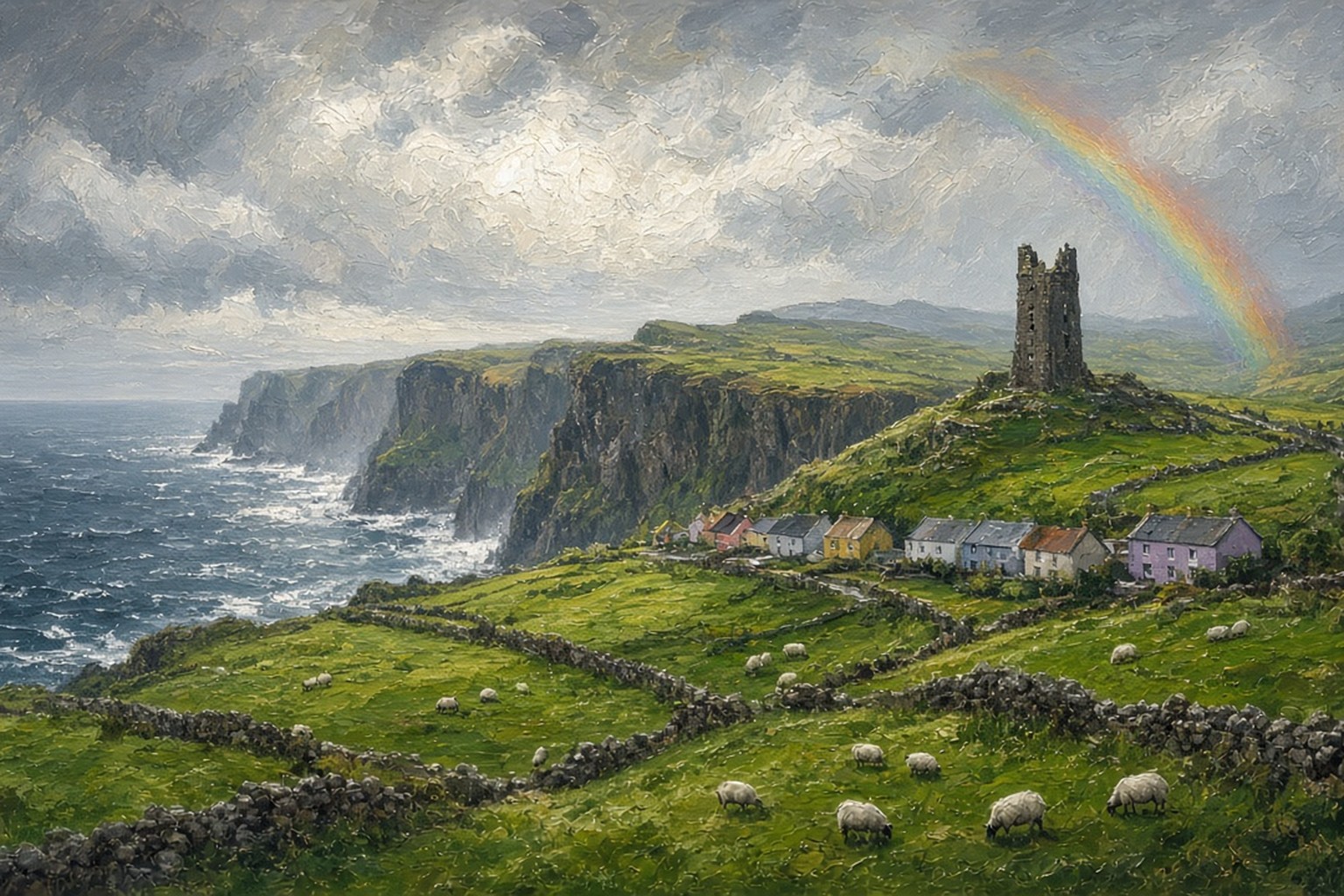
Ireland, an island nation on the western edge of Europe, is affectionately known as the “Emerald Isle” for its lush green landscapes. Famous for its dramatic coastline, ancient monuments, and warm hospitality, it has a cultural influence far greater than its size. From lively pubs filled with traditional music to a literary tradition that has produced world-renowned writers, Ireland offers a captivating blend of history, storytelling, and natural beauty.
Geography and Climate
The Republic of Ireland occupies about five-sixths of the island of Ireland, covering roughly 70,000 square kilometers, while Northern Ireland, part of the United Kingdom, lies in the northeast. The island is bordered by the Atlantic Ocean to the west and the Irish Sea to the east, which separates it from Great Britain.
Ireland’s landscape features a central lowland of fields, lakes, and bogs surrounded by coastal mountains and hills. Carrauntoohil in County Kerry is the highest peak, and the River Shannon is the longest river on the island. The rugged western coast is known for towering cliffs, rocky islands, and the unique limestone landscape of the Burren.
Ireland has a mild, temperate maritime climate influenced by the Atlantic Ocean and the warm waters of the North Atlantic Current. Rainfall is frequent throughout the year, which keeps the countryside famously green, while extreme temperatures are rare.
History and Independence
Ireland has been inhabited for thousands of years, and the passage tomb at Newgrange, built more than five thousand years ago, predates the Egyptian pyramids. Celtic culture took root during the Iron Age, and Christianity spread in the fifth century, traditionally associated with Saint Patrick. Irish monasteries became centers of learning, producing treasures such as the Book of Kells.
Viking raiders arrived in the ninth century and founded towns including Dublin, followed by the Anglo-Norman invasion in 1169, which began centuries of English involvement in Irish affairs. The Great Famine of 1845 to 1852, caused by potato blight, led to about one million deaths and the emigration of a million more.
The Easter Rising of 1916 and the War of Independence led to the Anglo-Irish Treaty of 1921 and the creation of the Irish Free State in 1922. Ireland adopted a new constitution in 1937 and formally became a republic in 1949. It joined the European Economic Community in 1973, and the Good Friday Agreement of 1998 brought peace to Northern Ireland.
Economy and Natural Resources
Ireland has a modern, open economy that grew rapidly during the “Celtic Tiger” years of the 1990s and early 2000s. Many multinational technology and pharmaceutical companies have their European headquarters in the country, making these sectors major drivers of exports and employment.
Agriculture remains important, especially dairy and beef production, and Irish food and drink products are exported around the world. Fishing, forestry, and the processing of agricultural products add to the rural economy, supporting jobs in towns and villages across the country.
Ireland uses the euro and benefits from access to the European single market. Wind energy is a growing natural resource, with ambitious plans to expand onshore and offshore wind power along its windy coastline.
Culture and Language
Irish, a Celtic language also known as Gaelic, and English are the official languages, with Irish being the first official language under the constitution. While English is spoken by almost everyone, Irish is taught in schools and spoken daily in Gaeltacht regions, mainly along the western coast.
Ireland has a remarkable literary heritage, with writers such as James Joyce, William Butler Yeats, Samuel Beckett, and Seamus Heaney. Four Irish writers have been awarded the Nobel Prize in Literature. Traditional music, played on instruments such as the fiddle, tin whistle, and bodhrán, fills pubs and festivals across the country.
Gaelic games, including hurling and Gaelic football, are deeply woven into community life, with passionate rivalries between counties. Saint Patrick’s Day on March 17 is celebrated not only in Ireland but by people of Irish heritage around the world.
Food and Cuisine
Irish cuisine is hearty and comforting, built on quality local ingredients such as dairy, meat, potatoes, and seafood. Irish stew, traditionally made with lamb, potatoes, and onions, is a classic dish, while colcannon combines mashed potatoes with cabbage or kale. Boxty, a type of potato pancake, and soda bread are also traditional favorites.
A full Irish breakfast typically includes sausages, bacon, eggs, black and white pudding, and toast. Coastal areas are known for oysters, mussels, and salmon. Ireland is also famous for its stout, especially Guinness, and for Irish whiskey, which has a long and proud distilling history.
Tourism and Attractions
Dublin, the capital, offers historic sites such as Trinity College, home of the Book of Kells, along with lively streets, museums, and the Guinness Storehouse. The Cliffs of Moher on the Atlantic coast are one of Ireland’s most visited natural attractions, rising dramatically above the ocean.
The Ring of Kerry and the Wild Atlantic Way showcase breathtaking coastal scenery, while Killarney National Park features lakes, mountains, and woodlands. The ancient monastic island of Skellig Michael and the Neolithic site of Brú na Bóinne are UNESCO World Heritage Sites, and Galway, the Aran Islands, and the Rock of Cashel add to the country’s charm.
Challenges and Opportunities
Ireland faces challenges such as a shortage of affordable housing, rising living costs, and heavy reliance on a small number of multinational companies for tax revenue. The effects of Brexit have also raised complex questions about trade and the border with Northern Ireland.
However, Ireland’s young, highly educated workforce, strong technology sector, and renewable energy potential provide solid foundations for the future. Its cultural influence and global diaspora continue to strengthen its connections around the world.
A Land of Stories and Song
Ireland is a country where every hill, castle, and village seems to have a story to tell. From the ancient stones of Newgrange to the music-filled pubs of Galway and the windswept cliffs of the west, it captures the heart with its beauty and warmth. Proud of its past and confident in its future, Ireland remains a truly enchanting land.