
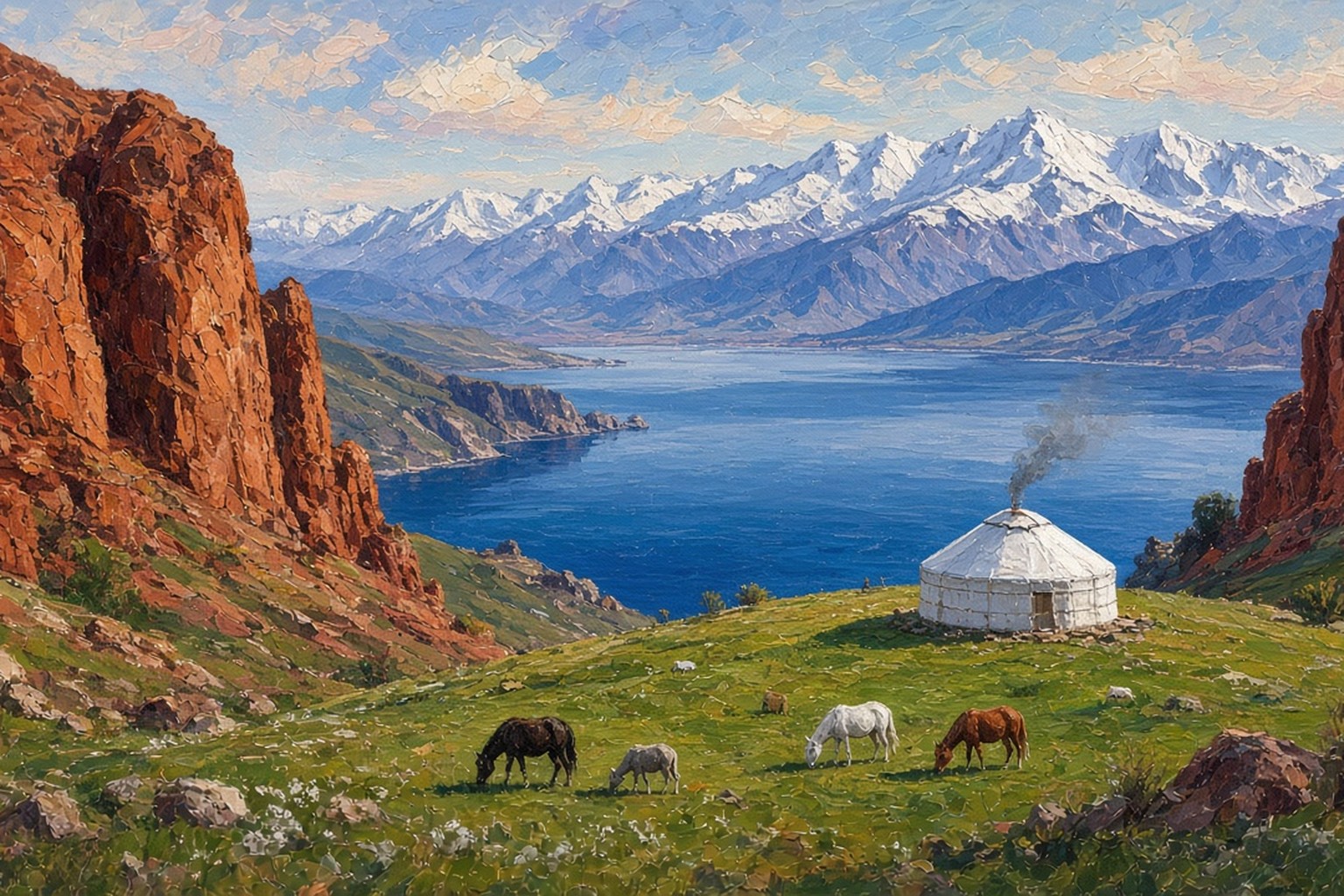
Kyrgyzstan, a landlocked country in Central Asia, is often called the “Switzerland of Central Asia” for its soaring mountains, alpine meadows, and crystal-clear lakes. More than ninety percent of its territory is mountainous, dominated by the mighty Tian Shan range. With a proud nomadic heritage, legendary hospitality, and some of the most unspoiled landscapes in the world, Kyrgyzstan is a paradise for lovers of nature and culture.
Geography and Climate
Kyrgyzstan covers about 200,000 square kilometers and is bordered by Kazakhstan to the north, Uzbekistan to the west, Tajikistan to the southwest, and China to the east and southeast. The capital, Bishkek, lies in the fertile Chüy Valley in the north, while Osh is the main city of the south.
The Tian Shan mountains cover much of the country, and the Pamir-Alay ranges rise in the south. The highest peak, Jengish Chokusu, also known as Victory Peak, stands at about 7,439 meters on the border with China. Glaciers feed rivers that flow into the Fergana Valley and beyond, and Issyk-Kul, one of the largest alpine lakes in the world, lies in the northeast.
Kyrgyzstan has a continental climate, with warm summers in the valleys and cold, snowy winters in the mountains. Temperatures vary greatly with altitude, and high mountain passes can see snow even in summer.
History and Independence
For centuries, the region was crossed by branches of the Silk Road, linking China with Central Asia and Europe. Ancient sites such as the Burana Tower and the stone caravanserai of Tash Rabat recall this era of trade and travel. Kyrgyz tribes, whose heritage is celebrated in the epic of Manas, became the dominant people of the region over time.
In the nineteenth century, the area came under the control of the Kokand Khanate and was later incorporated into the Russian Empire. After the Russian Revolution, it became part of the Soviet Union, eventually forming the Kirghiz Soviet Socialist Republic. Soviet rule brought collectivization, settlement of nomadic communities, and industrial development.
Kyrgyzstan declared independence on August 31, 1991. Since then, it has developed a lively, though at times turbulent, political life, with changes of government in 2005, 2010, and 2020 driven by public protests.
Economy and Natural Resources
Kyrgyzstan’s economy relies on agriculture, mining, and remittances. Gold is the leading export, with the Kumtor mine being one of the largest gold mines in Central Asia. The country also has deposits of coal, antimony, and other minerals.
Agriculture and livestock herding employ a large share of the population, producing wheat, cotton, tobacco, fruits, vegetables, and meat. Remittances from Kyrgyz citizens working abroad, mainly in Russia, account for one of the highest shares of national income in the world.
Abundant mountain rivers give Kyrgyzstan significant hydropower potential, and hydroelectric plants supply most of its electricity. Tourism is growing quickly, as travelers discover the country’s trekking routes, lakes, and nomadic culture, supported by community-based tourism networks in rural areas.
Culture and Language
Kyrgyz is the state language, while Russian is an official language and is widely spoken, especially in cities. Most people are Muslim, and the country also has an Orthodox Christian minority. Nomadic traditions remain at the heart of Kyrgyz identity.
The yurt is a powerful national symbol, and the crown of the yurt, called the tunduk, appears on the national flag. The epic of Manas, one of the longest epic poems in the world, is performed by storytellers known as manaschi. The three-stringed komuz is the most beloved traditional instrument, and the tall white felt hat called the kalpak is a symbol of national pride.
Horseback games such as kok-boru remain popular, and Kyrgyzstan hosted the first World Nomad Games in 2014. Felt carpets known as shyrdak, decorated with bold patterns, are a cherished craft recognized by UNESCO.
Food and Cuisine
Kyrgyz cuisine reflects the nomadic lifestyle and the influences of the Silk Road. Beshbarmak, a dish of boiled meat and noodles, is a national favorite served at celebrations. Plov, rice cooked with meat, carrots, and onions, and lagman, hand-pulled noodles with vegetables and meat, are popular across the country.
Manty, steamed dumplings filled with meat and onions, and samsa, baked pastries, are common snacks. Kumis, fermented mare’s milk, is a traditional summer drink, while boorsok, pieces of fried dough, are served with tea at almost every gathering.
Dairy products are central to the diet, including kurut, small dried balls of salty cheese, and kaymak, a rich clotted cream eaten with bread. Hospitality traditions mean that guests are often offered a generous spread called a dastorkon, a tablecloth laden with bread, sweets, dried fruits, nuts, and tea.
Tourism and Attractions
Issyk-Kul Lake, which remains unfrozen even in winter, is the country’s most popular destination, with beaches, hot springs, and mountain views. Song-Kul, a high-altitude lake surrounded by summer pastures, offers the chance to stay in yurts with herding families and ride horses across open meadows.
Ala Archa National Park, near Bishkek, provides easy access to dramatic mountain scenery and hiking trails. The red rock formations of Jeti-Oguz and Skazka Canyon, the town of Karakol, and the Sulaiman-Too Sacred Mountain in Osh, a UNESCO World Heritage Site, add to the country’s many attractions.
Challenges and Opportunities
Kyrgyzstan faces challenges including poverty, political instability, dependence on remittances, and vulnerability to natural hazards such as earthquakes and mudslides. Melting glaciers due to climate change threaten long-term water supplies for farms and cities across the region. Improving roads, healthcare, and education in remote mountain areas also remains an important priority.
However, its stunning landscapes, rich culture, and renewable energy resources offer significant opportunities. Growth in community-based tourism, agriculture, and hydropower could help build a more prosperous and sustainable future.
A Kingdom of Mountains and Nomads
Kyrgyzstan is a land where snow-capped peaks rise above green valleys and nomadic traditions endure across high pastures. From the shores of Issyk-Kul to the sacred mountain of Osh and the yurts of Song-Kul, it offers unforgettable encounters with nature and hospitality. Wild, welcoming, and authentic, Kyrgyzstan is one of Central Asia’s greatest treasures.