
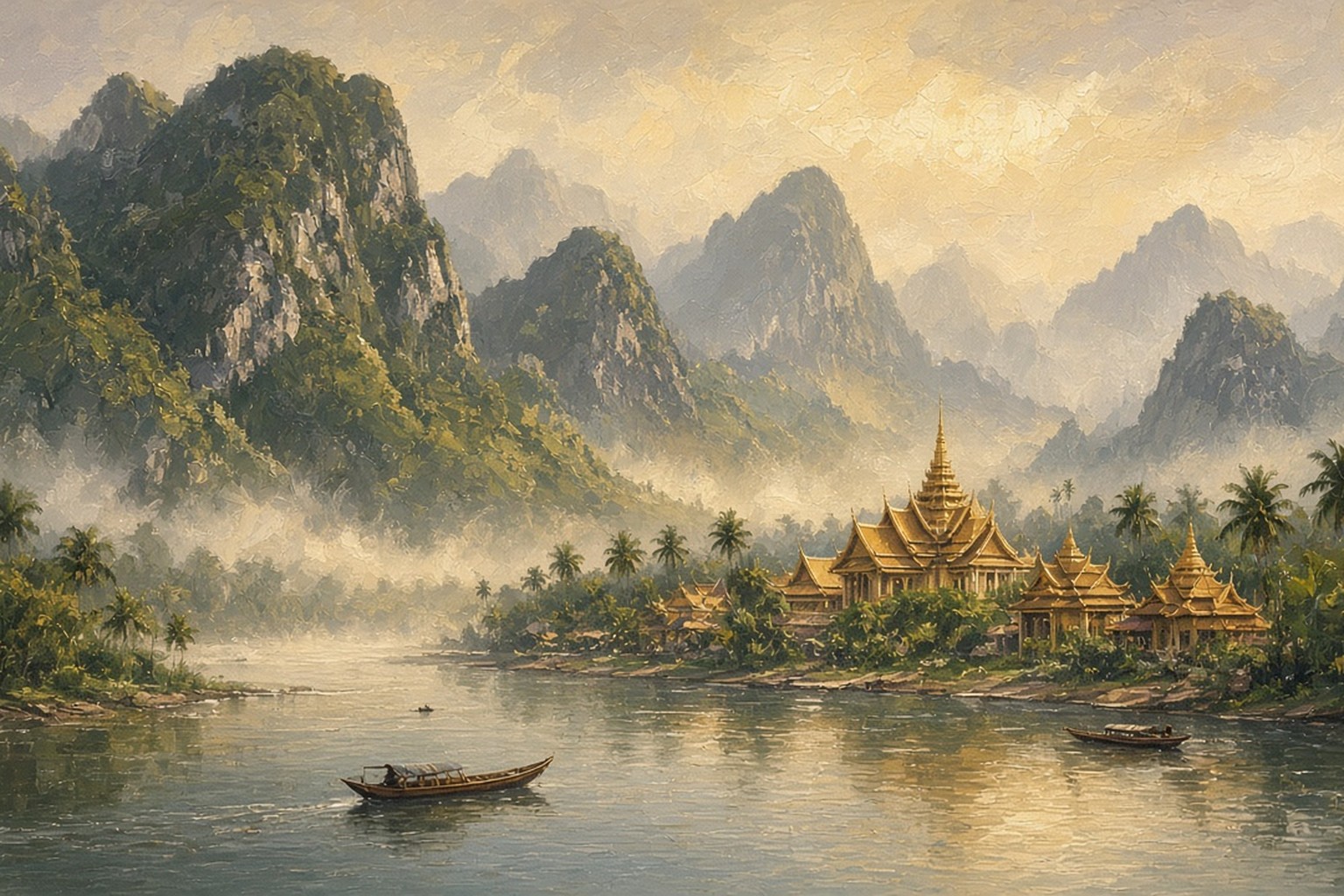
Laos, officially the Lao People’s Democratic Republic, is a landlocked country in the heart of Southeast Asia known for its tranquil pace of life, mountainous landscapes, and Buddhist traditions. The mighty Mekong River flows through the country, shaping its history, economy, and culture. Once known as Lan Xang, the “Land of a Million Elephants,” Laos enchants visitors with golden temples, misty mountains, and gentle hospitality.
Geography and Climate
Laos covers about 237,000 square kilometers and is the only landlocked country in Southeast Asia. It is bordered by China to the north, Vietnam to the east, Cambodia to the south, Thailand to the west, and Myanmar to the northwest.
Much of Laos is mountainous and covered in forests, with the Annamite Range running along its eastern border with Vietnam. The Mekong River forms much of the border with Thailand and provides fertile plains for farming. Notable landscapes include the Bolaven Plateau in the south, known for coffee plantations and waterfalls, and the mysterious Plain of Jars in the north.
Laos has a tropical monsoon climate with a rainy season from roughly May to October and a dry season from November to April. Temperatures are warm in the lowlands, while the highlands can be cool, especially in the winter months, when morning mist often fills the valleys.
History and Independence
The Kingdom of Lan Xang was founded in 1353 by King Fa Ngum and became one of the largest kingdoms in Southeast Asia. It was a center of Theravada Buddhism and culture for centuries, with Luang Prabang and later Vientiane serving as capitals. In the early eighteenth century, Lan Xang split into rival kingdoms, which later came under the influence of neighboring Siam.
In 1893, France established a protectorate over Laos, making it part of French Indochina. After World War II, the independence movement grew, and Laos achieved full independence from France in 1953. A long civil war followed, closely linked to the wider conflict in Vietnam.
During that period, Laos was subjected to intense aerial bombing, and it is often described as the most heavily bombed country per capita in history. In 1975, the monarchy was abolished and the Lao People’s Democratic Republic was established. The country has since gradually opened its economy to foreign trade and investment, and it joined the Association of Southeast Asian Nations in 1997.
Economy and Natural Resources
Agriculture employs a large share of the Lao population, with rice as the main crop, alongside coffee, corn, cassava, and vegetables. Coffee from the Bolaven Plateau has gained international recognition.
Laos has abundant rivers and has built many hydroelectric dams, exporting electricity to neighboring countries and earning the nickname “the battery of Southeast Asia.” Mining of copper, gold, and other minerals is also an important source of export revenue.
The Laos-China Railway, opened in 2021, connects Vientiane with southern China and aims to boost trade and tourism. Tourism, particularly to Luang Prabang and the countryside, has become a valuable source of income and jobs.
Culture and Language
Lao is the official language, and the country is home to many ethnic groups, including the Lao, Khmu, and Hmong, each with distinct languages and customs. Theravada Buddhism is practiced by most of the population, and temples, known as wats, are central to community life.
In Luang Prabang, the morning alms-giving ceremony, in which monks walk silently through the streets to receive offerings of sticky rice, is a cherished tradition. The baci ceremony, in which white strings are tied around the wrists to bring good fortune, marks weddings, births, and other important occasions.
Music played on the khaen, a bamboo mouth organ recognized by UNESCO, accompanies dance and celebrations. Boun Pi Mai, the Lao New Year in April, is celebrated with water splashing, processions, and temple visits.
Food and Cuisine
Lao cuisine is fresh, herbal, and often spicy, with sticky rice at the center of nearly every meal. Larb, a minced meat or fish salad flavored with lime, herbs, chili, and toasted rice powder, is often considered the national dish. Tam mak hoong, a spicy green papaya salad, is another favorite.
Khao piak sen, a comforting rice noodle soup, is popular for breakfast, while jaew, a range of chili-based dipping sauces, accompanies many dishes. French influence lives on in the popular baguette sandwiches called khao jee pâté, and strong Lao coffee is enjoyed throughout the day.
Meals are typically shared family-style, with sticky rice served in small woven baskets and eaten by hand. Fresh herbs such as mint, dill, and lemongrass, along with fermented fish sauce called padaek, give Lao dishes their distinctive flavor. Beerlao, the national beer, is a popular companion to an evening meal.
Tourism and Attractions
Luang Prabang, a UNESCO World Heritage Site, is famous for its gilded temples, French colonial buildings, and peaceful setting at the meeting of the Mekong and Nam Khan rivers. Nearby, the turquoise pools of Kuang Si Falls are a popular natural attraction.
In Vientiane, the capital, the golden stupa of Pha That Luang is a national symbol. The Plain of Jars and the ancient temple complex of Vat Phou in Champasak are also UNESCO World Heritage Sites, while Vang Vieng, the Kong Lor Cave, and the river islands of Si Phan Don offer adventure and relaxation.
Challenges and Opportunities
Laos faces challenges including high public debt, poverty in rural areas, and the dangerous legacy of unexploded ordnance that still affects farmland. Large hydropower and infrastructure projects also raise environmental and social concerns.
At the same time, its natural resources, strategic location between larger economies, and growing tourism sector offer opportunities for development. Investments in education, sustainable agriculture, and ecotourism could help improve livelihoods across the country.
A Gentle Land Along the Mekong
Laos is a land of quiet beauty, where saffron-robed monks, golden temples, and misty mountains create a timeless atmosphere. From the riverside streets of Luang Prabang to the waterfalls of the Bolaven Plateau and the mysterious Plain of Jars, it invites travelers to slow down and savor each moment. Gentle and welcoming, Laos is a true treasure of Southeast Asia.