
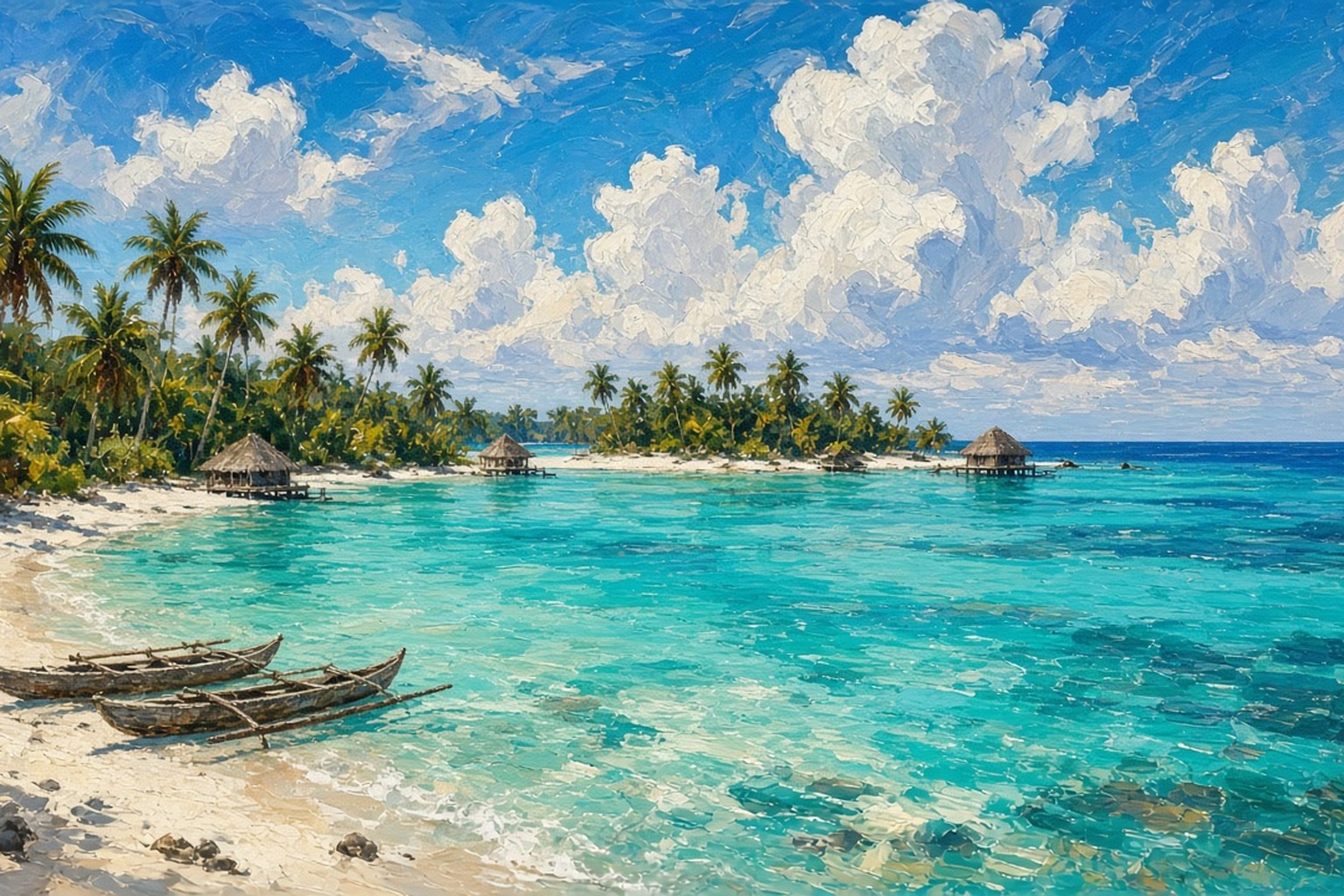
Kiribati, pronounced “Kiribas,” is a remote island nation scattered across the central Pacific Ocean. Made up of low-lying coral atolls and a single raised limestone island, it spans an immense area of ocean on both sides of the equator. Known as one of the first places on Earth to greet each new day, Kiribati is a land of turquoise lagoons, rich marine life, and resilient communities with deep ties to the sea.
Geography and Climate
Kiribati consists of thirty-three islands grouped into three main chains, the Gilbert Islands, the Phoenix Islands, and the Line Islands. Although its total land area is only about 811 square kilometers, its islands are spread across more than three million square kilometers of ocean. It is the only country located in all four hemispheres.
Most of the islands are coral atolls rising only a few meters above sea level, with narrow strips of land surrounding shallow lagoons. Banaba is the exception, a raised limestone island once rich in phosphate. Kiritimati, or Christmas Island, in the Line Islands, has the largest land area of any coral atoll in the world.
The climate is hot and humid throughout the year, moderated by trade winds. Rainfall varies widely between islands and from year to year, and droughts can affect water supplies on the drier atolls. Fresh water comes mainly from rainfall and thin underground lenses beneath the islands.
History and Independence
The Gilbert Islands were settled by Micronesian voyagers thousands of years ago, and later contact brought influences from Samoa and other parts of the Pacific. The I-Kiribati, as the people are known, developed sophisticated skills in navigation, fishing, and building on the atolls.
European explorers and whalers visited the islands from the sixteenth to the nineteenth centuries. Britain declared a protectorate over the Gilbert and Ellice Islands in 1892, later making them a colony. During World War II, the Battle of Tarawa in 1943 was one of the fiercest battles of the Pacific campaign.
In 1978, the Ellice Islands separated to become Tuvalu. The Gilbert Islands gained independence on July 12, 1979, taking the name Kiribati, a local rendering of “Gilberts.” Phosphate mining on Banaba led many of its residents to be relocated to Rabi Island in Fiji, where their descendants still live.
Economy and Natural Resources
Kiribati has a small economy that depends heavily on the ocean. Licensing fees paid by foreign fishing fleets, particularly for tuna, provide a large share of government revenue. Its vast exclusive economic zone is among the most important tuna fishing grounds in the Pacific.
Copra, the dried meat of coconuts, is the main agricultural export, and seaweed farming and the export of aquarium fish provide additional income for some communities. Many households also rely on subsistence fishing and gardening.
A trust fund built from earlier phosphate mining revenues helps support the national budget. Remittances from I-Kiribati seafarers and workers abroad, along with international assistance, are also important sources of income.
Culture and Language
The national languages are Gilbertese, known locally as te taetae ni Kiribati, and English. Most people are Christian, mainly Catholic or Protestant, and church life plays a central role in the community, with choirs and religious festivals bringing villages together.
The maneaba, a large open-sided meeting house with a high thatched roof, is the heart of village life, where elders meet, decisions are made, and celebrations are held. Respect for elders and strong family ties are core values, and customs guide behavior within the maneaba.
Traditional dance is a treasured art form, performed with graceful arm movements that imitate the flight of frigatebirds, a national symbol. Dancers wear woven skirts and garlands of flowers, and songs often tell stories of history and island life.
Food and Cuisine
I-Kiribati cuisine is based on the resources of the sea and the atoll. Fish, such as tuna and reef fish, is eaten daily and may be served raw, grilled, or cooked in coconut milk. Shellfish, crabs, and octopus are also popular.
Coconut is essential to the diet, providing milk, oil, and sap that can be made into a sweet syrup. Breadfruit, pandanus fruit, and giant swamp taro, known as babai, are traditional staples, with babai holding special importance at feasts. Rice and imported foods have become increasingly common in recent decades.
Meals are often shared communally, especially during celebrations held in the maneaba, where families bring dishes of fish, babai, and coconut-based foods to share. Toddy, the fresh sap collected from coconut palms, is a traditional drink that can also be boiled into a rich syrup used in cooking and desserts.
Tourism and Attractions
Kiritimati is renowned among anglers for its world-class bonefishing and among birdwatchers for its huge seabird colonies. Its lagoons and flats attract visitors seeking a remote and peaceful escape.
In Tarawa, visitors can see relics from World War II, including bunkers and coastal guns, and experience traditional village life on the outer islands, where homes are built from local materials and daily routines follow the tides. The Phoenix Islands Protected Area, a UNESCO World Heritage Site, is one of the largest marine protected areas in the world, safeguarding coral reefs, sharks, and seabirds in a nearly untouched environment.
Challenges and Opportunities
Kiribati faces serious challenges from climate change, as rising sea levels, coastal erosion, and saltwater intrusion threaten land and fresh water. Overcrowding in South Tarawa, the capital area, places strain on housing, sanitation, and health services.
Kiribati has become an important voice in international climate discussions, and its government has explored long-term plans for adaptation and food security. Sustainable fisheries, ocean conservation, and education offer pathways to a more secure future.
An Ocean Nation on the Edge of Dawn
Kiribati is a nation defined by the ocean, where life revolves around lagoons, reefs, and the rhythm of the tides. From the dances of the maneaba to the pristine waters of the Phoenix Islands, it offers a glimpse of island culture shaped by the sea. Facing the future with courage, Kiribati greets each new day first among nations.