
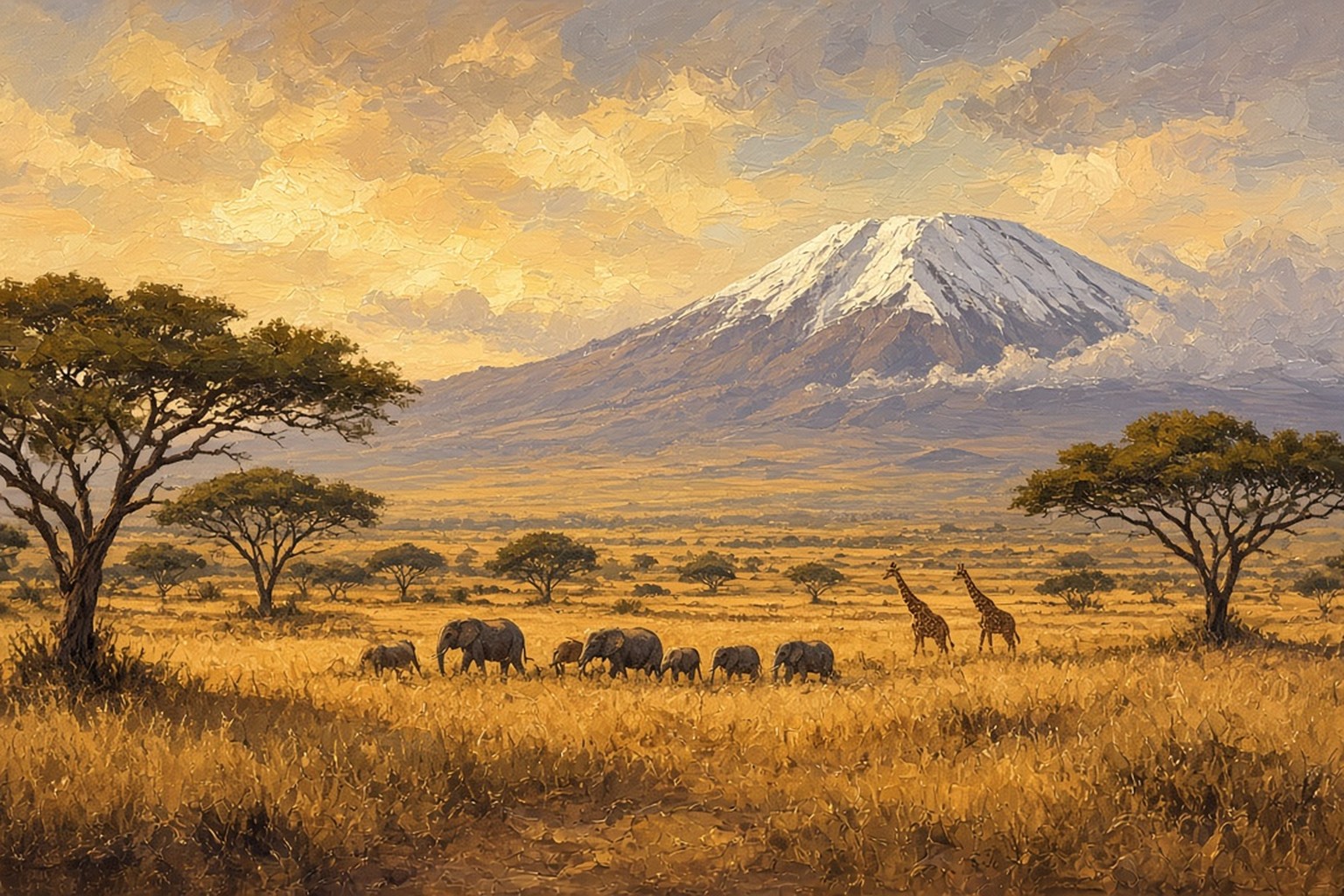
Kenya, a country on the east coast of Africa, is famous for its sweeping savannas, abundant wildlife, and breathtaking landscapes. Straddling the equator and divided by the Great Rift Valley, it is home to snow-capped mountains, sparkling lakes, and palm-fringed beaches along the Indian Ocean. Often celebrated as the home of the classic safari, Kenya combines natural wonders with a vibrant mix of cultures and a dynamic, fast-growing economy.
Geography and Climate
Kenya covers about 580,000 square kilometers and is bordered by Ethiopia to the north, Somalia to the northeast, Tanzania to the south, Uganda to the west, and South Sudan to the northwest. Its southeastern coast faces the Indian Ocean, lined with beaches, coral reefs, and mangroves.
The Great Rift Valley cuts through the country from north to south, creating dramatic escarpments, volcanoes, and a chain of lakes. Mount Kenya, the second highest mountain in Africa, rises in the central highlands, while Lake Victoria, the continent’s largest lake, lies in the west. In the arid north, Lake Turkana is the largest permanent desert lake in the world.
Kenya’s climate varies by altitude, with a hot and humid coast, temperate highlands, and dry plains in the north and east. Most regions experience two rainy seasons, the long rains from March to May and the short rains from October to December.
History and Independence
Kenya has one of the richest fossil records of early humans, and discoveries around Lake Turkana have shed light on human evolution. Over many centuries, Bantu, Nilotic, and Cushitic peoples settled in the region, while Swahili city-states such as Mombasa, Malindi, and Lamu flourished through Indian Ocean trade.
The Portuguese arrived in the late fifteenth century and built Fort Jesus in Mombasa, before Omani Arabs gained control of much of the coast. In the late nineteenth century, Britain established the East Africa Protectorate, which became the Colony of Kenya in 1920. During the 1950s, the Mau Mau uprising challenged colonial rule and land seizures.
Kenya gained independence on December 12, 1963, and became a republic the following year, with Jomo Kenyatta as its first president. Multiparty politics returned in the early 1990s, and a new constitution adopted in 2010 introduced a devolved system of county governments.
Economy and Natural Resources
Kenya has the largest economy in East Africa and serves as a regional hub for trade, finance, and transport. Agriculture remains a key sector, with tea, coffee, and cut flowers among the most important exports, and Kenya is one of the world’s leading exporters of black tea.
The country is a pioneer in mobile money, and the M-Pesa service, launched in 2007, transformed how millions of people send and receive payments. Nairobi’s technology scene, with its startups, innovation hubs, and regional offices of global firms, has earned it the nickname “Silicon Savannah.”
Kenya generates most of its electricity from renewable sources, especially geothermal power from the Rift Valley, along with hydropower and wind. Tourism, built around wildlife safaris and coastal resorts, is another major source of income and jobs.
Culture and Language
Swahili and English are Kenya’s official languages, and the country is home to more than forty ethnic groups, including the Kikuyu, Luhya, Kalenjin, Luo, Kamba, and Maasai. Christianity is the majority religion, while Islam is widely practiced, especially along the coast.
Each community has its own traditions of music, dance, and dress, and the Maasai are internationally known for their distinctive red clothing and beadwork. Popular music styles include benga and modern Afro-pop, and storytelling remains an important cultural tradition passed down through generations. Kenyan writers such as Ngũgĩ wa Thiong’o have also earned international acclaim.
Kenya is famous for its long-distance runners, who have won numerous Olympic medals and major marathon titles. Many of these athletes train in the high-altitude town of Iten in the Rift Valley, which attracts runners from around the world.
Food and Cuisine
Kenyan cuisine is simple, hearty, and varied by region. Ugali, a firm maize porridge, is a staple eaten with sukuma wiki, sautéed collard greens, and stews of beef, chicken, or beans. Nyama choma, grilled meat often enjoyed with friends, is a national favorite.
Githeri, a mix of maize and beans, and chapati, a flatbread introduced by Indian communities, are common everyday dishes. Along the coast, Swahili cuisine features coconut, spices, and seafood, with dishes such as pilau rice and biryani. Mandazi, lightly sweet fried dough, and spiced Kenyan tea are popular snacks.
Kenyan tea is often brewed with milk, sugar, and spices such as ginger and cardamom, and it is enjoyed throughout the day. Fresh tropical fruits, including mangoes, pineapples, and passion fruit, are sold at roadside stalls and markets across the country.
Tourism and Attractions
The Maasai Mara National Reserve is world famous for the Great Migration, when vast herds of wildebeest and zebras cross the plains between Kenya and Tanzania. Amboseli National Park offers views of elephants with Mount Kilimanjaro rising across the border, while Tsavo and Samburu reveal the beauty of Kenya’s wilder regions.
Lake Nakuru is known for its flamingos and rhinos, and Nairobi National Park allows visitors to see wildlife against a city skyline. On the coast, the UNESCO-listed Lamu Old Town and Fort Jesus showcase Swahili and colonial history, while Diani Beach and Watamu offer white sands and coral reefs.
Challenges and Opportunities
Kenya faces challenges including inequality, youth unemployment, public debt, and corruption. Droughts and floods linked to climate change threaten farmers and herders, and human-wildlife conflict affects communities near protected areas.
Yet the country’s entrepreneurial spirit, strong technology sector, and renewable energy resources offer bright prospects. Continued investment in education, infrastructure, and conservation could help Kenya build on its role as a leader in East Africa.
A Land of Wild Beauty and Bold Spirit
Kenya is a land where vast herds roam golden plains and innovation thrives in bustling cities. From the slopes of Mount Kenya to the shores of Lamu and the endless horizons of the Maasai Mara, it offers experiences that stay with visitors forever. Diverse, energetic, and proud, Kenya continues to captivate the world.