
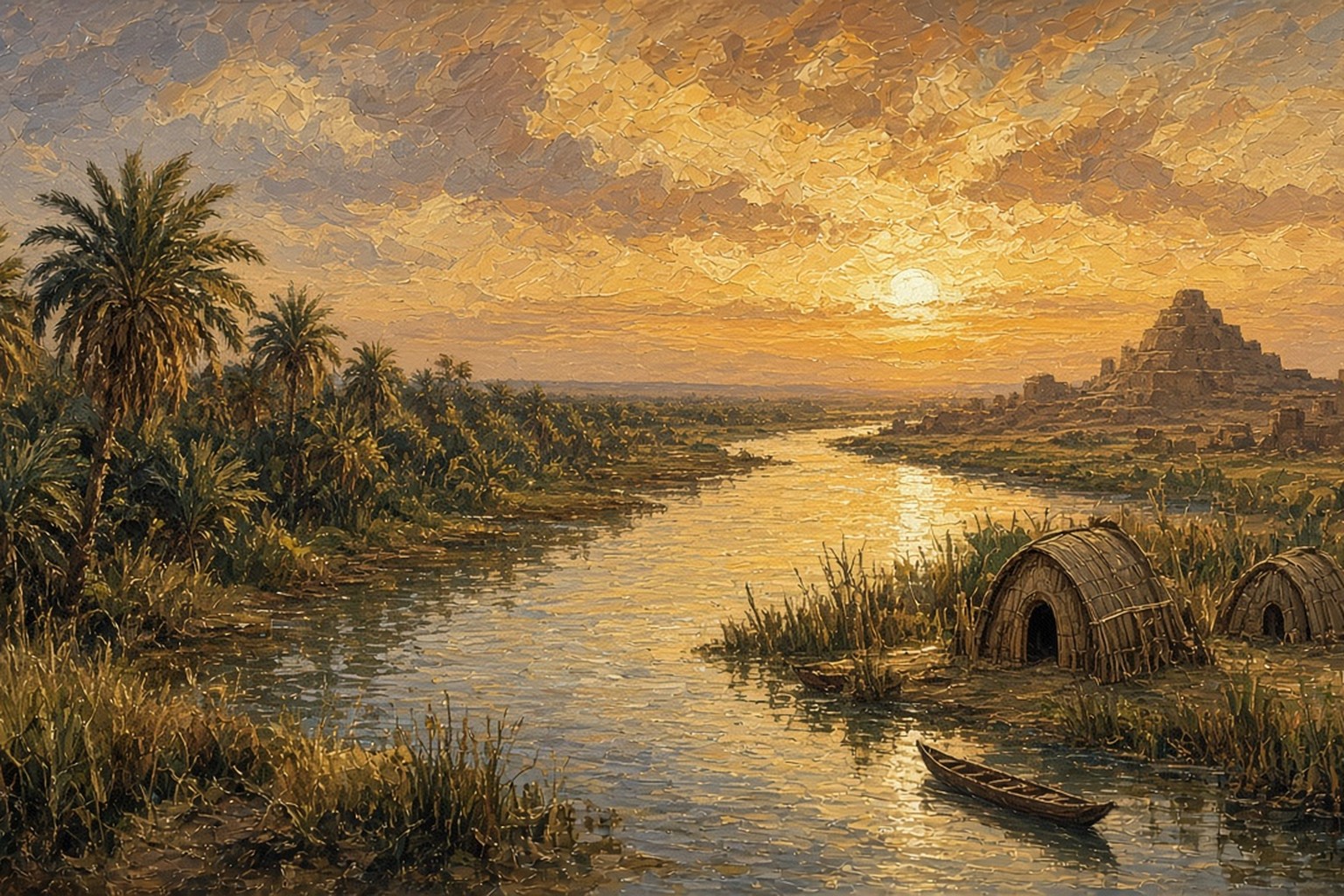
Iraq, located in the heart of the Middle East, is often called the “Cradle of Civilization” because it lies within ancient Mesopotamia, the fertile land between the Tigris and Euphrates rivers. It was here that some of the earliest cities, writing systems, and legal codes emerged. With a rich blend of cultures, sacred sites, and historic cities, Iraq holds a profound place in the story of humanity.
Geography and Climate
Iraq covers about 438,000 square kilometers and is bordered by Turkey to the north, Iran to the east, Kuwait and Saudi Arabia to the south, and Jordan and Syria to the west. A short coastline on the Persian Gulf near Basra gives the country access to the sea.
The Tigris and Euphrates rivers flow through the country from northwest to southeast, joining to form the Shatt al-Arab before reaching the Gulf. Between them lies a fertile alluvial plain, while the western and southern regions are largely desert. In the north and northeast, the Zagros Mountains rise across the Kurdistan Region, and in the south, the Mesopotamian Marshes form one of the largest wetland systems in the Middle East.
Iraq has a hot desert climate in much of the country, with extremely hot, dry summers and mild winters. The northern highlands are cooler and receive more rainfall, including snow in the mountains during winter.
History and Independence
Mesopotamia was home to the Sumerians, who built cities such as Ur and Uruk and developed cuneiform, one of the earliest known writing systems. Later civilizations included the Akkadians, Babylonians, and Assyrians. The Babylonian king Hammurabi created one of the earliest written law codes, and the city of Babylon became legendary for its grandeur.
In the seventh century, the region became part of the Islamic world, and in 762 the Abbasid Caliphate founded Baghdad, which grew into a leading center of learning and trade. Baghdad was sacked by the Mongols in 1258, and the region later came under Ottoman rule for several centuries.
After World War I, Iraq was placed under a British mandate, and it gained independence as the Kingdom of Iraq in 1932. The monarchy was overthrown in 1958, and the country later came under Ba’ath Party rule. Iraq endured the Iran-Iraq War, the 1991 Gulf War, the 2003 invasion led by the United States, and the fight against the Islamic State group, which was declared defeated in 2017.
Economy and Natural Resources
Iraq holds some of the largest proven oil reserves in the world, and oil exports provide the great majority of government revenue. Major oil fields are concentrated in the south near Basra and in the north around Kirkuk and the Kurdistan Region, and Basra’s ports handle most of the country’s crude exports.
Agriculture has deep roots in the fertile river valleys, producing wheat, barley, rice, vegetables, and dates. Iraq was historically one of the world’s largest producers of dates, and date palms remain a symbol of the country.
Efforts are underway to diversify the economy by rebuilding infrastructure, developing natural gas resources, and expanding industry, agriculture, and tourism. Reconstruction of cities affected by conflict remains an important priority.
Culture and Language
Arabic and Kurdish are the official languages of Iraq, and Turkmen, Syriac, and other languages are also spoken. The population includes Arabs, Kurds, Turkmen, Assyrians, Yazidis, and other communities, giving the country a rich cultural mosaic. Islam is the majority religion, practiced by both Shia and Sunni Muslims, alongside Christian and other faith communities.
Iraq has a long tradition of poetry, calligraphy, and music. The Iraqi maqam, a classical vocal tradition, is recognized by UNESCO as part of humanity’s intangible heritage. Baghdad’s Al-Mutanabbi Street, named after a renowned classical poet, has long been a famous gathering place for booksellers and readers.
Hospitality is a central value, and guests are traditionally welcomed with tea or coffee. Religious occasions and family celebrations bring people together, and major pilgrimages draw millions of visitors to the holy cities of Karbala and Najaf.
Food and Cuisine
Iraqi cuisine reflects the country’s long history and diverse influences. Masgouf, a dish of carp split open and slowly grilled beside an open fire, is often considered the national dish. Dolma, vegetables and vine leaves stuffed with rice and meat, and kubba, dumplings made from rice or bulgur, are beloved staples.
Meals are often served with samoon, a diamond-shaped bread, and accompanied by strong sweet tea. Kleicha, cookies filled with dates or nuts, are traditional treats during holidays, while dates themselves are enjoyed in countless forms throughout the year.
Tourism and Attractions
Iraq is home to several UNESCO World Heritage Sites, including the ancient city of Babylon, the ruins of Hatra, the Abbasid city of Samarra, and the Citadel of Erbil, one of the oldest continuously inhabited settlements in the world. The great ziggurat of Ur, near Nasiriyah, is a striking reminder of Sumerian civilization.
The Mesopotamian Marshes, listed by UNESCO together with nearby ancient cities, offer a glimpse of a traditional way of life among reed houses and waterways. The mountains and valleys of the Kurdistan Region attract visitors with their scenery, waterfalls, and cooler climate. In Baghdad, the Iraq Museum preserves one of the world’s most important collections of Mesopotamian antiquities.
Challenges and Opportunities
Iraq faces serious challenges, including the legacy of decades of conflict, corruption, unemployment, and dependence on oil revenue. Water scarcity is growing due to drought, rising temperatures, and reduced river flows.
Despite these difficulties, Iraq has a young population, vast energy resources, and an extraordinary cultural heritage. Continued stability, investment in infrastructure and water management, and the growth of tourism could open new paths for development.
A Cradle of Civilization Reborn
Iraq is a land where the first chapters of human history were written, and its rivers still nourish life and memory. From the ziggurat of Ur to the bustling streets of Baghdad and the mountains of the north, the country carries a legacy few nations can match. As it rebuilds, Iraq continues to hold a unique and enduring place in the world.