
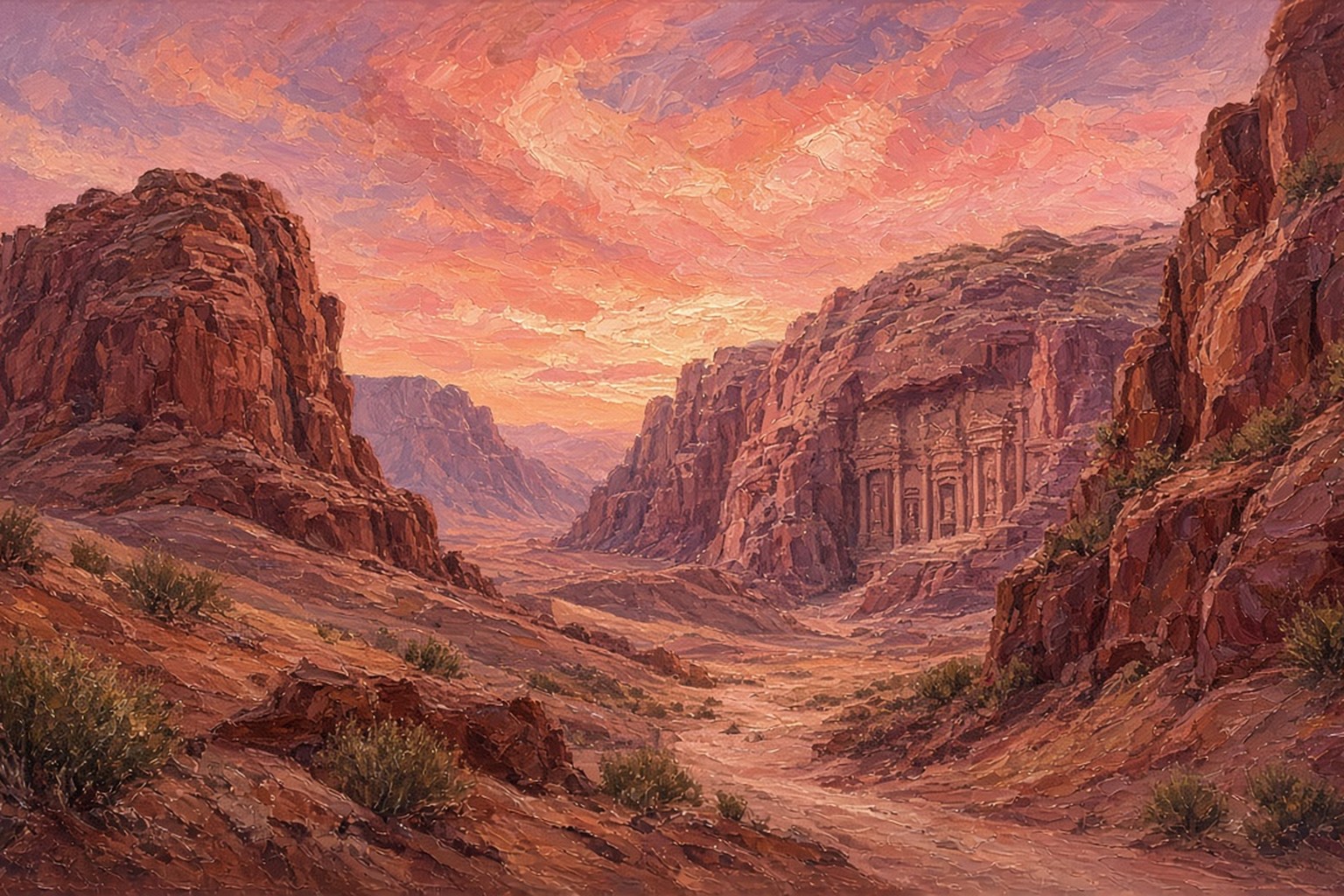
Jordan, officially the Hashemite Kingdom of Jordan, is a country in the heart of the Middle East known for its ancient wonders and warm hospitality. It is home to Petra, the famous “Rose City” carved into red sandstone cliffs, as well as the vast desert landscapes of Wadi Rum and the mineral-rich shores of the Dead Sea. Rich in history and tradition, Jordan has long been a crossroads of civilizations and trade.
Geography and Climate
Jordan covers about 89,000 square kilometers and is bordered by Syria to the north, Iraq to the northeast, Saudi Arabia to the east and south, and Israel and the West Bank to the west. A short coastline on the Gulf of Aqaba gives the country access to the Red Sea.
The Jordan Rift Valley runs along the western border, containing the Jordan River and the Dead Sea, whose shores are the lowest point on land on Earth. East of the valley, highlands rise with towns, farms, and forests, before giving way to the deserts that cover most of the country. In the south, the dramatic sandstone mountains and valleys of Wadi Rum create one of the world’s most striking desert landscapes.
Much of Jordan has an arid desert climate, with hot, dry summers and cool winters. The highlands receive more rainfall and occasional snow, and Jordan is one of the most water-scarce countries in the world. Spring brings wildflowers to the hills, including the black iris, the national flower.
History and Independence
The lands of Jordan have been inhabited since prehistoric times and were home to ancient kingdoms such as Ammon, Moab, and Edom. The Nabataeans, an Arab people who grew wealthy through the incense and spice trade, built their capital at Petra. The region later became part of the Roman Empire, which left behind impressive cities such as Jerash.
Following Byzantine rule, the area became part of the Islamic caliphates in the seventh century and was later governed by the Ottoman Empire for about four hundred years. During World War I, the Great Arab Revolt, led by the Hashemite family, helped end Ottoman control in the region.
After the war, the Emirate of Transjordan was established under British mandate with Abdullah I as its ruler. Jordan gained full independence on May 25, 1946, becoming a kingdom. King Hussein ruled from 1952 to 1999 and signed a peace treaty with Israel in 1994, and his son, King Abdullah II, has led the country since 1999.
Economy and Natural Resources
Jordan has a service-oriented economy, with tourism, banking, information technology, and trade playing important roles. The country has limited water and energy resources, which shapes many economic policies.
Phosphates and potash, extracted partly from the Dead Sea, are among Jordan’s main natural resources and exports. Pharmaceuticals, textiles, and fertilizers are significant manufactured goods, and agriculture in the Jordan Valley produces vegetables and fruits.
Remittances from Jordanians working abroad and international assistance support the economy. Jordan has also invested heavily in solar and wind energy to reduce its reliance on imported fuel, taking advantage of its abundant sunshine.
Culture and Language
Arabic is the official language, and English is widely spoken in business and education. Most Jordanians are Sunni Muslims, and the country is also home to long-established Christian communities. Jordan has welcomed large numbers of refugees over the decades, which has added to its cultural diversity.
Bedouin traditions remain an important part of Jordanian identity, especially values of generosity and hospitality. Guests are traditionally welcomed with bitter Arabic coffee flavored with cardamom. The red-and-white checkered headscarf known as the shemagh is a familiar national symbol.
Traditional music, poetry, and the dabke folk dance are enjoyed at weddings and celebrations. Handicrafts such as mosaics, embroidered textiles, and sand bottles reflect the creativity of Jordanian artisans.
Food and Cuisine
Jordanian cuisine is hearty and generous, often shared from large platters. The national dish, mansaf, consists of lamb cooked in a sauce of fermented dried yogurt called jameed, served over rice and flatbread, and it is recognized by UNESCO as intangible cultural heritage. Mansaf is traditionally served at weddings, holidays, and important gatherings.
Other popular dishes include maqluba, an upside-down dish of rice, vegetables, and meat, and zarb, a Bedouin barbecue cooked underground in the desert sand. Hummus, falafel, and fresh salads are everyday favorites, while knafeh, a sweet cheese pastry soaked in syrup, is a beloved dessert.
A traditional Jordanian breakfast might include labneh, a thick strained yogurt, along with olive oil, za’atar herb blend, olives, and warm bread. Sweet tea, often flavored with fresh mint or sage, is served throughout the day. Street vendors in Amman sell freshly baked ka’ak, sesame bread rings, and roasted nuts.
Tourism and Attractions
Petra, a UNESCO World Heritage Site, is Jordan’s most famous attraction, with monumental tombs and temples carved into rose-colored cliffs, including the iconic Treasury. Wadi Rum, also listed by UNESCO, offers camping, jeep tours, and breathtaking desert scenery.
The ancient Roman city of Jerash features remarkably preserved streets, theaters, and temples. Visitors can float in the Dead Sea, dive among coral reefs in Aqaba, admire the ancient mosaic map in Madaba, and explore the Citadel and Roman Theater in Amman. The baptism site of Bethany Beyond the Jordan and the Dana Biosphere Reserve add further variety.
Challenges and Opportunities
Jordan faces challenges including severe water scarcity, unemployment, especially among young people, and economic pressure from hosting large refugee populations. Instability in neighboring countries has also affected trade and tourism.
Despite these difficulties, Jordan’s stability, educated workforce, and world-class heritage sites offer strong opportunities. Investments in renewable energy, technology, and sustainable tourism could help drive growth in the years ahead.
A Kingdom of Desert and Wonder
Jordan is a land where ancient civilizations carved their legacy into stone and desert winds shape timeless landscapes. From the rose-red city of Petra to the silent dunes of Wadi Rum and the healing waters of the Dead Sea, it offers wonders at every turn. Welcoming and resilient, Jordan invites travelers to discover its remarkable treasures.