
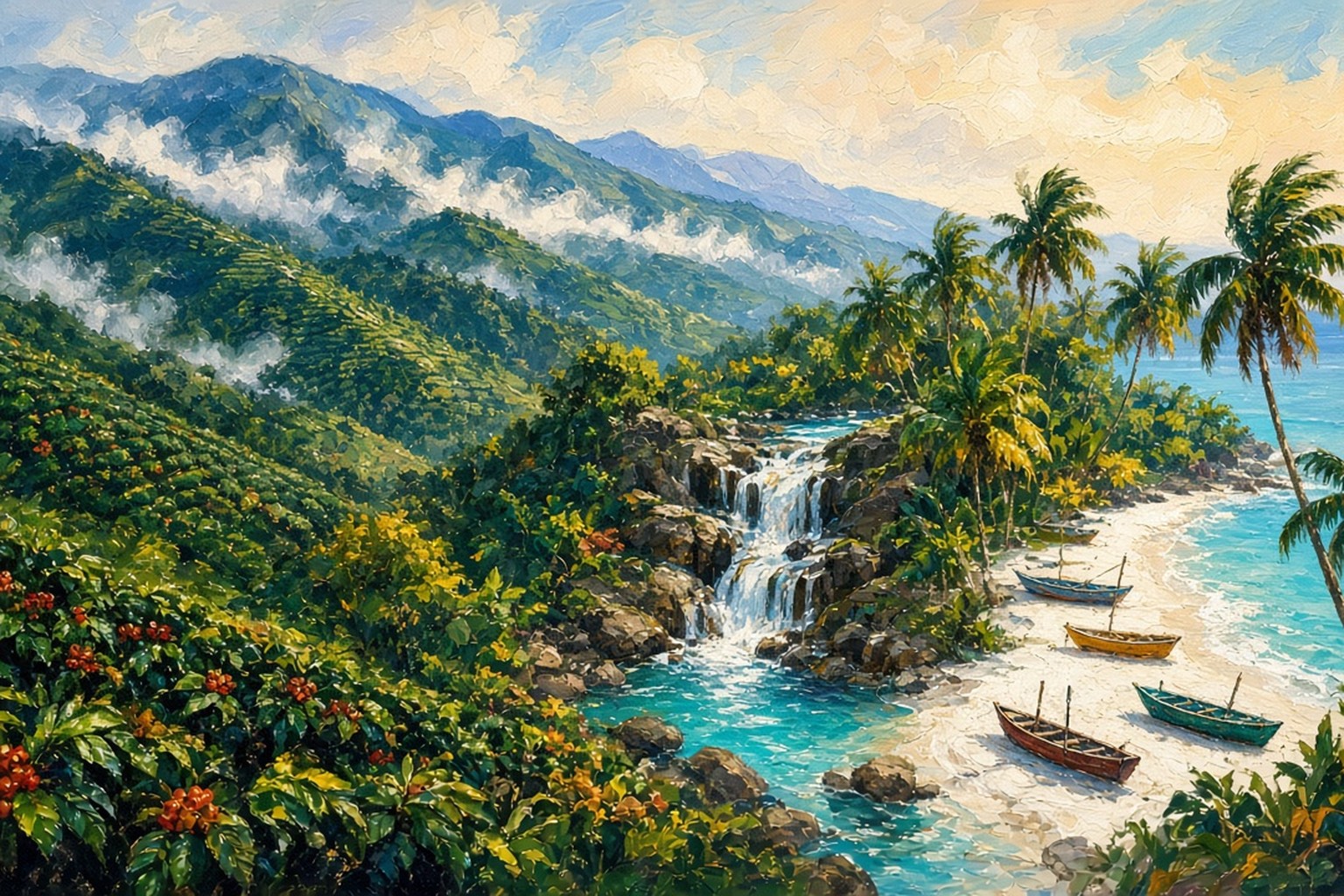
Jamaica, a lush and mountainous island in the Caribbean Sea, is famous around the world for its music, athletes, and vibrant spirit. Its name comes from the Taíno word “Xaymaca,” often translated as “land of wood and water,” a fitting description of its forested hills, rivers, and waterfalls. With its national motto, “Out of Many, One People,” Jamaica celebrates a rich blend of cultures and a powerful creative energy.
Geography and Climate
Jamaica is the third largest island in the Caribbean, after Cuba and Hispaniola, covering about 10,990 square kilometers. It lies south of Cuba and west of Hispaniola, surrounded by the warm waters of the Caribbean Sea.
The island’s interior is dominated by mountains, with the Blue Mountains in the east rising to Blue Mountain Peak, the highest point on the island. The Cockpit Country in the west features a striking limestone landscape of rounded hills and deep hollows. Numerous rivers flow from the highlands to the coast, creating waterfalls and fertile valleys, while beaches and coral reefs line much of the shoreline.
Jamaica has a tropical climate, warm and humid throughout the year, with cooler temperatures in the mountains. Rainfall is heaviest in the northeast, and the island lies in the path of Atlantic hurricanes, which can cause significant damage during the season from June to November, as Hurricane Gilbert did in 1988.
History and Independence
The Taíno people were the original inhabitants of Jamaica. Christopher Columbus arrived in 1494, and the Spanish established a colony in the early sixteenth century. The Indigenous population declined sharply under Spanish rule, and enslaved Africans were brought to the island.
In 1655, England seized Jamaica from Spain, and it became one of Britain’s most valuable sugar colonies, built on the labor of enslaved Africans. Communities of escaped Africans known as Maroons resisted colonial forces from the mountains, and their leader Nanny of the Maroons is honored as a national hero. Slavery was abolished in the 1830s, but hardship and inequality continued, leading to events such as the Morant Bay Rebellion of 1865.
In the twentieth century, a growing labor and nationalist movement pushed for self-government. Jamaica gained independence from Britain on August 6, 1962, becoming a parliamentary democracy within the Commonwealth. Leaders such as Alexander Bustamante and Norman Manley, both now national heroes, played key roles in this transition, and Independence Day remains a major national celebration.
Economy and Natural Resources
Tourism is one of the most important sectors of Jamaica’s economy, attracting visitors to its beaches, resorts, and cultural attractions. Bauxite and alumina, used to make aluminum, are among the country’s main exports and have long been significant natural resources.
Agriculture produces sugarcane, bananas, citrus, and spices, along with the world-famous Blue Mountain coffee, prized for its smooth flavor. Rum production is another proud tradition, and Jamaican rums are exported across the globe.
Remittances from Jamaicans living abroad, particularly in the United States, Canada, and the United Kingdom, provide vital support for many households. Business process outsourcing and other services are growing sources of employment, particularly in Kingston and Montego Bay, where call centers and technology firms serve international clients.
Culture and Language
English is the official language of Jamaica, while Jamaican Patois, an English-based creole with West African influences, is widely spoken in daily life. Christianity is the dominant religion, and the island is also the birthplace of the Rastafari movement, which has had a strong influence on Jamaican culture and music.
Jamaica has had an extraordinary impact on world music. Ska, rocksteady, reggae, and dancehall all originated on the island, and reggae music, popularized internationally by artists such as Bob Marley, is recognized by UNESCO as part of humanity’s intangible heritage.
Sport is another source of national pride, especially athletics. Jamaican sprinters have achieved remarkable success at the Olympic Games and world championships, and the island’s passion for track and field begins in its schools. The annual high school championships, known as Champs, draw huge crowds and have helped launch many international careers.
Food and Cuisine
Jamaican cuisine is bold and flavorful, blending African, European, Indian, and Chinese influences. The national dish, ackee and saltfish, combines the buttery ackee fruit with salted codfish, onions, and peppers. Jerk chicken and pork, marinated with allspice and fiery Scotch bonnet peppers and slowly grilled, are famous worldwide.
Other favorites include curry goat, oxtail stew, rice and peas cooked with coconut milk, and flaky beef patties. Festival, a slightly sweet fried dumpling, and bammy, a flatbread made from cassava, often accompany seafood dishes such as escovitch fish, which is fried and topped with a tangy pickle of vinegar, onions, carrots, and peppers. Refreshing drinks such as sorrel, made from hibiscus flowers, are especially popular at Christmas.
Tourism and Attractions
Montego Bay, Negril, and Ocho Rios are Jamaica’s best-known resort areas. Negril is celebrated for its long Seven Mile Beach and dramatic cliffs, while Ocho Rios is home to Dunn’s River Falls, where water cascades over terraced rocks into the sea.
The Blue and John Crow Mountains, a UNESCO World Heritage Site, offer hiking, coffee farms, and stunning views. In Kingston, the capital, visitors can explore music history at the Bob Marley Museum, while the historic town of Port Royal, the Luminous Lagoon, and the YS Falls add to the island’s variety.
Challenges and Opportunities
Jamaica faces challenges including crime, economic inequality, and vulnerability to hurricanes, flooding, and the effects of climate change. The country has worked hard in recent years to reduce its public debt and strengthen economic stability.
Its strong global cultural brand, natural beauty, and talented people offer major opportunities in tourism, creative industries, agriculture, and services. Investment in education, infrastructure, and climate resilience can help secure a brighter future.
An Island of Rhythm and Spirit
Jamaica is an island where music fills the air, mountains meet the sea, and culture pulses with energy. From the misty peaks of the Blue Mountains to the beaches of Negril and the streets of Kingston, it leaves a lasting impression on all who visit. Proud and creative, Jamaica continues to share its rhythm with the world.