
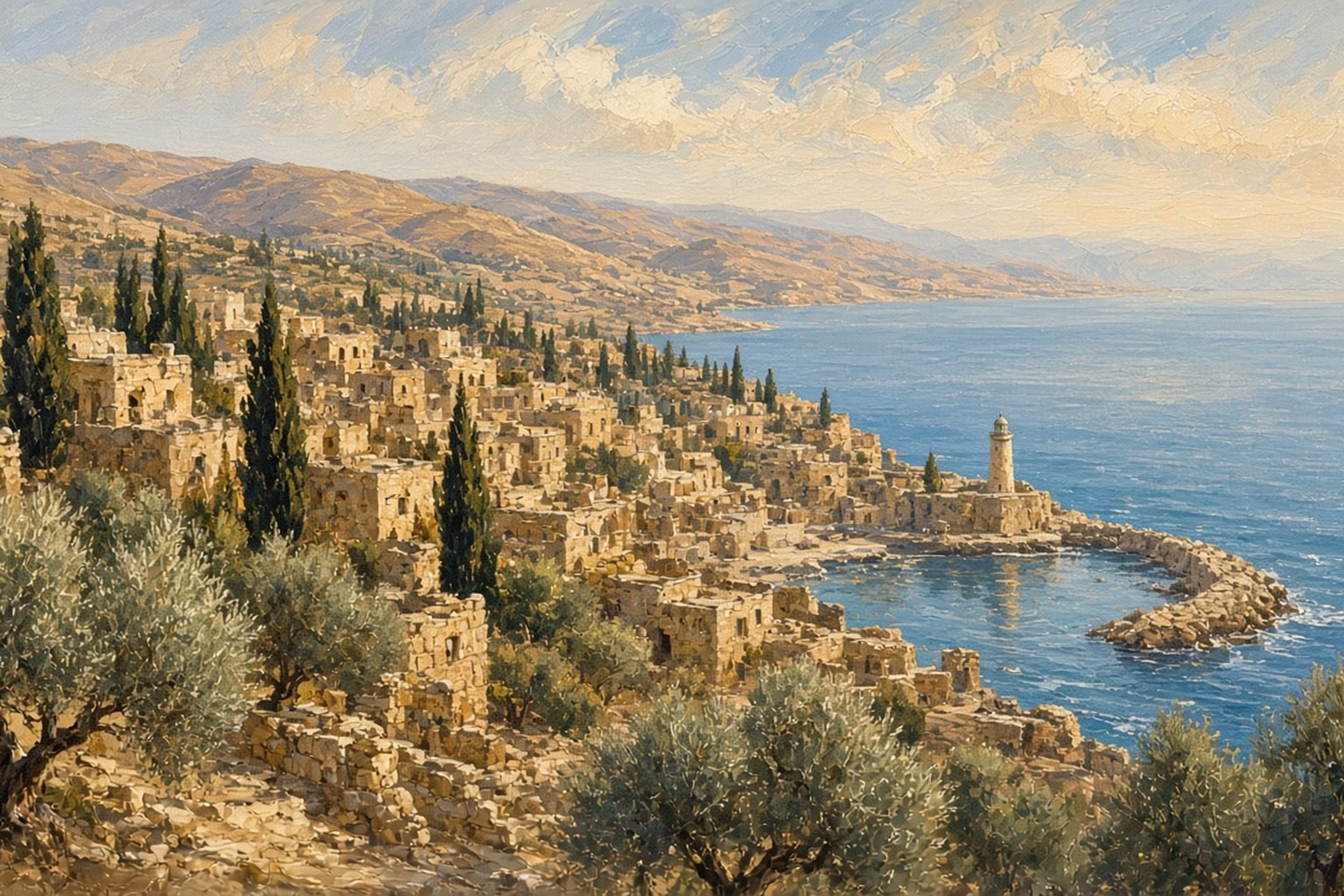
Israel, a small country on the eastern shore of the Mediterranean Sea, sits at the crossroads of Africa, Asia, and Europe. Its land is deeply significant to Judaism, Christianity, and Islam, and it is home to some of the world’s most important religious and historical sites. Known for its varied landscapes, ancient cities, and dynamic technology sector, Israel is a place where long history and modern innovation meet.
Geography and Climate
Israel is bordered by Lebanon to the north, Syria to the northeast, Jordan to the east, and Egypt to the southwest, with the Palestinian territories of the West Bank and the Gaza Strip also adjoining it. The country is long and narrow, stretching from the green hills of the Galilee in the north to the Red Sea port of Eilat in the south.
Despite its small size, Israel has remarkably diverse terrain. A fertile coastal plain runs along the Mediterranean, while hills and mountains rise inland. The Jordan Rift Valley contains the Sea of Galilee and the Dead Sea, whose shores are the lowest point on land on Earth. The Negev Desert covers more than half of the country’s land area.
The climate is Mediterranean in the north and along the coast, with hot, dry summers and mild, rainy winters. The south and east are arid, and water scarcity has long shaped life and innovation in the region.
History and Independence
The land has been inhabited since prehistoric times and was home to ancient Israelite kingdoms, with Jerusalem as a central city. Over the centuries, the region was ruled by many powers, including the Babylonians, Persians, Greeks, Romans, Byzantines, Arab caliphates, Crusaders, Mamluks, and the Ottoman Empire, which governed it for four centuries.
After World War I, the area came under a British mandate. Jewish immigration grew, driven in part by the Zionist movement and by persecution in Europe, including the Holocaust. In 1947, the United Nations proposed partitioning the territory into Jewish and Arab states, and on May 14, 1948, David Ben-Gurion proclaimed the establishment of the State of Israel.
The war that followed independence led to the displacement of large numbers of Palestinians, a central issue in the conflict that continues today. Further wars took place in 1967 and 1973, and Israel later signed peace treaties with Egypt in 1979 and Jordan in 1994. Relations with the Palestinians remain unresolved, and recent years have seen renewed and devastating conflict.
Economy and Natural Resources
Israel has an advanced, technology-driven economy and is often called the “Start-Up Nation” for its many new companies and high levels of research and development. Key sectors include software, cybersecurity, medical technology, pharmaceuticals, and semiconductors.
Because natural water is scarce, Israel has become a world leader in water technology, pioneering drip irrigation and producing much of its drinking water through desalination. Agriculture is highly efficient, exporting fruits, vegetables, and flowers.
The discovery of offshore natural gas fields in the Mediterranean has transformed the country’s energy sector and enabled gas exports to neighboring countries. Diamond cutting and trading, tourism, and defense industries also contribute to the economy, supported by a highly skilled workforce and strong universities.
Culture and Language
Hebrew is the official language, revived as a spoken language in the late nineteenth and twentieth centuries, while Arabic holds a special status and is spoken by a large minority. Israel’s population is predominantly Jewish, with significant Muslim, Christian, and Druze communities.
Jewish immigrants from Europe, the Middle East, North Africa, Ethiopia, and the former Soviet Union have created a vibrant blend of traditions, music, and cuisine. The weekly Sabbath, or Shabbat, and holidays such as Passover, Yom Kippur, and Hanukkah shape the rhythm of the calendar.
Israel has a lively arts scene, with theater, literature, film, and contemporary dance enjoying wide audiences. Tel Aviv is known for its beaches, nightlife, and Bauhaus architecture, while Jerusalem’s museums preserve treasures such as the Dead Sea Scrolls.
Food and Cuisine
Israeli cuisine reflects the many cultures of its people and the flavors of the wider Mediterranean and Middle East. Hummus, falafel, and tahini are everyday staples, often served in warm pita with fresh salads. Shakshuka, eggs poached in a spiced tomato and pepper sauce, is a popular breakfast dish.
Sabich, a pita filled with fried eggplant and boiled egg, reflects the influence of Iraqi Jewish cooking, while bourekas, flaky savory pastries, are found in bakeries everywhere. Fresh produce, olive oil, dates, and local wines are important parts of the table, and challah bread is traditionally eaten on Shabbat.
Tourism and Attractions
Jerusalem is one of the world’s most visited holy cities, with sites such as the Western Wall, the Church of the Holy Sepulchre, and the Al-Aqsa Mosque compound within its historic Old City. The city attracts pilgrims and travelers of many faiths from around the world.
The ancient fortress of Masada, overlooking the Dead Sea, and the White City of Tel Aviv are UNESCO World Heritage Sites, as are the Bahá’í Gardens in Haifa and the old city of Acre. Visitors can float in the mineral-rich waters of the Dead Sea, hike in the Negev, explore the Galilee, or dive in the coral reefs near Eilat.
Challenges and Opportunities
Israel faces major challenges, including the unresolved Israeli-Palestinian conflict, regional security threats, and periods of intense violence. Domestic issues such as the high cost of living, housing prices, and social and political divisions are also widely debated.
At the same time, the country’s strengths in science, technology, and water management offer solutions with global relevance. Many hope that dialogue and diplomacy can one day bring lasting peace and security for all the peoples of the region.
A Land of Ancient Roots and Modern Dreams
Israel is a land where ancient stones and modern skylines share the same horizon. From the timeless streets of Jerusalem to the beaches of Tel Aviv and the stark beauty of the Negev, it offers a remarkable variety of experiences within a small space. Rich in history and innovation, it remains one of the most closely watched countries in the world.