
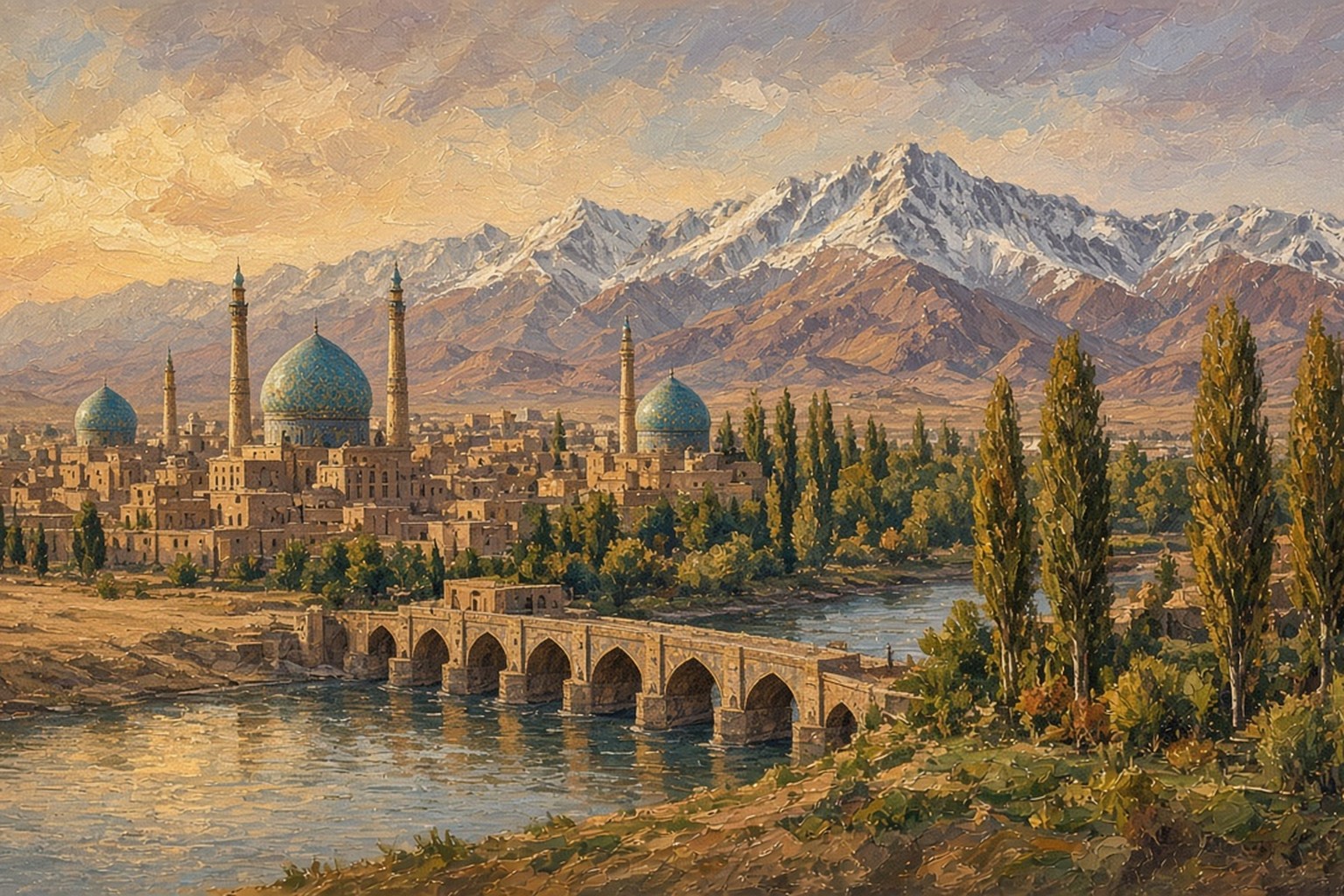
Iran, officially the Islamic Republic of Iran and historically known in the West as Persia, is one of the world’s oldest continuous civilizations. Set between the Caspian Sea and the Persian Gulf, it is a land of rugged mountains, vast deserts, and graceful cities adorned with turquoise domes. Its poetry, carpets, gardens, and architecture have influenced cultures far beyond its borders, making Iran a country of extraordinary heritage.
Geography and Climate
Iran covers approximately 1.65 million square kilometers, making it one of the largest countries in the Middle East. It borders Iraq and Turkey to the west, Armenia, Azerbaijan, and Turkmenistan to the north, and Afghanistan and Pakistan to the east. The Caspian Sea lies to the north, while the Persian Gulf and the Gulf of Oman form its southern coastline.
Much of the country is a high central plateau ringed by mountains. The Zagros Mountains run along the west, while the Alborz range in the north includes Mount Damavand, the country’s highest peak and a dormant volcano. The interior holds two great deserts, the Dasht-e Kavir and the Dasht-e Lut, the latter known for some of the hottest land surface temperatures ever recorded.
Iran’s climate is largely arid or semi-arid, with hot summers and cold winters on the plateau. In contrast, the narrow Caspian coastal plain is humid and green, with forests, rice paddies, and tea plantations.
History and Independence
Civilization in Iran dates back thousands of years, from the ancient Elamites to the Medes and Persians. In the sixth century BCE, Cyrus the Great founded the Achaemenid Empire, which grew into one of the largest empires of the ancient world. Later rulers such as Darius I built the magnificent ceremonial capital of Persepolis.
After Alexander the Great’s conquest, Iran was ruled by the Parthian and Sasanian empires before the Arab conquest in the seventh century brought Islam. The Safavid dynasty, which rose in 1501, established Shia Islam as the state religion, and under Shah Abbas I the city of Isfahan became one of the most splendid capitals in the world.
Unlike many of its neighbors, Iran was never formally colonized, although foreign powers exerted strong influence in the nineteenth and twentieth centuries. The Constitutional Revolution of the early 1900s created a parliament, and the Pahlavi dynasty ruled from 1925 until the 1979 revolution established the Islamic Republic. The country then endured a long war with Iraq from 1980 to 1988.
Economy and Natural Resources
Iran holds some of the world’s largest proven reserves of oil and natural gas, and energy exports have long been central to its economy. The country has also developed significant petrochemical, steel, automotive, and cement industries.
Agriculture is diverse, producing wheat, rice, fruits, nuts, and especially pistachios and saffron, of which Iran is the world’s leading producer. Handwoven Persian carpets remain a celebrated export and an important craft tradition.
International sanctions have significantly affected trade, investment, and access to global financial systems. Iran’s economy has also faced high inflation, prompting efforts to expand domestic production and trade with regional partners.
Culture and Language
Persian, also known as Farsi, is the official language, while Azerbaijani, Kurdish, Luri, Arabic, Baluchi, and other languages are spoken by Iran’s diverse communities. The majority of Iranians are Shia Muslims, and the country is also home to Sunni, Christian, Jewish, Zoroastrian, and other religious communities.
Poetry holds a cherished place in Iranian life. Ferdowsi’s epic Shahnameh, or “Book of Kings,” preserves ancient Persian legends, while the verses of Hafez and Saadi are memorized and quoted by people of all ages. The tombs of Hafez and Saadi in Shiraz and of Ferdowsi in Tus are places of pilgrimage for admirers, and many families keep a copy of Hafez’s collected poems at home.
The most important celebration is Nowruz, the Persian New Year, which begins at the spring equinox and is recognized by UNESCO as intangible heritage. Persian miniature painting, calligraphy, tilework, and classical music reflect centuries of artistic refinement.
Food and Cuisine
Iranian cuisine is known for its fragrant rice, fresh herbs, and delicate balance of sweet and sour flavors. Chelow kabab, grilled meat served with saffron-scented rice, is often considered the national dish. Ghormeh sabzi, a herb and kidney bean stew, and fesenjan, a rich stew of pomegranate and walnuts, are household favorites.
Tahdig, the crispy golden layer at the bottom of the rice pot, is a prized delicacy. Tea is served throughout the day, often with sweets such as gaz, a nougat from Isfahan, while faloodeh, a frozen dessert of thin noodles and rosewater, is a refreshing summer treat.
Tourism and Attractions
The ruins of Persepolis, a UNESCO World Heritage Site, showcase the grandeur of the Achaemenid Empire with their carved staircases and columns. In Isfahan, Naqsh-e Jahan Square is surrounded by stunning mosques and palaces, and historic bridges such as Si-o-se-pol span the Zayandeh River.
Shiraz is famous for its gardens and the colorful stained glass of the Nasir al-Mulk Mosque, while the desert city of Yazd is known for its mud-brick architecture and windcatchers. The historic bazaar of Tabriz, a UNESCO World Heritage Site, the elegant traditional houses and gardens of Kashan, and the forested mountains and rice fields of the Caspian coast offer further variety for travelers.
Challenges and Opportunities
Iran faces challenges including the impact of sanctions, inflation, unemployment among young people, and political tensions with other countries. Water scarcity, drought, and air pollution in major cities are also serious environmental concerns.
At the same time, the country has a highly educated population, abundant natural resources, and a cultural heritage of global significance. Investment in technology, renewable energy, tourism, and sustainable water management could open new opportunities for its future.
A Land of Poetry and Splendor
Iran is a land where ancient empires, timeless poetry, and exquisite artistry come together. From the columns of Persepolis to the tiled domes of Isfahan and the gardens of Shiraz, every city tells a chapter of a remarkable story. Rich in heritage and hospitality, Iran remains a country of profound beauty and depth.