
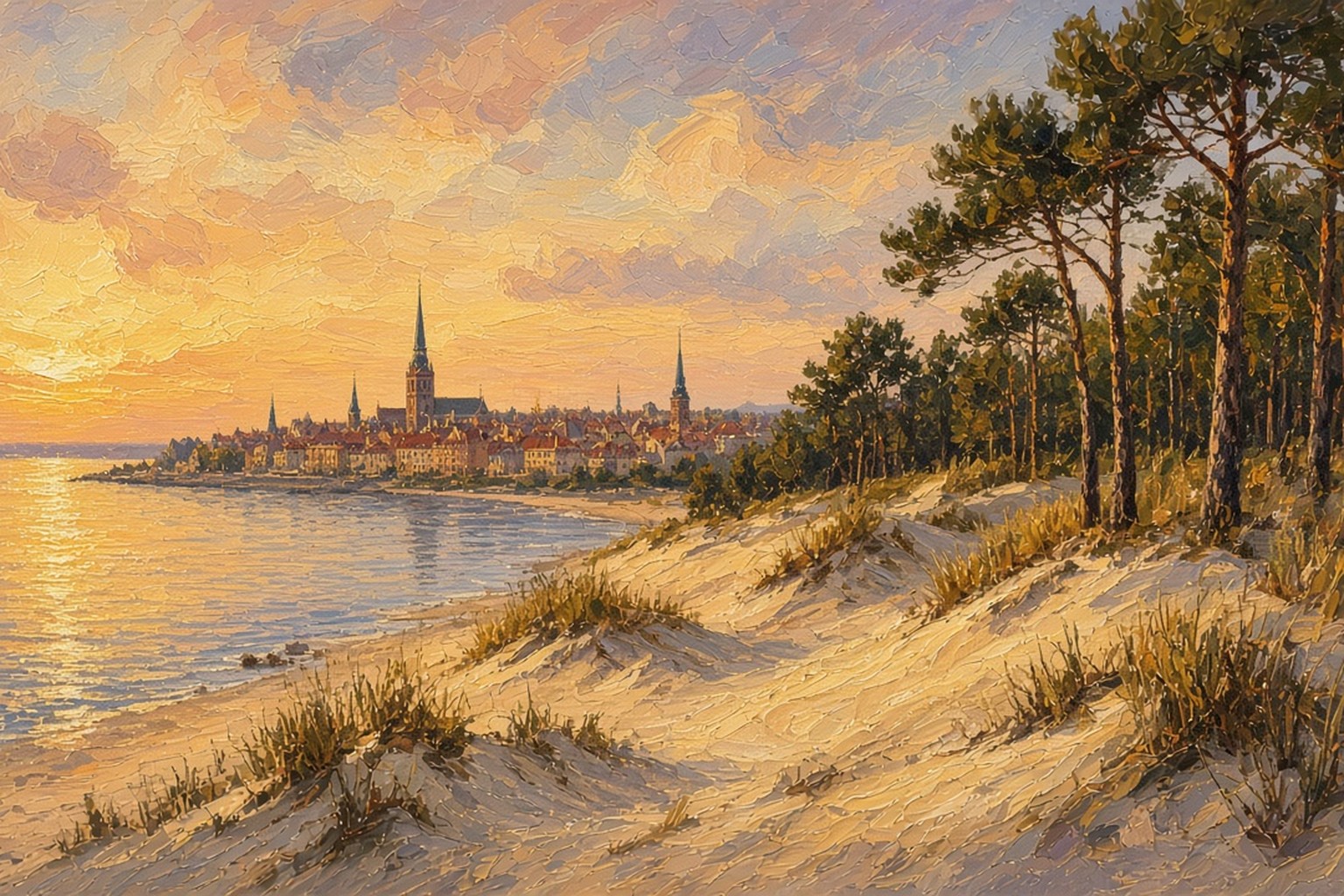
Latvia is a Baltic nation in northeastern Europe known for its vast forests, long sandy coastline, and rich tradition of song. Its capital, Riga, is the largest city in the Baltic states and is celebrated for its medieval Old Town and remarkable Art Nouveau architecture. Often called a “singing nation,” Latvia combines natural beauty with a proud and resilient cultural identity.
Geography and Climate
Latvia covers about 64,600 square kilometers and is bordered by Estonia to the north, Russia to the east, Belarus to the southeast, and Lithuania to the south. To the west lies the Baltic Sea and the wide Gulf of Riga, giving the country around 500 kilometers of coastline lined with dunes and pine trees.
The landscape is mostly low and gently rolling, with the highest point, Gaiziņkalns, rising only about 312 meters above sea level. Forests cover roughly half of the territory, and the country is dotted with thousands of lakes, rivers, and wetlands. The Daugava, the largest river, flows through Riga before reaching the sea.
Latvia has a temperate climate with four distinct seasons. Summers are mild and pleasant, with long daylight hours around midsummer, while winters can be cold and snowy, especially in the eastern region of Latgale. Spring and autumn bring colorful transformations to the countryside.
History and Independence
The ancestors of modern Latvians, Baltic tribes such as the Curonians, Latgalians, Selonians, and Semigallians, lived in the region for thousands of years. In the thirteenth century, German crusaders conquered the area, and Riga, founded in 1201, became an important member of the Hanseatic League trading network.
Over the following centuries, Latvian lands were ruled in turn by Germans, Poles, Swedes, and the Russian Empire. Latvia declared its independence on 18 November 1918 and won recognition after a war of independence. In 1940, it was occupied by the Soviet Union, followed by Nazi German occupation and renewed Soviet control from 1944.
In 1989, Latvians joined Estonians and Lithuanians in the Baltic Way, a human chain stretching across the three countries in a peaceful call for freedom. Latvia restored its independence in 1990 and 1991. It joined both the European Union and NATO in 2004 and adopted the euro in 2014.
Economy and Natural Resources
Latvia has a modern, open economy based largely on services, trade, and manufacturing. Its forests are one of its most valuable resources, and timber and wood products are among the country’s leading exports.
The ice-free ports of Riga, Ventspils, and Liepāja have long made Latvia a hub for shipping and transit between Eastern and Western Europe. Food processing, chemicals, pharmaceuticals, and machinery are also important industries, while agriculture produces grain, dairy, and meat.
In recent years, Latvia has developed a growing technology sector, with startups and information technology companies based in Riga. Tourism, logistics, and renewable energy, including hydropower on the Daugava River, also contribute to the economy.
Culture and Language
Latvian is the official language and, together with Lithuanian, is one of only two surviving Baltic languages. Russian is also widely spoken, especially in Riga and the eastern regions. Latvian culture draws deeply on folklore, nature, and seasonal traditions.
Folk songs known as dainas are central to Latvian identity, and hundreds of thousands of them were collected by the folklorist Krišjānis Barons. The Latvian Song and Dance Festival, held regularly since 1873, brings together thousands of singers and dancers and is recognized by UNESCO as part of the Baltic song and dance celebrations.
The most beloved holiday is Jāņi, the midsummer celebration in June, when people gather in the countryside, wear wreaths of flowers and oak leaves, light bonfires, and sing through the shortest night of the year. Traditional crafts such as weaving, ceramics, and amber jewelry remain popular.
Food and Cuisine
Latvian cuisine is hearty and rooted in farm traditions, featuring potatoes, grains, dairy, pork, and fish. Dark rye bread, known as rupjmaize, is a staple at nearly every meal. Grey peas with bacon are a classic dish, especially during the winter holidays.
Along the coast, smoked fish such as sprats and flounder are highly valued, and Riga sprats are famous far beyond Latvia. At midsummer, people enjoy caraway cheese and local beer, while sklandrausis, a sweet pie made with rye dough, carrots, and potatoes, is a specialty of the Kurzeme region.
Forest foods play an important role, and many Latvians enjoy picking mushrooms and berries in late summer and autumn. Riga Black Balsam, a dark herbal liqueur, is a well-known national drink, often enjoyed in small amounts or mixed into coffee and cocktails.
Tourism and Attractions
The Historic Centre of Riga is a UNESCO World Heritage Site, famous for its cobbled streets, church spires, and one of the world’s finest collections of Art Nouveau buildings. The town of Kuldīga, with its wide waterfall on the Venta River, is also on the World Heritage list.
Gauja National Park, with its sandstone cliffs, caves, and medieval castles at Sigulda, Turaida, and Cēsis, is a favorite destination for hiking and canoeing. Visitors also enjoy the elegant Rundāle Palace, the seaside resort of Jūrmala, and the wild beaches of the western coast.
Latvia’s countryside is also ideal for slow travel, with nature trails, bird-watching towers, and rural guesthouses. In winter, frozen lakes and snowy forests offer opportunities for cross-country skiing and sauna traditions.
Challenges and Opportunities
Latvia faces challenges such as population decline due to emigration and low birth rates, as well as differences in income between Riga and rural regions. Strengthening energy security and integrating its communities are also ongoing priorities.
At the same time, its educated workforce, strategic location, and membership in the European Union offer strong opportunities for growth. Investments in technology, green energy, and sustainable tourism could help Latvia build a prosperous future.
A Land of Songs and Forests
Latvia is a country where ancient songs echo through pine forests and medieval streets meet striking modern design. From the vibrant capital of Riga to quiet lakes, coastal dunes, and castle-studded valleys, it offers a rich blend of history and nature. Proud of its heritage and open to the world, Latvia is a true gem of the Baltic.