
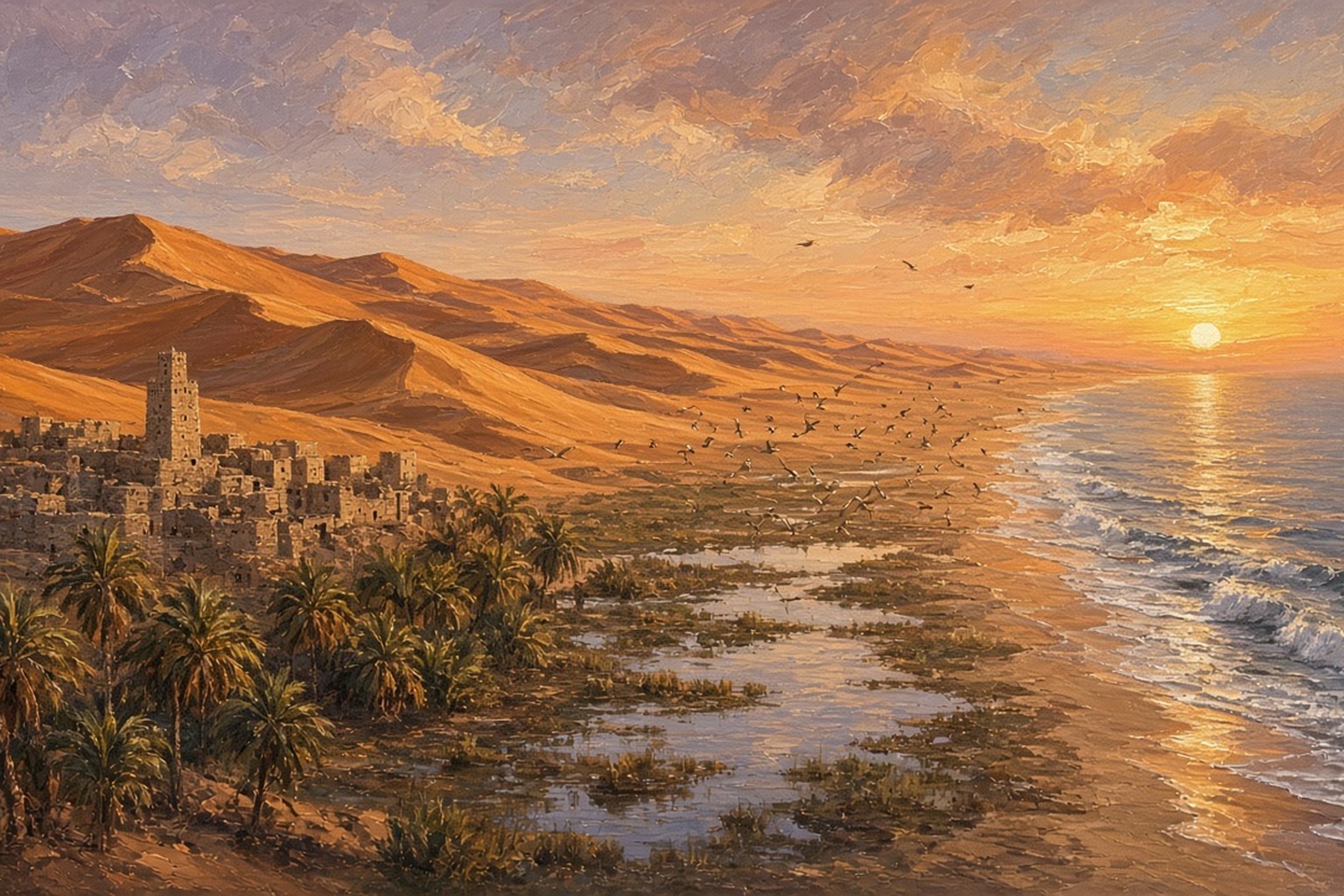
Mauritania is a vast country in northwest Africa, where the Sahara Desert meets the Atlantic Ocean. Its landscapes include towering sand dunes, rocky plateaus, ancient caravan towns, and one of the richest coastal ecosystems in the world. Bridging the Arab world and sub-Saharan Africa, Mauritania offers a fascinating blend of nomadic heritage, Islamic scholarship, and desert beauty.
Geography and Climate
Mauritania covers about 1.03 million square kilometers and is bordered by Western Sahara to the northwest, Algeria to the northeast, Mali to the east and southeast, and Senegal to the southwest. The Atlantic Ocean forms its western coastline, stretching for around 750 kilometers.
Most of the country lies within the Sahara, with vast sand seas, rocky plateaus, and isolated mountains. In the Adrar region lies the Richat Structure, a giant circular geological formation about 40 kilometers wide, often called the “Eye of the Sahara.” The Senegal River in the south provides fertile land for farming along its banks.
The climate is hot and dry for most of the year, with very little rainfall in the north. The southern regions receive a short rainy season during the summer months. Along the coast, cool ocean currents make temperatures milder, while dusty harmattan winds often blow from the desert.
History and Independence
Thousands of years ago, the Sahara was greener, and rock paintings in the region show herds of animals and early pastoral life. Later, Berber groups and Soninke peoples lived in the area, and the Ghana Empire extended into its southern parts. In the eleventh century, the Almoravid movement emerged from this region and spread its influence as far as Spain and Morocco.
Caravan towns such as Chinguetti, Ouadane, Tichitt, and Oualata grew wealthy from trans-Saharan trade and became important centers of Islamic learning. Arab tribes arrived over the following centuries, shaping the language and culture of the region.
France gradually established control in the early twentieth century, and Mauritania became part of French West Africa. The country gained independence on 28 November 1960, with Moktar Ould Daddah as its first president. The new capital, Nouakchott, was built near the coast, growing from a small village into the country’s largest city.
Economy and Natural Resources
Mauritania is rich in natural resources, especially iron ore, which has long been one of its main exports. Ore from the mines near Zouérat is carried to the port of Nouadhibou on one of the longest and heaviest trains in the world.
The country’s Atlantic waters are among the richest fishing grounds in the world, making fishing a major source of exports and jobs. Gold and copper mining are also important, and offshore natural gas fields shared with Senegal have opened new opportunities for energy production.
Many people still depend on herding camels, goats, sheep, and cattle, while farmers grow millet, sorghum, rice, and dates. With abundant sunshine and strong winds, Mauritania also has excellent potential for solar and wind power.
Culture and Language
Arabic is the official language, and the local Arabic dialect, Hassaniya, is widely spoken. Pulaar, Soninke, and Wolof are recognized as national languages, and French is commonly used in business and education. Islam is the religion of nearly the entire population.
Mauritanian culture is deeply influenced by nomadic traditions, and many families still keep strong ties to life in the desert. Hospitality is a central value, and guests are welcomed into tents or homes with tea and generous meals.
Music is performed by traditional griots, known as iggawen, who play instruments such as the tidinit, a lute, and the ardin, a harp played by women. Poetry is highly respected, and the country is sometimes called the “land of a million poets.”
Food and Cuisine
Mauritanian cuisine reflects its desert, coastal, and West African influences. Rice and fish dishes such as thieboudienne are popular in the south and along the coast, while couscous and grilled meats are common in the north.
Méchoui, a whole roasted lamb, is served at celebrations and special gatherings. Camel meat and camel milk are traditional foods in desert regions, and dates are an essential staple, especially during Ramadan.
Tea is the most important social drink, prepared with green tea, mint, and plenty of sugar. It is traditionally served in three rounds, each with a different strength and flavor, and sharing tea is a sign of friendship and respect.
Tourism and Attractions
The ancient ksour, or fortified towns, of Chinguetti, Ouadane, Tichitt, and Oualata are UNESCO World Heritage Sites, known for their stone mosques and historic libraries of Islamic manuscripts. Chinguetti, often called a holy city of the Sahara, is surrounded by spectacular sand dunes.
Banc d’Arguin National Park, another UNESCO site, protects coastal wetlands and islands that host millions of migratory birds, as well as traditional Imraguen fishing communities. Visitors can also explore the Richat Structure, the oasis of Terjit, and the lively fish market of Nouakchott.
Traveling by four-wheel drive across the Adrar plateau, visitors can sleep under brilliant desert stars, visit palm groves, and meet nomadic families. The coastal city of Nouadhibou, near the Cap Blanc peninsula, offers fishing, beaches, and access to a protected coastline that is home to one of the last colonies of Mediterranean monk seals.
Challenges and Opportunities
Mauritania faces challenges such as desertification, water scarcity, poverty, and the impacts of climate change on herding and farming. Creating jobs for young people and expanding access to education and health care are ongoing priorities.
At the same time, its mineral wealth, rich fisheries, natural gas reserves, and renewable energy potential offer significant opportunities. Mauritania also participates in the Great Green Wall initiative, which aims to restore land across the Sahel. Investments in infrastructure and skills could help spread prosperity across the country.
Where the Desert Meets the Sea
Mauritania is a land of endless dunes, ancient caravan cities, and wild Atlantic shores. From the manuscript libraries of Chinguetti to the bird-filled islands of Banc d’Arguin and the mysterious Eye of the Sahara, it offers a journey into a unique and timeless world. Proud of its heritage and rich in potential, Mauritania is a hidden gem of Africa.