
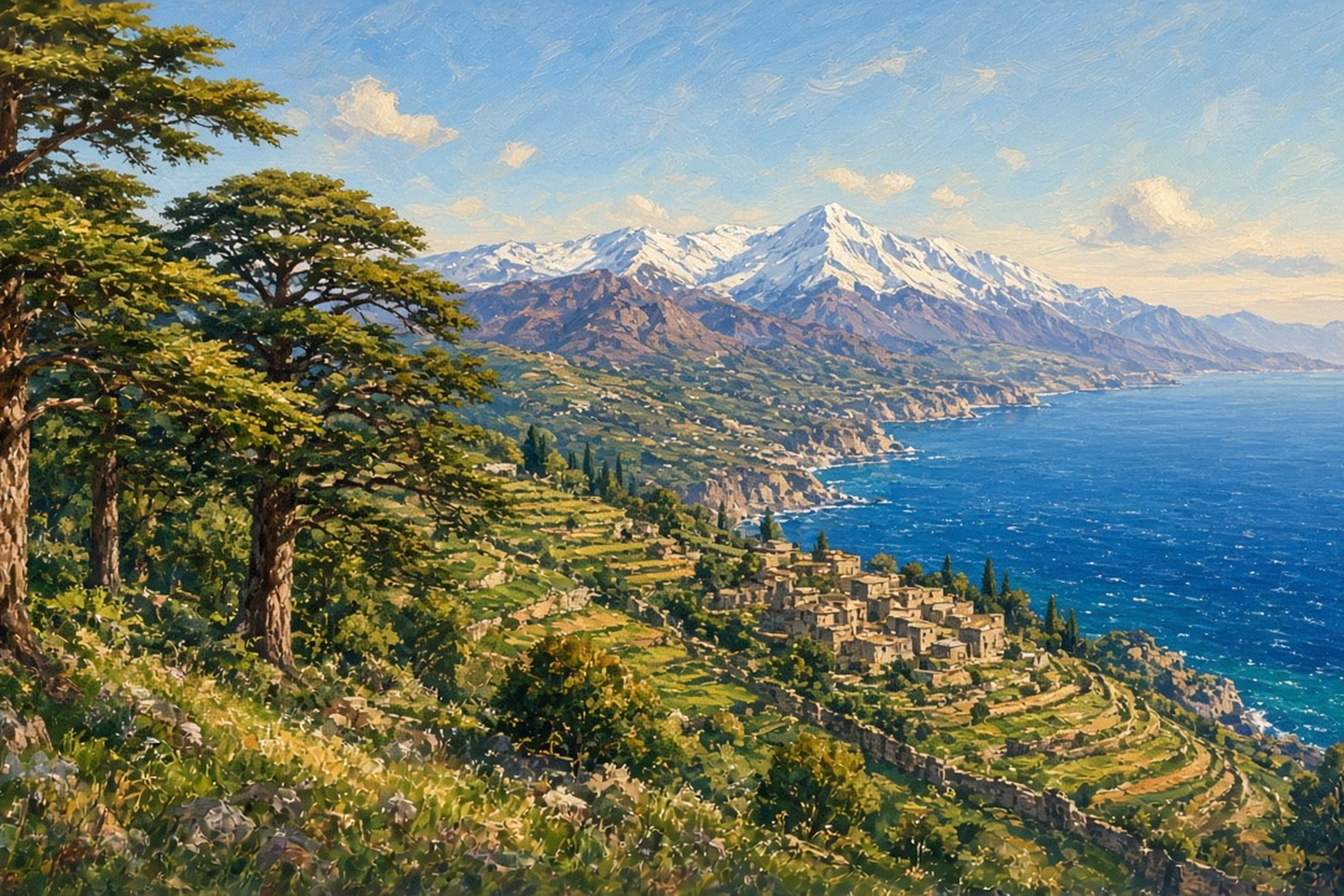
Lebanon is a small country on the eastern shore of the Mediterranean Sea, renowned for its ancient history, snow-capped mountains, and vibrant culture. Home to some of the world’s oldest cities, it was once the heartland of the Phoenicians, the great seafarers and traders of antiquity. Famous for its cedar trees, legendary hospitality, and celebrated cuisine, Lebanon has long been a crossroads of civilizations.
Geography and Climate
Lebanon covers about 10,450 square kilometers, making it one of the smallest countries in the Middle East. It is bordered by Syria to the north and east, Israel to the south, and the Mediterranean Sea to the west, with a narrow coastal plain where most major cities are located.
Two mountain ranges run parallel through the country, the Mount Lebanon range near the coast and the Anti-Lebanon range along the Syrian border. Between them lies the fertile Beqaa Valley, the country’s agricultural heartland. The highest peak, Qurnat as Sawda, rises to just over 3,000 meters.
Lebanon has a Mediterranean climate, with hot, dry summers and mild, rainy winters along the coast. In the mountains, winters bring heavy snow, allowing visitors in some seasons to ski in the morning and relax by the sea in the afternoon.
History and Independence
The coastal cities of Byblos, Sidon, and Tyre were among the most important centers of Phoenician civilization, which spread trade and the alphabet across the Mediterranean. Over the centuries, the region was ruled by Assyrians, Persians, Greeks, Romans, Byzantines, and Arab caliphates.
From the early sixteenth century, the area was part of the Ottoman Empire, with Mount Lebanon enjoying a degree of local autonomy. After World War I, it came under French mandate, and the state of Greater Lebanon was proclaimed in 1920. Lebanon gained independence on 22 November 1943, and the last French troops left in 1946.
In the following decades, Beirut became a regional center of banking, culture, and tourism. A long civil war from 1975 to 1990 caused great loss and destruction, ending with the Taif Agreement. In recent years, the country has faced a severe financial crisis and the devastating Beirut port explosion of August 2020.
Economy and Natural Resources
Lebanon’s economy has traditionally relied on services, including banking, trade, and tourism. Remittances from the large Lebanese diaspora around the world are also an important source of income for many families.
Agriculture thrives in the Beqaa Valley and on the mountain terraces, producing fruits, vegetables, olives, and grapes. Lebanese wine has a long history, with wineries in the Beqaa Valley gaining international recognition.
Lebanon has few mineral resources, but its abundant water from mountain springs and rivers sets it apart in the region. Since 2019, a deep economic and financial crisis has sharply reduced living standards, making recovery and reform urgent priorities.
Culture and Language
Arabic is the official language, while French and English are widely spoken, and many Lebanese switch easily between all three. The country is home to many religious communities, including various Christian and Muslim groups, and its political system is designed to share power among them.
Lebanese culture is known for its music, poetry, and lively social life. The singer Fairuz is a beloved national icon, and the dabke, a traditional line dance, is performed at weddings and celebrations. Writers such as Kahlil Gibran, author of The Prophet, have brought Lebanese literature worldwide fame.
Family and hospitality are at the heart of daily life, and guests are often welcomed with coffee, sweets, and generous meals. Beirut is known for its art galleries, festivals, and nightlife, reflecting the creative spirit of its people.
Food and Cuisine
Lebanese cuisine is celebrated around the world for its fresh ingredients, herbs, and olive oil. Meals often begin with mezze, a spread of small dishes such as hummus, baba ghanoush, tabbouleh, fattoush, and stuffed grape leaves. Kibbeh, made from bulgur and minced meat, is often considered the national dish.
Grilled meats, falafel, and shawarma are popular, while manakish, a flatbread topped with za’atar and olive oil, is a favorite breakfast. Sweet treats include baklava and knafeh, and meals are often accompanied by arak, an anise-flavored spirit, or strong Lebanese coffee.
Meals in Lebanon are social occasions, often lasting for hours as family and friends share many plates at once. Fresh bread, seasonal vegetables, and fruit from the mountains are always on the table, and no meal feels complete without generous portions offered to every guest.
Tourism and Attractions
Lebanon has several UNESCO World Heritage Sites, including the ancient port city of Byblos, the Roman temples of Baalbek, the ruins of Tyre and Anjar, and the Qadisha Valley with the Forest of the Cedars of God. Each offers a glimpse into thousands of years of history.
Beirut’s seaside Corniche, the Jeita Grotto with its spectacular limestone caves, the medieval souks of Tripoli and Sidon, and the mountain villages of the Chouf region are also popular. Visitors can enjoy hiking, skiing, and wine tasting in a remarkably compact area.
The coastal town of Batroun, with its old stone streets and Phoenician sea wall, has become a favorite seaside escape. Further inland, the Shouf Biosphere Reserve protects some of the country’s remaining cedar forests and offers peaceful trails through mountain scenery.
Challenges and Opportunities
Lebanon faces serious challenges, including economic collapse, political deadlock, damaged infrastructure, and regional instability. Many young people have emigrated in search of opportunities, and public services such as electricity remain unreliable.
Yet the country’s greatest strengths remain its educated population, entrepreneurial spirit, and worldwide diaspora. With meaningful reforms and stability, Lebanon’s tourism, agriculture, and creative industries could once again flourish.
Lebanon’s cultural heritage, natural beauty, and famous cuisine continue to attract visitors from around the world. Renewable energy, especially solar power, has grown rapidly as families and businesses seek reliable electricity.
A Mosaic of Mountains and Memory
Lebanon is a land where ancient ruins overlook the sea and cedar forests crown rugged mountains. From the vibrant streets of Beirut to the timeless harbors of Byblos and Tyre, it offers a rich tapestry of history, faith, and flavor. Resilient and welcoming, Lebanon continues to inspire all who discover it.