
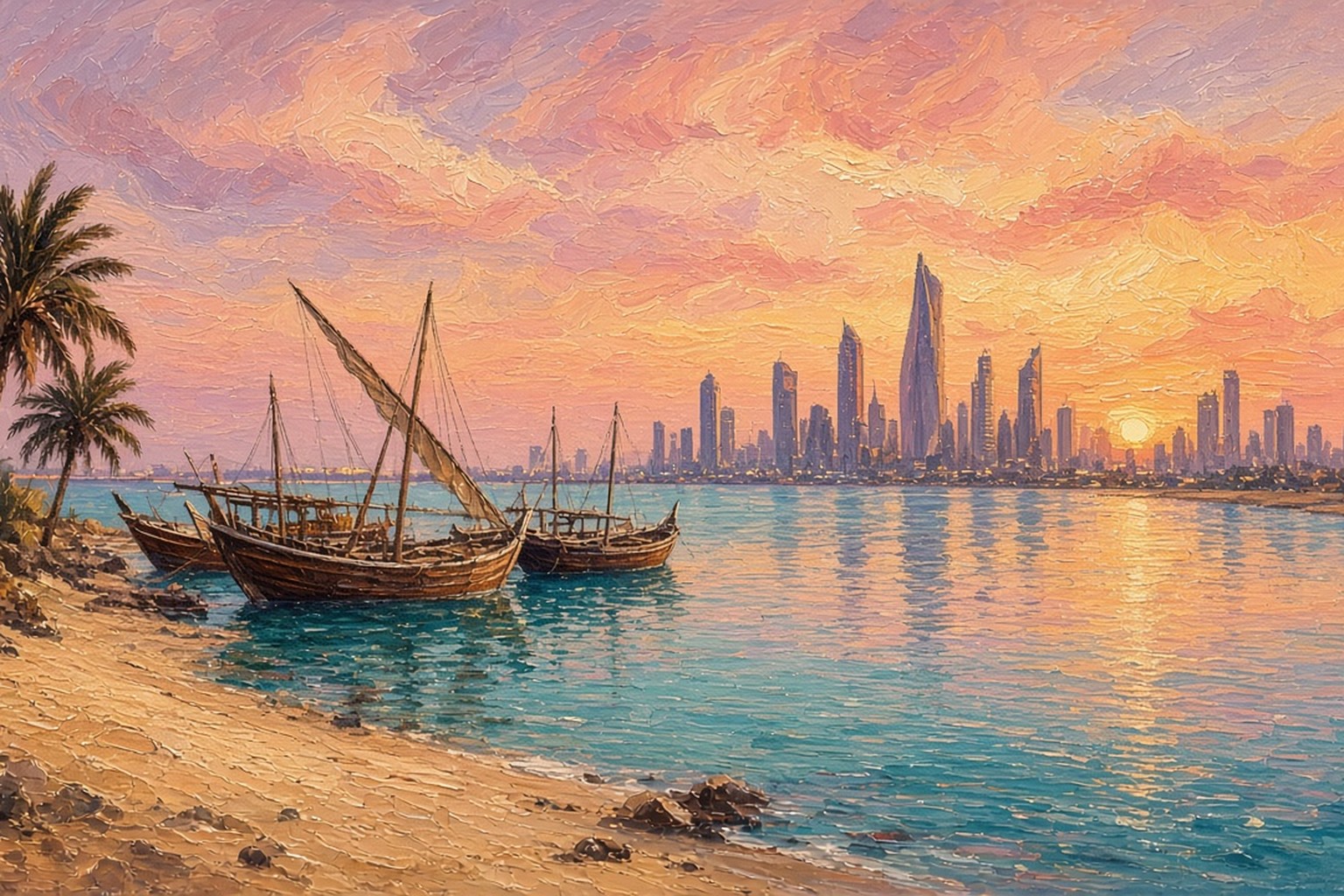
Kuwait, a small but wealthy nation at the head of the Persian Gulf, is known for its vast oil reserves, modern skyline, and proud seafaring heritage. Once a modest trading and pearl-diving port, it has transformed into one of the world’s richest countries while preserving its traditions of hospitality and community. With its distinctive Kuwait Towers, bustling souqs, and desert landscapes, Kuwait offers an intriguing blend of old and new.
Geography and Climate
Kuwait covers about 17,800 square kilometers on the northeastern edge of the Arabian Peninsula. It is bordered by Iraq to the north and west and Saudi Arabia to the south, with a coastline along the Persian Gulf to the east. Kuwait Bay, one of the largest natural harbors in the region, cuts deeply into the coast near the capital, Kuwait City.
The country is mostly flat, arid desert with gently undulating plains and few natural sources of fresh water. It includes several islands, the largest of which is Bubiyan, while Failaka Island holds important archaeological remains. Kuwait relies heavily on desalinated seawater to meet its water needs.
Kuwait has a hot desert climate, with long, extremely hot summers that rank among the hottest on Earth and short, mild winters. Rainfall is scarce, and dust storms are common, especially in early summer. Brief winter rains can bring a surprising touch of green to the desert in spring.
History and Independence
The region has a long history of human settlement, and Failaka Island was home to ancient Dilmun-era communities and later a Hellenistic settlement. In the eighteenth century, families from central Arabia settled in Kuwait, and the Al-Sabah family emerged as rulers, a role they continue to hold today.
Kuwait grew into a thriving port known for shipbuilding, trade, and pearl diving. In 1899, it signed an agreement with Britain that made it a British protectorate, offering protection while largely preserving local rule. Oil was discovered in 1938, and production after World War II transformed the economy.
Kuwait gained independence on June 19, 1961, and soon established an elected National Assembly, one of the earliest in the Gulf region. In August 1990, Iraq invaded and occupied the country, and Kuwait was liberated in February 1991 by an international coalition. The country then rebuilt its infrastructure and oil industry.
Economy and Natural Resources
Kuwait holds some of the largest proven oil reserves in the world, and oil exports provide the great majority of government revenue. The Burgan field, south of Kuwait City, is among the largest oil fields ever discovered.
Oil wealth has supported a high standard of living, extensive public services, and generous social benefits for citizens. The Kuwait Investment Authority, established in 1953, is considered the world’s oldest sovereign wealth fund and invests the country’s revenues around the globe.
The government has sought to diversify the economy through its long-term development vision, encouraging growth in finance, logistics, petrochemicals, and private enterprise. The Kuwaiti dinar is one of the highest-valued currency units in the world.
Culture and Language
Arabic is the official language, and English is widely used in business and education. Islam is the state religion, and the country has a large expatriate population from across Asia, the Middle East, and beyond, making Kuwait a diverse society.
The diwaniya, a traditional gathering where men meet to socialize, discuss news, and share ideas, is a central part of Kuwaiti social life. Hospitality is deeply valued, and guests are welcomed with Arabic coffee and dates, often served with great ceremony.
Kuwait’s maritime past lives on through traditional songs of pearl divers, the craft of wooden dhow building, and annual events celebrating seafaring heritage. Al Sadu, a traditional Bedouin weaving craft, is recognized by UNESCO as intangible cultural heritage. Kuwait also has a lively theater and arts scene that is well known across the Gulf.
Food and Cuisine
Kuwaiti cuisine blends Arabian, Persian, Indian, and Mediterranean influences, reflecting centuries of trade. Machboos, spiced rice cooked with chicken, lamb, or fish, is considered the national dish. Mutabbaq samak, fish served over fragrant rice, highlights the country’s love of seafood.
Harees, a dish of slow-cooked wheat and meat, is especially popular during Ramadan, while gabout, stuffed flour dumplings in a rich sauce, is a traditional favorite. Sweet treats include luqaimat, small fried dough balls drizzled with date syrup, and desserts flavored with saffron and cardamom.
Meals are often shared with extended family, particularly on Fridays and during Ramadan, when the evening iftar brings households together. Fresh fish such as zubaidi, a type of pomfret, and hamour, a grouper, are local favorites at seafood markets. Sweet tea and cardamom-scented Arabic coffee accompany conversation at nearly every gathering.
Tourism and Attractions
The Kuwait Towers, with their distinctive blue-green spheres overlooking the Gulf, are the country’s most famous landmark and a symbol of its modern development. Souq Al-Mubarakiya, one of the oldest markets in Kuwait, offers spices, textiles, perfumes, and traditional foods in a lively atmosphere.
The Grand Mosque, the Liberation Tower, and the Sheikh Abdullah Al-Salem Cultural Centre showcase Kuwait’s architecture and cultural ambitions. Visitors can stroll along the Arabian Gulf Street waterfront, explore the green spaces of Al Shaheed Park, learn about weaving at Sadu House, or take a ferry to the archaeological sites of Failaka Island.
Challenges and Opportunities
Kuwait faces challenges including heavy dependence on oil revenue, the need to create private-sector jobs for young citizens, and the impact of extreme heat and climate change. Debates over economic reforms, subsidies, and public spending are ongoing.
Its considerable financial reserves, strategic location, and educated population provide strong foundations for change. Investments in renewable energy, technology, and infrastructure could help Kuwait build a more diversified and sustainable economy.
A Pearl of the Gulf
Kuwait is a nation that has turned a desert coastline into a modern, prosperous state while honoring its maritime roots. From the bustling lanes of Souq Al-Mubarakiya to the gleaming Kuwait Towers and the quiet shores of Failaka, it reveals a fascinating story of change and continuity. Warm and welcoming, Kuwait remains a true pearl of the Gulf.