
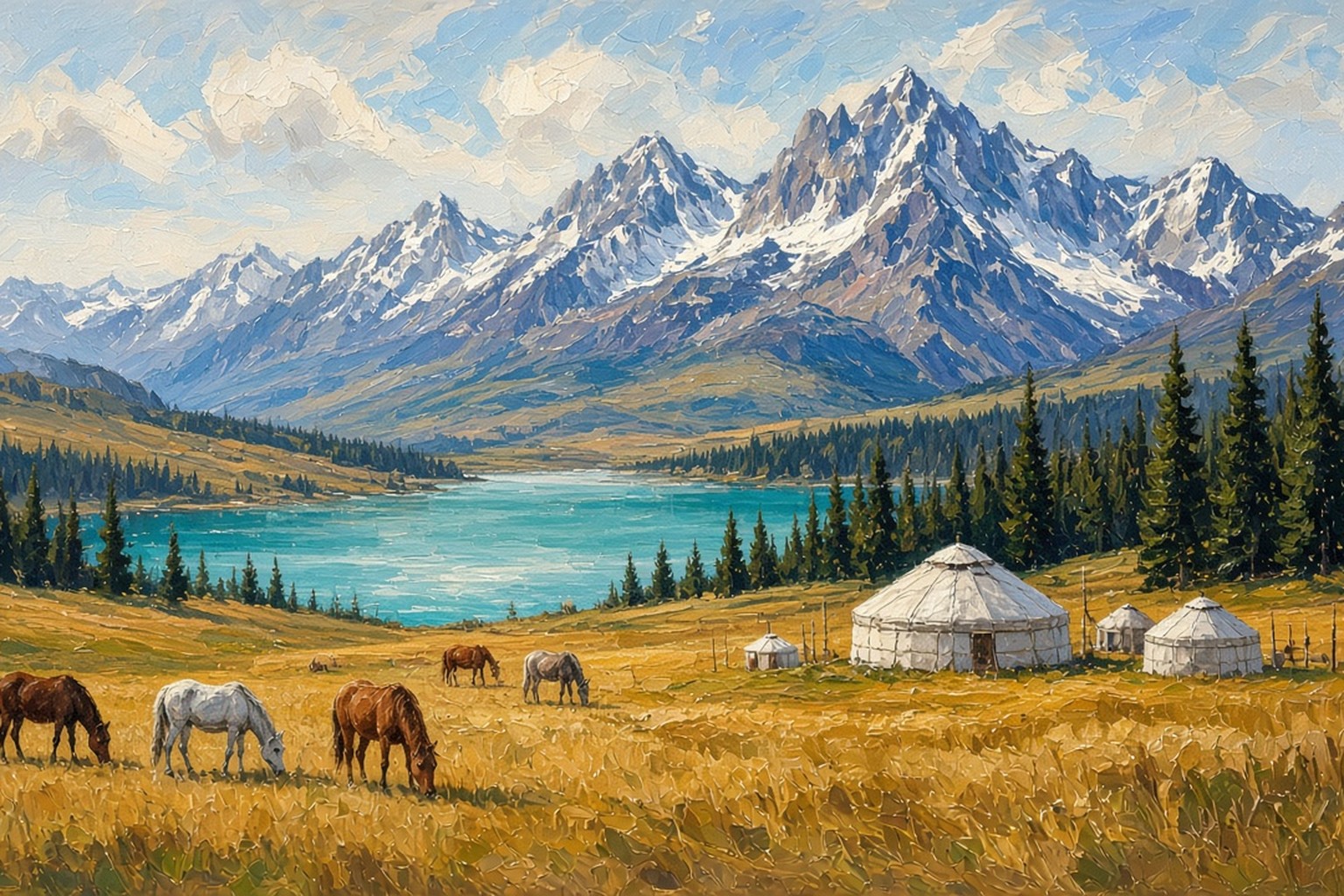
Kazakhstan, the world’s largest landlocked country, stretches across the vast heart of Central Asia from the Caspian Sea to the Altai Mountains. Often described as the “land of the Great Steppe,” it is a place of endless grasslands, snow-capped peaks, deserts, and sparkling mountain lakes. With a proud nomadic heritage, modern cities, and abundant natural resources, Kazakhstan has emerged as one of the most dynamic nations in the region.
Geography and Climate
Kazakhstan covers about 2.7 million square kilometers, making it the ninth largest country in the world. It borders Russia to the north and west, China to the east, and Kyrgyzstan, Uzbekistan, and Turkmenistan to the south. To the west, it has a long shoreline on the Caspian Sea.
Much of the country consists of flat steppe and semi-desert, while the southeast is framed by the towering Tian Shan mountains and the east by the Altai range. Important bodies of water include Lake Balkhash, part of which is freshwater and part saline, and the northern portion of the Aral Sea, which shrank dramatically during the twentieth century. Natural wonders such as Charyn Canyon and the Kolsai Lakes highlight the country’s scenic diversity.
Kazakhstan has a sharply continental climate, with hot summers and very cold winters, especially in the north. Rainfall is generally low, and temperatures can vary greatly between day and night.
History and Independence
For thousands of years, the steppe was home to nomadic peoples, including the Saka, who were renowned horsemen and craftsmen. Turkic tribes later dominated the region, and in the thirteenth century it became part of the Mongol Empire. In the fifteenth century, the Kazakh Khanate was established, uniting Kazakh tribes across the steppe.
From the eighteenth century, the Russian Empire gradually extended its control over the Kazakh lands. After the Russian Revolution, the territory became part of the Soviet Union. The Soviet era brought tragic famine in the early 1930s, forced settlement of nomads, large-scale farming through the Virgin Lands Campaign, and nuclear testing near Semey.
Kazakhstan declared independence on December 16, 1991, the last Soviet republic to do so. In 1997, the capital moved from Almaty to Astana, which has since grown into a modern city with striking architecture. Kazakhstan voluntarily gave up the nuclear weapons it inherited from the Soviet Union.
Economy and Natural Resources
Kazakhstan is rich in natural resources and has the largest economy in Central Asia. Oil and gas from fields such as Tengiz and Kashagan are major exports, and the country is the world’s largest producer of uranium.
It also has significant deposits of coal, iron, copper, zinc, chromium, and other minerals. Agriculture is important, especially wheat production on the northern steppe, along with livestock farming.
The country’s location between China and Europe has made it a key transit route for trade, with railways and roads linking East and West. The government has sought to diversify the economy through investment in manufacturing, technology, logistics, and renewable energy.
Culture and Language
Kazakh is the state language, while Russian is also widely spoken and used officially. The country is home to many ethnic groups, including Kazakhs, Russians, Uzbeks, Ukrainians, and Uyghurs. Islam is the majority religion, and Orthodox Christianity is the second largest faith.
Nomadic traditions remain an important part of Kazakh identity. The yurt, a portable felt dwelling, is a national symbol, and horsemanship is celebrated through traditional games. Hunting with golden eagles is an ancient art still practiced in some regions, and the two-stringed dombra is the country’s beloved musical instrument, often accompanying epic songs and poetry.
Nauryz, celebrated at the spring equinox, is one of the most important holidays, marked by festive gatherings and special foods. Hospitality is highly valued, and guests are traditionally honored with generous meals. Traditional crafts such as felt-making, embroidery, and silver jewelry continue to be passed down through generations.
Food and Cuisine
Kazakh cuisine reflects the nomadic way of life, with meat and dairy at its heart. The national dish, beshbarmak, consists of boiled meat, usually horse or lamb, served over flat noodles with onion broth. Its name means “five fingers,” as it was traditionally eaten by hand.
Kazy, a sausage made from horse meat, and baursak, fluffy fried dough, are served at celebrations. Fermented drinks such as kumis, made from mare’s milk, and shubat, made from camel’s milk, are traditional favorites. The region around Almaty is considered the ancestral home of the domestic apple, and apples remain a proud local symbol.
Tourism and Attractions
Almaty, the largest city, sits at the foot of the Tian Shan mountains and offers access to Big Almaty Lake, ski resorts, and alpine hiking. Charyn Canyon, with its dramatic red rock formations, and the clear blue Kolsai Lakes are popular natural destinations.
In Astana, the Bayterek Tower and other modern landmarks reflect the country’s ambitions, while the Mausoleum of Khoja Ahmed Yasawi in Turkistan is a UNESCO World Heritage Site. Burabay National Park, Altyn-Emel National Park, and the Baikonur Cosmodrome, from which Yuri Gagarin launched into space, add to the country’s appeal. Travelers can also stay in traditional yurts on the steppe and experience nomadic hospitality firsthand.
Challenges and Opportunities
Kazakhstan faces challenges such as dependence on oil and mineral exports, environmental damage from the Soviet era, and the ongoing effects of the Aral Sea disaster. Efforts to improve governance, reduce inequality, and support small businesses are also important priorities. Water management is a growing concern as rivers shared with neighboring countries face increasing demand.
At the same time, its vast resources, strategic location, and young population provide significant opportunities. Investments in renewable energy, education, and tourism could help build a more diversified and sustainable economy.
A Land of Endless Horizons
Kazakhstan is a country of vast horizons, where the spirit of the nomadic steppe meets the energy of modern cities. From the peaks of the Tian Shan to the shores of the Caspian Sea, its landscapes are as diverse as its people. Proud of its heritage and confident in its future, Kazakhstan invites the world to explore its wide open spaces.