
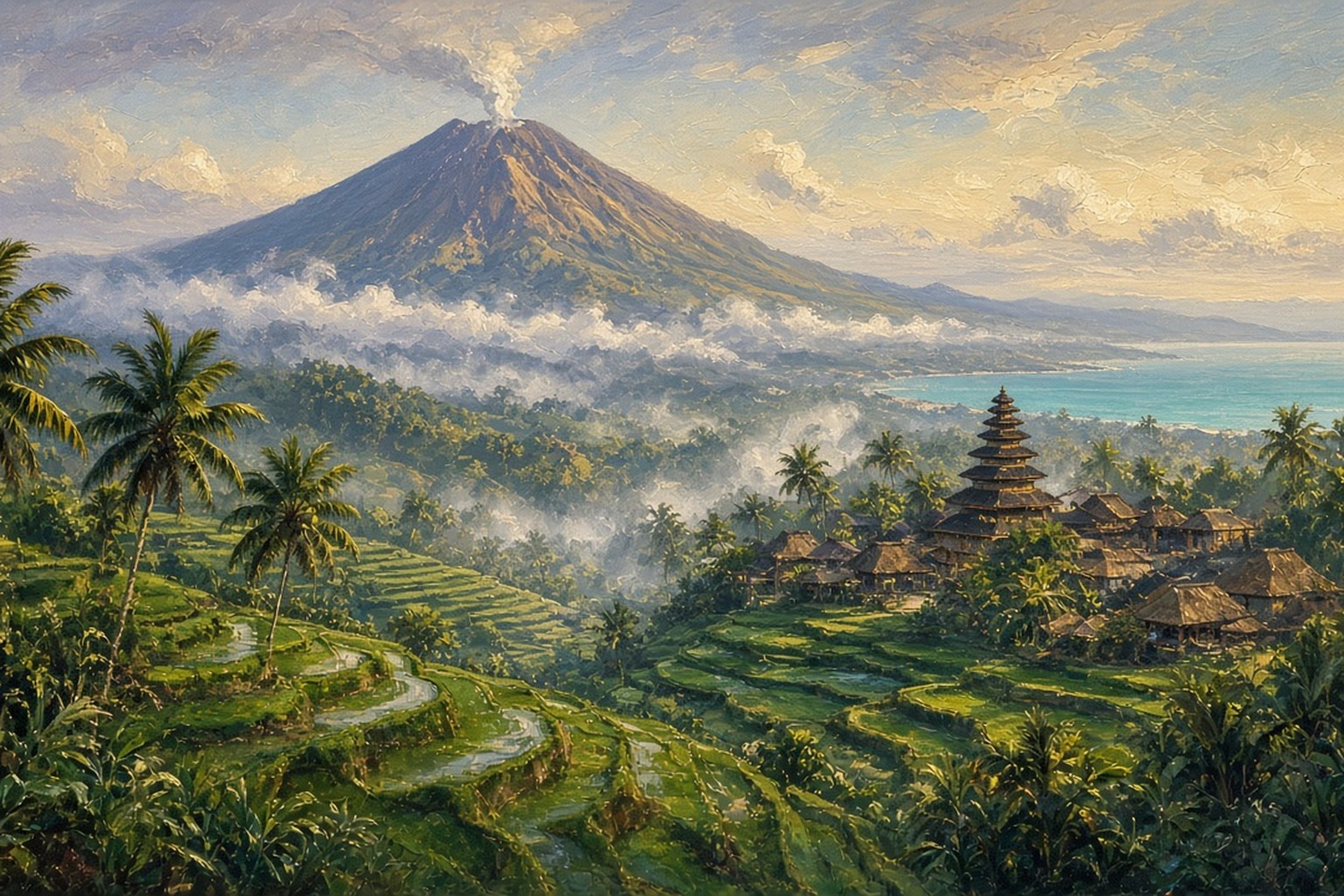
Indonesia, the world’s largest archipelagic nation, stretches across thousands of islands between the Indian and Pacific Oceans. Its national motto, “Bhinneka Tunggal Ika,” meaning “Unity in Diversity,” reflects the remarkable variety of peoples, languages, and cultures that make up the country. From smoking volcanoes and emerald rice terraces to coral reefs and ancient temples, Indonesia is one of the most fascinating and diverse places on Earth.
Geography and Climate
Indonesia is made up of more than 17,000 islands and covers roughly 1.9 million square kilometers of land. The largest islands include Sumatra, Java, Sulawesi, and the Indonesian portions of Borneo and New Guinea. Indonesia shares land borders with Malaysia on Borneo, Papua New Guinea on New Guinea, and Timor-Leste on the island of Timor.
The country lies along the Pacific Ring of Fire and has more active volcanoes than almost any other nation. Historic eruptions such as Tambora in 1815 and Krakatoa in 1883 had global effects. Dense tropical rainforests cover much of Borneo, Sumatra, and Papua, sheltering species such as orangutans, Sumatran tigers, and birds of paradise.
Indonesia has a tropical climate with high temperatures and humidity throughout the year. Most regions experience a wet season and a dry season, shaped by the monsoon winds.
History and Independence
The islands have been home to thriving kingdoms for well over a thousand years. The Buddhist Srivijaya empire, based in Sumatra, dominated regional trade, while the Hindu-Buddhist Majapahit kingdom on Java later extended its influence across much of the archipelago. Islam spread gradually through trade, becoming the majority religion over several centuries.
Attracted by valuable spices such as nutmeg and cloves, European traders arrived in the sixteenth century. The Dutch East India Company established control over key ports, and the Dutch government later ruled the territory as the Dutch East Indies. During World War II, the islands were occupied by Japan.
On August 17, 1945, Sukarno and Mohammad Hatta proclaimed Indonesia’s independence. After several years of conflict and negotiations, the Netherlands recognized Indonesian sovereignty in 1949. Following decades of rule under Sukarno and then Suharto, Indonesia began a transition to democracy in 1998 and now holds direct elections for its president.
Economy and Natural Resources
Indonesia has the largest economy in Southeast Asia and is a member of the G20. Its natural resources include coal, natural gas, nickel, tin, copper, and gold, and it is the world’s largest producer of palm oil and a major source of nickel used in batteries.
Agriculture remains important, with rice, rubber, coffee, cocoa, and spices grown across the islands. Manufacturing, services, and a fast-growing digital economy are expanding, especially in Jakarta and other major cities. Tourism, led by Bali, is also a significant source of income and employment.
Fisheries are vital to coastal communities, as Indonesia’s vast seas provide tuna, shrimp, and other seafood for both local markets and export. The government has encouraged processing of raw minerals within the country to create more jobs and capture greater value from its resources.
Culture and Language
Indonesian, or Bahasa Indonesia, is the national language and unites a population that speaks hundreds of regional languages, including Javanese and Sundanese. Indonesia has the largest Muslim population of any country, while Bali is predominantly Hindu and many communities are Christian or follow other faiths.
Indonesian arts are rich and varied. Batik, the art of wax-resist dyeing on fabric, and wayang puppet theater are recognized by UNESCO as part of humanity’s intangible heritage. Gamelan orchestras, featuring bronze gongs and metallophones, accompany dance, ceremonies, and performances throughout Java and Bali.
Each region preserves distinctive customs, such as the elaborate funeral ceremonies of the Toraja people in Sulawesi and the boat-shaped traditional houses of the Batak in Sumatra. Traditional dances, martial arts such as pencak silat, and colorful festivals reflect the creativity of the country’s many ethnic groups. Values of community cooperation, known as gotong royong, remain central to Indonesian society.
Food and Cuisine
Indonesian cuisine is bold, aromatic, and deeply regional. Nasi goreng, a fragrant fried rice, is often considered the national dish, while satay, grilled skewers of meat served with peanut sauce, is popular everywhere. Rendang, a rich dish of beef slowly cooked in coconut milk and spices, originates from the Minangkabau people of West Sumatra.
Gado-gado, a salad of vegetables, tofu, and egg with peanut dressing, and soto, a flavorful soup, are everyday favorites. Tempeh, a fermented soybean cake, originated in Java and is now enjoyed worldwide. Sambal, a spicy chili paste, accompanies almost every meal.
Street food stalls and small eateries called warung serve affordable meals throughout the day. Tropical fruits such as mangosteen, rambutan, salak, and durian are widely enjoyed. Indonesia is also renowned for its coffee, with beans from Sumatra, Java, Bali, and Sulawesi prized by coffee lovers around the world.
Tourism and Attractions
Bali is Indonesia’s most famous destination, known for its temples, terraced rice fields, beaches, and artistic traditions. On Java, the ninth-century Buddhist temple of Borobudur and the Hindu temple complex of Prambanan are UNESCO World Heritage Sites, and the city of Yogyakarta is a center of Javanese culture.
Komodo National Park is home to the Komodo dragon, the world’s largest lizard, while Raja Ampat, off the western tip of New Guinea, offers some of the richest marine biodiversity on the planet. Lake Toba in Sumatra, formed in a massive volcanic crater, and the dramatic landscapes of Mount Bromo attract adventurous travelers.
Challenges and Opportunities
Indonesia faces challenges including deforestation, pollution, inequality between regions, and frequent natural disasters such as earthquakes, eruptions, and tsunamis. Jakarta struggles with flooding and land subsidence, which has prompted plans for a new capital city, Nusantara, on Borneo.
The country’s young population, abundant resources, and strategic location offer enormous potential. Investments in renewable energy, infrastructure, education, and sustainable forestry could help Indonesia build an even more prosperous and resilient future.
An Archipelago of Endless Wonder
Indonesia is a nation woven from thousands of islands, each with its own landscapes, traditions, and stories. From the volcanic peaks of Java to the coral reefs of Raja Ampat and the temples of Bali, the country offers a lifetime of discovery. United in its diversity, Indonesia continues to grow as one of the world’s most dynamic nations.