
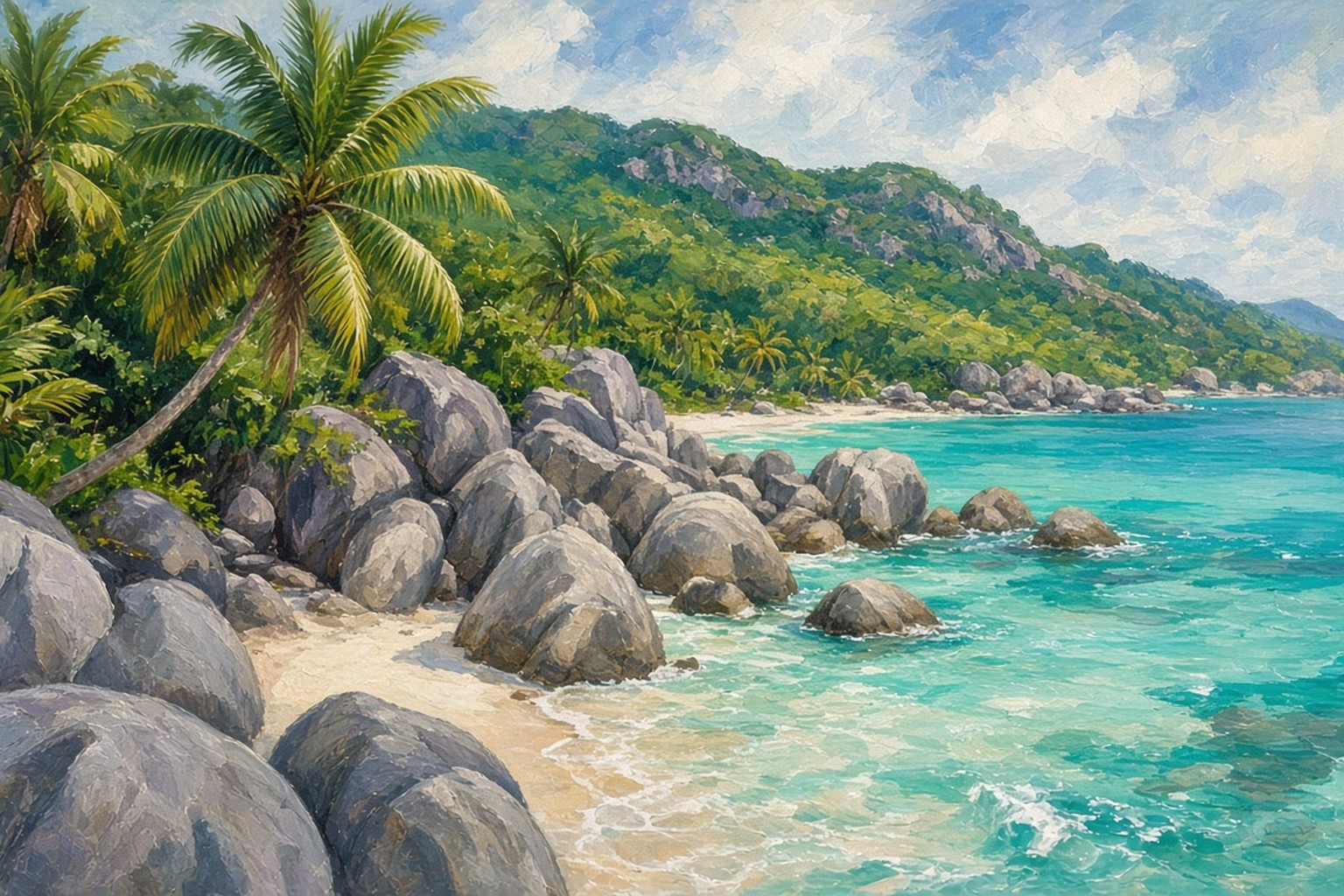
Seychelles is an island nation scattered across the western Indian Ocean, famed for granite boulders, white-sand beaches, and turquoise water. Its 115 islands lie about 1,500 kilometers off the east coast of Africa, and most of its roughly 100,000 people live on the main island of Mahé. The country is often described as a tropical paradise and is a global leader in conservation.
Geography and Climate
Seychelles has a land area of only about 455 square kilometers, which makes it the smallest African country by land area. The islands split into two groups, the granitic inner islands such as Mahé, Praslin, and La Digue, and the flat coral outer islands. The capital, Victoria, on Mahé, is one of the smallest capital cities in the world.
The granitic islands are among the few mid-ocean islands made of ancient rock, and their smooth, sculpted boulders are famous on beaches such as Anse Source d’Argent. The outer islands include Aldabra, one of the largest raised coral atolls on Earth. Mahé’s highest point, Morne Seychellois, rises to about 905 meters.
The climate is tropical and warm all year, with temperatures usually between 24 and 32 degrees Celsius. Seasonal trade winds bring heavier rain between November and March, and the islands lie outside the main cyclone belt. Calmer, drier weather from roughly May to October is a favorite time for diving and sailing.
History and Independence
The islands had no permanent inhabitants until the French claimed them in 1756, after earlier explorers had visited in the 1740s, and the first settlers arrived in 1770. They were named after Jean Moreau de Séchelles, a finance minister of King Louis XV. Enslaved Africans brought to work on plantations became the ancestors of much of today’s population.
Britain took control of the islands in 1810, during the Napoleonic Wars, and they were governed as part of Mauritius until 1903, when Seychelles became a separate crown colony. Political parties formed in the 1960s, and self-government came in 1975. Seychelles became an independent republic within the Commonwealth on 29 June 1976.
A one-party system ruled from 1977 until multiparty democracy returned in 1993. Since independence the country has also provided free education and health care to its citizens. Since 1993 it has held regular elections, and in 2020 voters chose an opposition candidate for president for the first time.
Economy and Natural Resources
Tourism is the largest part of the economy, with visitors drawn to the beaches, marine parks, and luxury resorts. Fishing is the second pillar, and the tuna canning plant in Victoria is a major employer and exporter. The Seychellois rupee is the national currency.
Seychelles has few land resources, so it imports most of its food and fuel. The government promotes what it calls the blue economy, which focuses on sustainable use of the ocean. It has also pioneered debt-for-nature swaps to fund marine protection.
Offshore financial services and small-scale agriculture, including cinnamon, tea, and vanilla, add variety. Planning rules keep resorts small and low-rise so that the islands’ natural beauty is protected. The country has one of the highest incomes per person in Africa.
Culture and Language
Seychellois Creole, called Kreol Seselwa, is the most widely spoken language, and English and French are also official languages. The culture blends African, French, British, Indian, and Chinese influences. Most people are Christian, and Roman Catholicism is the largest denomination, and small Hindu, Muslim, and other communities add to the mix. Creole is used in schools alongside English and French.
Music and dance reflect this mix, with the sega and moutya, a rhythmic dance that came from enslaved communities, standing out as traditions. The moutya’s slow drumbeat and call-and-response singing are often performed at gatherings, sometimes beside a beach bonfire. The annual Festival Kreol celebrates the islands’ creole identity with concerts, food, and art.
The colonial-era wooden houses with steep roofs and verandas are a hallmark of local architecture. Artists often draw on the sea, the forests, and the island’s birds as themes.
Food and Cuisine
Creole cooking relies on fresh fish, coconut milk, rice, and aromatic spices. Fresh tuna, red snapper, and the local favorite called bourgeois fish are common. Dishes include grilled fish with rice and fiery chili sauce, octopus curry, and the shark chutney that is a local favorite. Breadfruit, mango, and banana feature in many meals.
Locals enjoy ladob, a sweet dish of plantain or sweet potato simmered in coconut milk, as a dessert. Many restaurants also reflect Indian and Chinese influences, with curries and noodle dishes on the menu. Calou, a traditional palm sap drink, and the local Seybrew beer are popular refreshments.
Tourism and Attractions
The Vallée de Mai on Praslin, home to the rare coco de mer palm with the world’s heaviest seed, and Aldabra Atoll are UNESCO World Heritage Sites, and Aldabra shelters the world’s largest population of giant tortoises. Beaches such as Anse Lazio on Praslin and Anse Source d’Argent on La Digue regularly appear among the most beautiful in the world.
Visitors can also explore the Sainte Anne Marine National Park, hike through the misty forests of Morne Seychellois National Park, and watch giant Aldabra tortoises. Victoria’s Sir Selwyn Selwyn-Clarke Market is a lively place to find spices and fresh fish. In the center of town, a small clock tower modeled on London’s Little Ben marks the capital.
Diving, snorkeling, sailing, and bird watching are popular pastimes across the islands. Cousin Island, a nature reserve, is known for seabirds and for helping save the rare Seychelles warbler, while Bird Island is famous for its huge seabird colonies.
Challenges and Opportunities
As a small island state, Seychelles is very exposed to rising seas, coral bleaching, and coastal erosion. Its dependence on tourism and imports makes the economy vulnerable to global shocks. Protecting fragile ecosystems while welcoming visitors requires careful balance.
The country has already set aside about a third of its ocean waters for protection and continues to develop renewable energy. Its leadership in marine conservation and sustainable tourism offers a model for other small nations. The country has also been a strong voice for small island states in international climate discussions.
An Ocean Jewel of Granite and Palm
Seychelles is a sanctuary of rare wildlife, creole warmth, and breathtaking scenery in the middle of the Indian Ocean. Its dedication to protecting nature promises that its beauty will endure.