
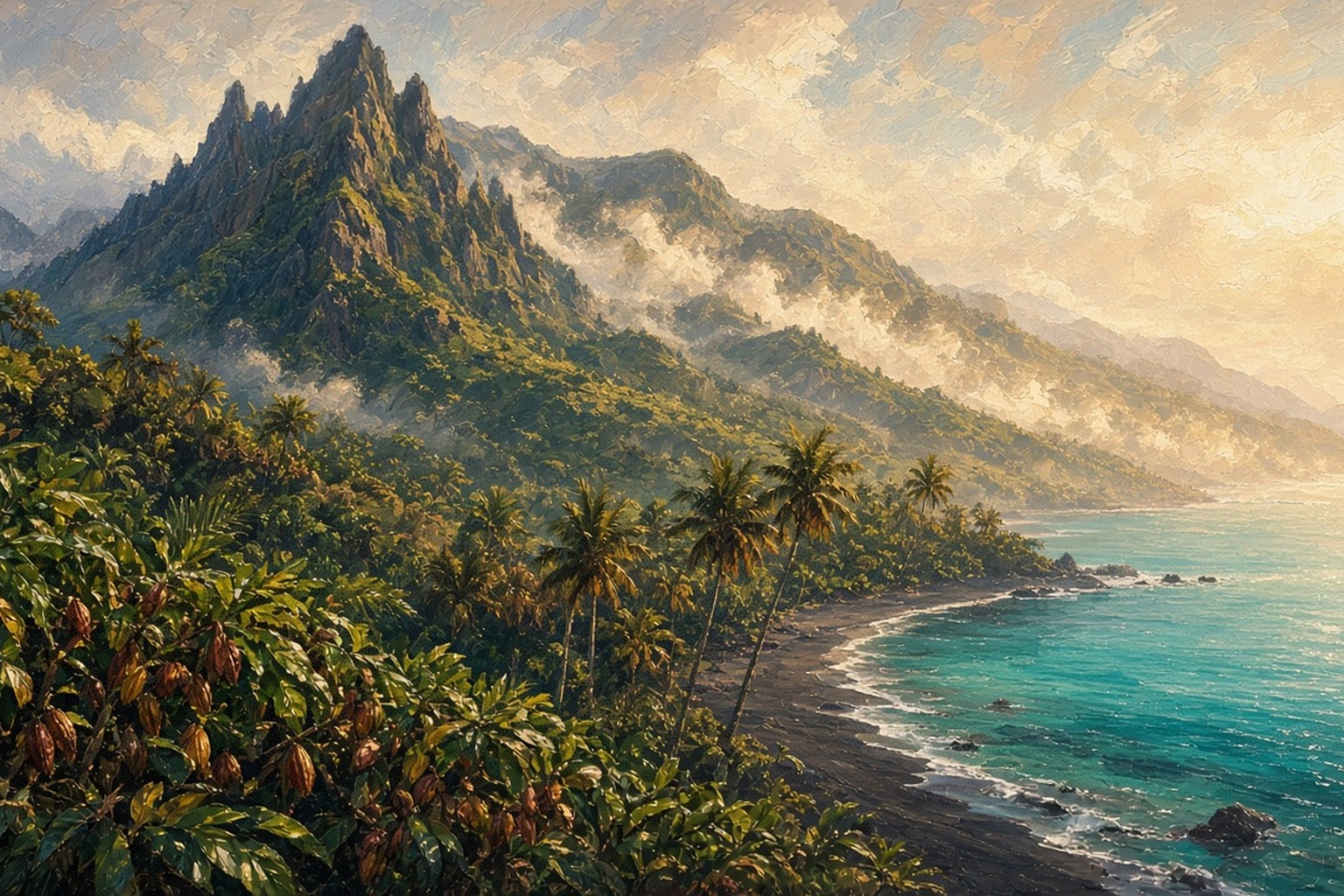
São Tomé and Príncipe is a small island nation in the Gulf of Guinea, off the western coast of Central Africa. Lush rainforests, volcanic peaks, and black-sand beaches have earned it the nickname the “Chocolate Islands,” after the cocoa that has shaped its history. It is the second smallest country in Africa by area and the smallest Portuguese-speaking nation in the world.
Geography and Climate
The country is made up of two main islands, São Tomé and Príncipe, along with several smaller islets, and covers about 964 square kilometers in total. The islands lie only a short distance north of the equator, and the line itself crosses the tiny islet of Ilhéu das Rolas. The capital and largest city is São Tomé, a port town on the northeastern coast of the main island.
Both islands are the remains of ancient volcanoes that rise from the seafloor, part of a chain that runs toward the African mainland. The highest point is Pico de São Tomé, at about 2,024 meters, and the dramatic spire of Pico Cão Grande rises sharply above the southern forests. Rivers, waterfalls, and misty valleys cut through a green interior that is rich in plant life.
The climate is tropical, warm, and humid throughout the year. A rainy season brings heavy showers from about September to May, while a drier season known as the gravana runs from June to August. The mountains receive much more rain than the northern coast, which is noticeably drier.
History and Independence
The islands were uninhabited when Portuguese navigators arrived around 1470, and they became one of the first tropical colonies settled by Europeans. Sugar plantations were established early, worked by enslaved people brought from the African mainland. São Tomé later became an important stopping point in the Atlantic slave trade.
In the nineteenth century, cocoa and coffee were introduced, and large estates called roças covered much of the islands. By the early twentieth century, São Tomé and Príncipe was one of the world’s leading cocoa producers. Labor conditions on the plantations drew international criticism and led to boycotts of the cocoa grown there.
The people of the islands campaigned for self-rule in the twentieth century, and independence from Portugal came on 12 July 1975. The country has been a multiparty democracy since the early 1990s, and it has seen peaceful changes of government at the ballot box. It joined the United Nations in 1975 and also belongs to the African Union.
Economy and Natural Resources
Cocoa is still the main export, and the islands produce high-quality beans that are sought after by makers of fine chocolate. Coffee, palm oil, copra, and pepper are also grown, and fishing provides food and income for many coastal communities. The national currency is the dobra.
Tourism is a growing source of income, drawing visitors who are interested in nature, history, and quiet beaches. Most manufactured goods and fuel must be imported, which makes the economy vulnerable to changes in world prices. Foreign aid and remittances from citizens abroad also play a role.
The islands’ natural wealth lies in their fertile volcanic soil, rich marine waters, and extraordinary biodiversity. Oil may lie beneath the sea, and the country shares a joint development zone with Nigeria, although large-scale production has not yet begun. Hydropower and solar energy offer paths to cleaner electricity.
Culture and Traditions
Portuguese is the official language and is spoken by nearly everyone. Several Creole languages are also used, including Forro on São Tomé, Angolar in the south, and Lung’Ie on Príncipe. The population descends from African, Portuguese, and Cape Verdean roots, and Roman Catholicism is the most widely practiced faith.
Music and dance are central to island life, with lively rhythms such as socopé and ússua heard at parties and festivals. The Tchiloli is a dramatic street performance based on a Portuguese medieval tale, and it is acted out in elaborate costumes with strong local flavor. The Danço Congo and other folk dances preserve memories of the islands’ many cultural influences.
Family and community ties are strong, and village life often revolves around fishing, farming, and shared meals. The old plantation houses and hospitals of the roças still stand as reminders of the colonial era. Many of them are now being restored as museums, inns, or small cooperatives.
Food and Cuisine
Island cooking relies on fresh fish, tropical vegetables, and plenty of spices and herbs. Calulu is a favorite stew made with smoked fish or meat, okra, and leafy greens, and it is often served with rice or funge. Breadfruit, bananas, cassava, and grilled fish appear in many everyday meals.
Chocolate is a point of pride, and local producers make dark bars, cocoa nibs, and drinks from beans grown on the islands. Coffee is also grown, and visitors can taste fresh palm wine in village markets. Tropical fruits such as papaya, mango, and passion fruit are widely sold.
Tourism and Attractions
Ilhéu das Rolas, with its equator monument, is a popular day trip, and Praia Banana is a postcard-perfect beach framed by palm trees. Obô Natural Park protects a large area of rainforest that is home to rare birds and plants. Roça Água-Izé and Roça Monte Café give visitors a look at the history of cocoa and coffee estates.
Príncipe was named a UNESCO Biosphere Reserve in 2012, and it offers quiet beaches, dense forests, and excellent bird watching. Sea turtles nest on many beaches between October and April, and whale watching and diving attract more adventurous visitors. The capital has a colonial-era cathedral, a fort, and a lively market.
Challenges and Opportunities
São Tomé and Príncipe faces high levels of poverty, limited infrastructure, and dependence on imports and foreign assistance. Reliable electricity, health care, and transport remain challenges, and public debt is a concern. Rising seas and stronger storms also threaten low-lying coastal areas.
The country is working to attract investment in sustainable tourism, organic agriculture, and renewable energy. High-quality cocoa and coffee have strong potential in specialty markets, and careful conservation can protect its remarkable wildlife. Improved education and better links with the rest of the world will help young people build their future at home.
Where Cocoa Meets the Equator
São Tomé and Príncipe is a quiet, green corner of the Atlantic, where mist-covered peaks, warm seas, and the scent of cocoa leave a lasting impression. Its welcoming people and unspoiled landscapes make it one of Africa’s most intriguing hidden treasures.