
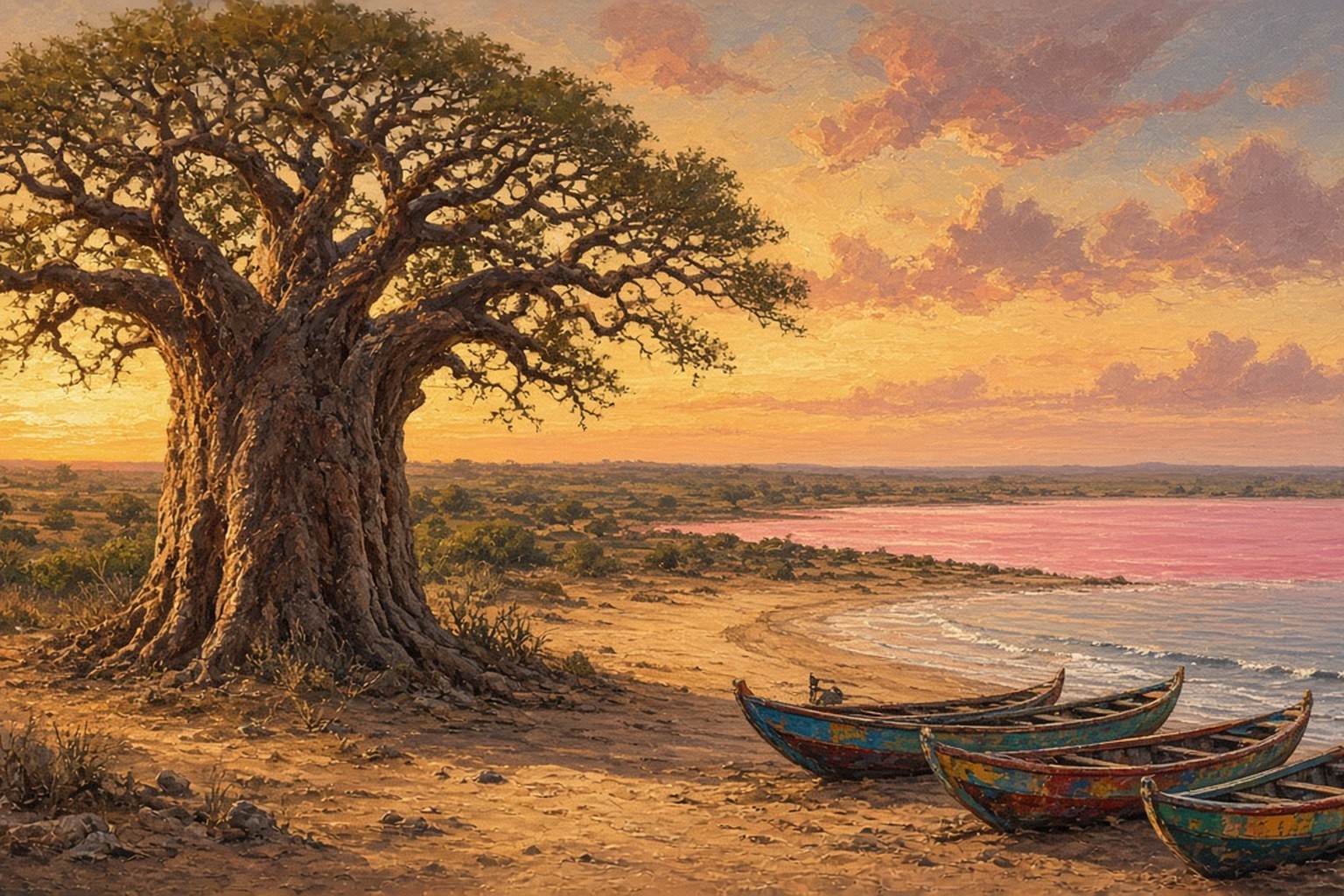
Senegal is a coastal nation on the westernmost edge of Africa, often called the “Land of Teranga,” a Wolof word for hospitality. Its capital, Dakar, sits on the Cap-Vert peninsula, which holds the westernmost point of the African mainland. Known for its music, its stable democratic tradition, and its warm welcome, Senegal is one of West Africa’s most admired countries.
Geography and Climate
Senegal covers about 197,000 square kilometers and is bordered by Mauritania, Mali, Guinea, and Guinea-Bissau, with the Atlantic Ocean along its western coast. The country surrounds The Gambia, which stretches inland along the Gambia River like a narrow strip. Most of the land is low and flat, and the highest point, near the Guinea border in the southeast, reaches only about 650 meters.
The Senegal River forms the northern border with Mauritania, while the Saloum and Casamance regions are known for their winding waterways and mangroves. The north belongs to the dry Sahel, and the south is greener, with forests and farmland. Lac Rose, also called Lake Retba, is famous for its pink waters, which are caused by tiny algae and a high salt content.
The climate is tropical, with a hot rainy season from roughly June to October and a drier, cooler season for the rest of the year. Rainfall is heavier in the south and much lighter in the north.
History and Independence
Long before European contact, the region was part of great West African kingdoms such as the Tekrur, the Jolof Empire, and the Mali Empire. The Wolof, Serer, Toucouleur, and other peoples built states along the river and the coast. Islam spread through the area from the eleventh century onward.
Portuguese traders arrived in the fifteenth century, and later the French and others competed for control of the coast. The island of Gorée, near Dakar, became a trading post and is remembered today as a place for reflection on the Atlantic slave trade. Senegal gradually came under French rule, with Saint-Louis serving as an early colonial capital and Dakar later becoming the capital of French West Africa.
Senegal gained independence from France in 1960, first as part of the short-lived Mali Federation with French Sudan, which became independent in June and dissolved that August, leaving Senegal a separate republic. Its first president, the poet Léopold Sédar Senghor, led the country for twenty years and then stepped down voluntarily. Senegal has since been regarded as one of Africa’s most stable democracies.
Economy and Natural Resources
Agriculture employs a large share of the population, with peanuts, millet, rice, and cotton among the main crops. Fishing is also vital, since the Atlantic waters provide food, jobs, and exports. Many families in coastal towns depend on the daily catch brought in by colorful wooden boats.
Phosphates, gold, and zircon are important mineral resources, and the country has begun producing offshore oil and gas in recent years. Tourism, services, and remittances from Senegalese living abroad also support the economy. The currency is the West African CFA franc.
Dakar is a major commercial and port city, and a new international airport at Diass has improved connections to the rest of the world. A modern regional express train now links Dakar with Diamniadio and the Diass airport area, easing travel around the capital. Telecommunications and a growing technology scene are adding new sources of growth.
Culture and Language
French is the official language, while Wolof is the most widely spoken language and serves as a common tongue across the country. Other national languages include Pulaar, Serer, Mandinka, and Diola. Most Senegalese are Muslim, and Sufi brotherhoods such as the Mourides and the Tijaniyya play a major role in daily life.
Music is at the heart of Senegalese culture, from the drumming of the sabar to the storytelling of the griots, who preserve history through song. The singer Youssou N’Dour made mbalax music famous around the world. Dakar is also known for its art scene, including the Dak’Art biennale of contemporary African art.
The idea of teranga shapes social life, and visitors are greeted warmly and often invited to share a meal. Traditional dress such as the flowing boubou and colorful wax-print fabrics is worn with pride on holidays and festive days. Wrestling, known as laamb, is the country’s most popular sport, and football is followed with equal passion.
Food and Cuisine
Thieboudienne, a dish of fish and rice cooked in a rich tomato sauce with vegetables, is the national dish and is often shared from a single large bowl. Yassa, made with chicken or fish marinated in lemon and onions, and mafé, a peanut stew, are also much loved across the country. Street snacks such as fataya pastries are sold in markets and on corners in every city.
Meals are often finished with sweet mint tea, served in three rounds that are said to grow gentler in flavor. Refreshing drinks include bissap, made from hibiscus flowers, and bouye, made from baobab fruit.
Tourism and Attractions
Gorée Island and the Island of Saint-Louis are both UNESCO World Heritage Sites, and Saint-Louis is admired for its colonial architecture and its music festivals. The Djoudj National Bird Sanctuary hosts millions of migratory birds, and the Saloum Delta offers quiet boat trips among mangroves and shell islands.
Dakar offers lively markets, the striking African Renaissance Monument, and beaches popular with surfers. In the southeast, Niokolo-Koba National Park, also a UNESCO site, protects elephants, lions, and chimpanzees. In central Senegal, the Stone Circles of Senegambia, a World Heritage Site shared with The Gambia, include Sine Ngayène and Wanar, where rings of standing laterite stones were raised over many centuries.
Challenges and Opportunities
Senegal faces challenges such as youth unemployment, coastal erosion, and the effects of drought and overfishing. Many young people seek opportunities abroad, which makes creating local jobs a national priority. Climate change also threatens farming communities and coastal towns.
At the same time, new energy projects, investment in infrastructure, and a young, creative population offer real promise. Tourism, creative industries, and modern farming also offer room to grow. The country’s peaceful political tradition and its role as a regional hub give it a strong foundation for the future.
Where the Drums Meet the Atlantic
Senegal is a land of rhythm, resilience, and generous hospitality, where traditions of the Sahel meet the open ocean. Its welcoming spirit leaves a lasting impression on everyone who visits.