
Niger is a vast landlocked country in West Africa, named after the great Niger River that flows through its southwestern corner. Much of the land lies within the Sahara Desert, where golden dunes, rugged mountains, and ancient caravan towns create breathtaking scenery. With its proud nomadic traditions, colorful festivals, and welcoming communities, Niger is a land of deep history and striking natural beauty.
Geography and Climate
Niger covers about 1.27 million square kilometers, making it the largest country in West Africa. It is bordered by Algeria and Libya to the north, Chad to the east, Nigeria and Benin to the south, and Burkina Faso and Mali to the west.
About two-thirds of the country is desert, including the vast sand seas of the Ténéré and the volcanic Aïr Mountains, whose highest peak, Mont Idoukal-n-Taghès, rises to just over 2,000 meters. The south belongs to the Sahel, a belt of savanna and farmland, while the Niger River provides water, fish, and fertile land in the southwest around the capital, Niamey. In the far southeast, Niger shares a shoreline of Lake Chad.
The climate is hot and dry for most of the year, with a short rainy season in the south between about June and September. Temperatures can be extreme in the desert, and dusty harmattan winds blow from the Sahara during the dry season. Despite the harsh conditions, Niger is home to wildlife such as addax antelope, gazelles, and the last wild herds of West African giraffes.
History and Independence
Rock engravings in the Aïr Mountains, including the famous life-sized giraffe carvings of Dabous, show that the Sahara was once green and full of animals. Over the centuries, the region became a crossroads of trans-Saharan trade, with caravans carrying salt, gold, and goods between North Africa and the lands to the south.
Powerful states influenced the territory, including the Songhai Empire in the west, the Kanem-Bornu Empire near Lake Chad, and the Hausa city-states in the south. The Tuareg Sultanate of Aïr, based in Agadez, controlled important desert trade routes from the fifteenth century.
France colonized the region in the late nineteenth and early twentieth centuries, and it became part of French West Africa. Niger gained independence on 3 August 1960, a date celebrated every year as a national holiday, and Niamey became the capital of the new nation.
Economy and Natural Resources
Most people in Niger work in agriculture and livestock herding. Farmers grow millet, sorghum, cowpeas, peanuts, and rice, while onions from the Tahoua region, known as the violet de Galmi, are exported across West Africa.
Herding of cattle, camels, goats, and sheep has supported nomadic communities for generations, and livestock is one of the country’s main exports. Markets in towns such as Agadez, Zinder, and Maradi are lively centers of trade.
Niger has significant mineral resources and has long been one of the world’s notable producers of uranium, mined near Arlit in the north. Oil production has also grown, and gold, coal, and other minerals offer further potential. Solar energy holds great promise in this sun-drenched land.
Culture and Traditions
Niger is home to many ethnic groups, including the Hausa, Zarma-Songhai, Tuareg, Fulani, Kanuri, Toubou, and Arab communities. Hausa is the most widely spoken language, alongside Zarma, Tamasheq, Fulfulde, Kanuri, and French, which has long been used in government and education.
Islam is practiced by the vast majority of the population, and religious holidays bring families together for prayers and feasts. Traditional music features instruments such as the imzad, a one-stringed fiddle played by Tuareg women, and drums at weddings and celebrations.
The Cure Salée festival near In-Gall gathers Tuareg and Fulani herders at the end of the rainy season, and the Wodaabe Fulani are famous for the Gerewol, where young men dance in elaborate makeup and jewelry. Tuareg silversmiths are renowned for their finely crafted jewelry, including the Agadez cross.
Food and Cuisine
Nigerien cuisine is simple and hearty, based on grains, vegetables, and meat. Millet and sorghum are made into a thick porridge called tuwo, served with sauces of okra, baobab leaves, peanuts, or tomatoes, and rice and beans are also common.
Kilishi, thin strips of dried and spiced meat, is a famous snack, and grilled brochettes are popular street food. Fura, a drink of millet balls mixed with soured milk, is refreshing in the heat, and strong sweet tea is served in three rounds as a sign of hospitality.
Dambou, a steamed dish of millet or rice couscous mixed with moringa leaves and peanuts, is a favorite in many homes. During festivals, families share roasted mutton, and dates, milk, and fresh bread are cherished at the end of each day of fasting during Ramadan.
Tourism and Attractions
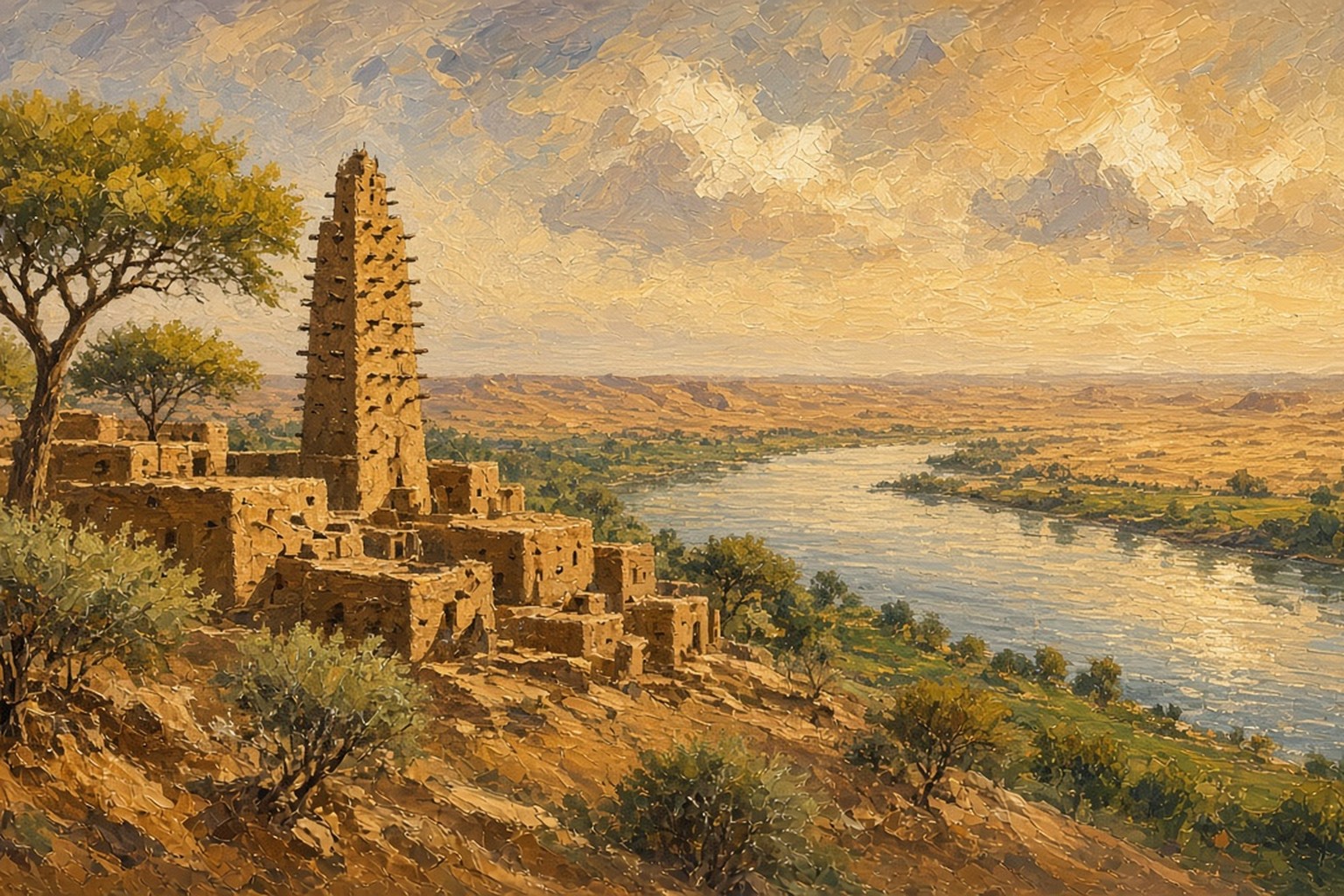
The historic center of Agadez, a UNESCO World Heritage Site, is famous for its Grand Mosque with a tall mud-brick minaret and narrow streets of earthen houses. The Aïr and Ténéré Natural Reserves, also listed by UNESCO, protect dramatic mountains, dunes, and desert wildlife.
W National Park, shared with Benin and Burkina Faso, is home to elephants, buffalo, and many bird species along the Niger River. Near Kouré, outside Niamey, visitors can sometimes see West African giraffes roaming freely, while the Grand Market and National Museum of Niamey offer a vivid look at daily life and heritage.
Challenges and Opportunities
Niger faces serious challenges, including droughts, desertification, food insecurity, rapid population growth, and security concerns in border regions. Improving education, health care, and access to water remains a key priority.
At the same time, its young population, mineral wealth, solar potential, and rich cultural heritage offer real opportunities. Projects to restore farmland, plant trees, and support small farmers are helping communities build resilience across the Sahel.
Where the Ténéré Meets the River
Niger is a land of shifting dunes, ancient rock art, and enduring nomadic traditions. From the earthen streets of Agadez to the silent sands of the Ténéré and the banks of the Niger River, it reveals a quiet grandeur shaped by history and resilience. Proud, hospitable, and timeless, Niger is a true gem of the Sahel.