
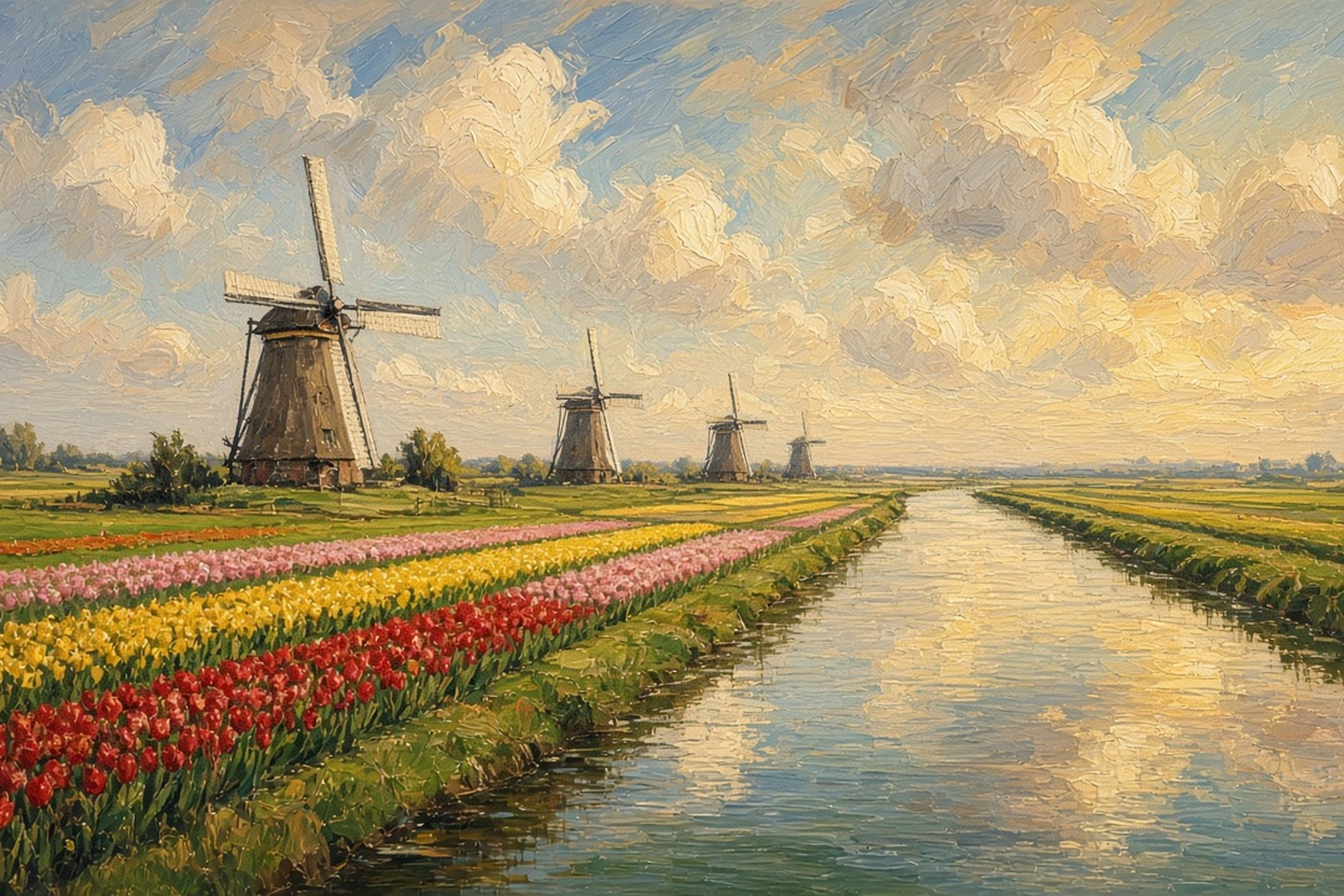
The Netherlands is a small, prosperous country in northwestern Europe, famous for its windmills, tulip fields, canals, and bicycles. Much of its land has been reclaimed from the sea, giving rise to the saying that “God created the world, but the Dutch created the Netherlands.” With its rich artistic heritage, open-minded culture, and charming historic cities, the Netherlands is one of Europe’s most delightful destinations.
Geography and Climate
The European part of the Netherlands covers about 41,500 square kilometers and is bordered by Germany to the east, Belgium to the south, and the North Sea to the north and west. The great rivers Rhine, Meuse, and Scheldt flow through the country and form a wide delta before reaching the sea.
The land is remarkably flat, and about a quarter of it lies below sea level, protected by dunes, dikes, and pumping stations. Over centuries, the Dutch drained lakes and marshes to create fertile polders, and the great Afsluitdijk turned a sea inlet into the freshwater IJsselmeer. The highest point in the European Netherlands, the Vaalserberg, rises only about 322 meters.
The climate is temperate and maritime, with mild summers, cool winters, and rain spread throughout the year. Winds from the North Sea are frequent, which once powered thousands of windmills and now drive modern wind turbines. In cold winters, canals and lakes sometimes freeze, allowing people to skate outdoors.
History and Independence
In Roman times, the region formed part of the empire’s northern frontier, and in the Middle Ages, it was divided into counties and duchies that later came under Burgundian and Habsburg rule. In 1568, a revolt led by William of Orange began against Spanish rule, starting the Eighty Years’ War.
The independence of the Dutch Republic was formally recognized in 1648 by the Peace of Münster. During the seventeenth century, known as the Dutch Golden Age, the country became a leading power in trade, science, and art, and the Dutch East India Company, founded in 1602, built a vast trading network.
After a period of French rule, the Kingdom of the Netherlands was established in 1815. The country was occupied during the Second World War, and after liberation, it became a founding member of NATO and of the European communities that grew into the European Union. King Willem-Alexander has reigned since 2013.
Economy and Natural Resources
The Netherlands has one of the most developed and open economies in the world. The Port of Rotterdam is the largest port in Europe, and Amsterdam Airport Schiphol is one of the continent’s busiest air hubs, making the country a major gateway for trade.
Despite its small size, the Netherlands is one of the world’s largest exporters of agricultural products, thanks to highly efficient farming and greenhouses. It is world-famous for flowers and bulbs, especially tulips, as well as for cheese, vegetables, and dairy products.
The country is also a leader in technology, engineering, and water management, and it is home to major international companies. Large natural gas fields in Groningen once supplied much of Europe, but production there has ended, and the focus has shifted to offshore wind and other renewable energy.
Culture and Language
Dutch is the official language, and West Frisian is also an official language in the province of Friesland. Most Dutch people speak English very well, and many also speak German or French.
The Netherlands has given the world some of its greatest painters, including Rembrandt, Johannes Vermeer, Vincent van Gogh, and Piet Mondrian. Delft blue pottery, wooden clogs, and traditional costumes from fishing villages are well-known symbols of Dutch heritage.
Cycling is a way of life, and there are more bicycles than people in the country. King’s Day on 27 April turns the streets orange with markets, music, and celebrations, while Sinterklaas, celebrated on 5 December, is a much-loved family tradition.
Food and Cuisine
Dutch cuisine is hearty and simple, with an emphasis on bread, dairy, potatoes, and vegetables. Stamppot, mashed potatoes mixed with vegetables such as kale or sauerkraut and served with smoked sausage, is a classic winter dish.
The country is famous for its cheeses, especially Gouda and Edam, and for stroopwafels, thin waffles filled with caramel syrup. Raw herring with onions, bitterballen, poffertjes, and oliebollen, sweet fried dough balls eaten at New Year, are other favorites.
Dutch apple pie is a beloved treat in cafés, often enjoyed with whipped cream and coffee. Thanks to historic ties with Indonesia, the rijsttafel, a feast of many small dishes served with rice, is also popular.
Tourism and Attractions
Amsterdam enchants visitors with its seventeenth-century canal ring, a UNESCO World Heritage Site, as well as the Rijksmuseum, the Van Gogh Museum, and the Anne Frank House. The Hague is home to the Mauritshuis, the Peace Palace, and the seat of the Dutch government, while Rotterdam is known for its bold modern architecture.
In spring, the Keukenhof gardens and the surrounding bulb fields burst into color with millions of tulips, hyacinths, and daffodils. The windmills of Kinderdijk, also a UNESCO site, and the open-air museum at Zaanse Schans showcase traditional Dutch life.
Charming towns such as Delft, Utrecht, Maastricht, and the car-free village of Giethoorn are also popular. In the north, the Wadden Sea, a UNESCO World Heritage Site, offers islands, mudflat hiking, and seals.
Challenges and Opportunities
The Netherlands faces challenges such as rising sea levels, a shortage of affordable housing, and the need to reduce nitrogen emissions from agriculture. Balancing a densely populated country with nature protection remains an important task.
At the same time, its world-leading expertise in water management, its innovative economy, and its large investments in offshore wind energy offer great opportunities. These strengths could help the Netherlands remain a model of sustainable living.
A Country Reclaimed from the Sea
The Netherlands is a land of windmills, waterways, and wide skies, shaped by centuries of ingenuity and cooperation with the sea. From the canals of Amsterdam and the tulip fields of Keukenhof to the windmills of Kinderdijk and the islands of the Wadden Sea, it offers beauty and inspiration at every turn. Creative, welcoming, and full of charm, the Netherlands is a true gem of Europe.