
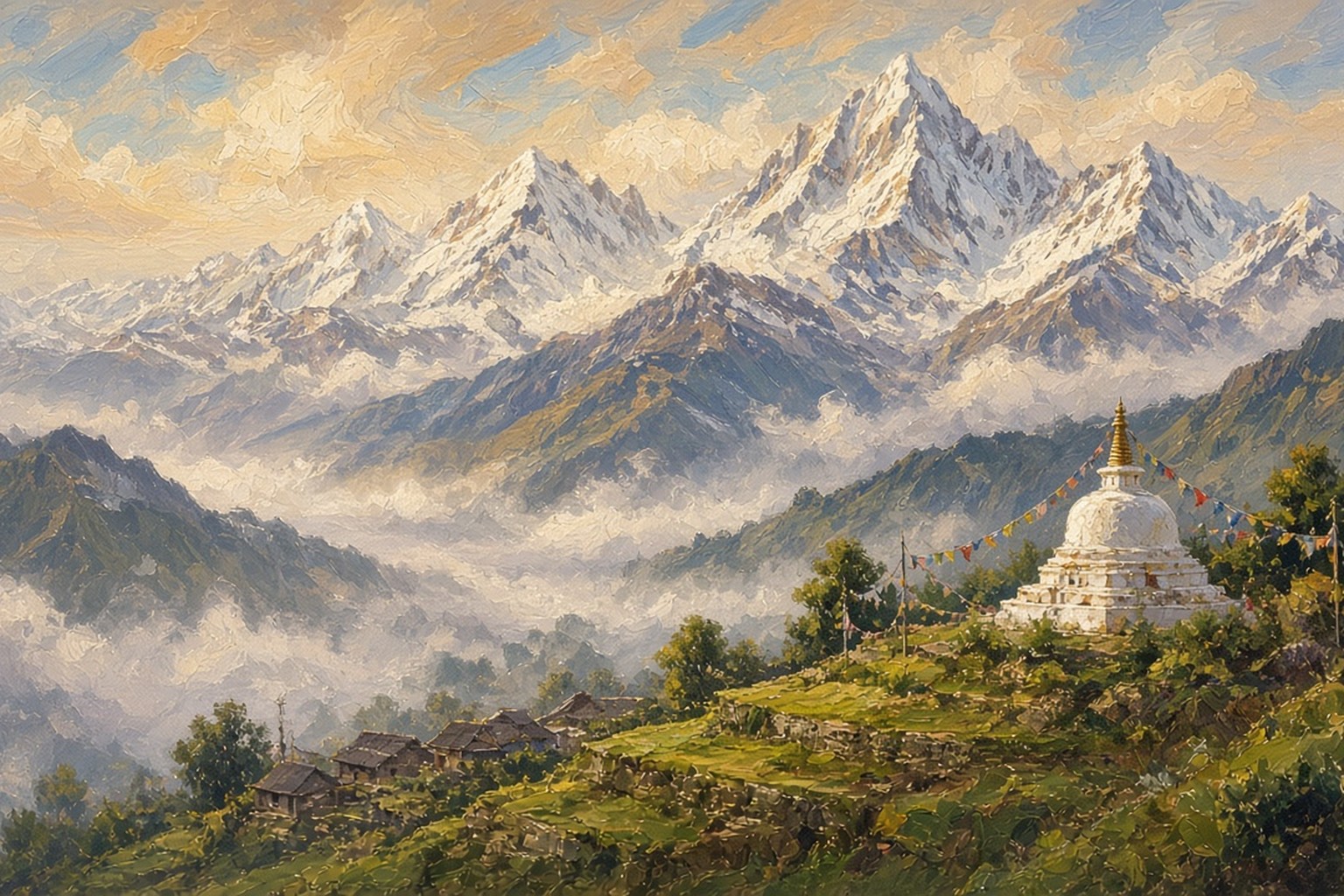
Nepal is a landlocked country in South Asia, nestled between China and India along the heart of the Himalayas. Home to Mount Everest, the highest mountain on Earth, it is a land of soaring peaks, green hills, ancient temples, and sacred sites. With its rich spiritual heritage, colorful festivals, and famously warm hospitality, Nepal is one of the world’s most inspiring destinations.
Geography and Climate
Nepal covers about 147,500 square kilometers and is bordered by China to the north and India to the east, south, and west. Although it is relatively small, its elevation ranges from lowland plains to the highest point on the planet.
The country is often described in three regions: the high Himalayas in the north, the hills and valleys in the middle, and the flat, fertile Terai plains in the south. Eight of the world’s ten highest mountains, including Mount Everest, Kangchenjunga, Lhotse, and Annapurna, are found wholly or partly in Nepal. Fast-flowing rivers such as the Koshi, Gandaki, and Karnali carve deep gorges as they flow south toward the Ganges.
Because of these dramatic changes in altitude, Nepal’s climate ranges from subtropical in the Terai to alpine and arctic in the high mountains. The summer monsoon from about June to September brings most of the year’s rain, while autumn and spring offer clear skies and pleasant weather. Forests, rhododendrons, and wildlife thrive across these varied zones.
History and Independence
Nepal has a long and rich history. Lumbini, in the south, is revered as the birthplace of Siddhartha Gautama, who became the Buddha, and the Kathmandu Valley was ruled by the Licchavi and later the Malla dynasties, who built magnificent palaces and temples.
In 1768, Prithvi Narayan Shah of Gorkha unified many small kingdoms into a single nation with Kathmandu as its capital. Nepal was never colonized, although a war with the British East India Company ended with the Treaty of Sugauli in 1816, which set many of its modern borders.
From 1846 to 1951, the powerful Rana family ruled as hereditary prime ministers. After decades of political change and a civil conflict that ended in 2006, the monarchy was abolished in 2008, and Nepal became a federal democratic republic. A new constitution was adopted in 2015.
Economy and Natural Resources
Agriculture employs a large share of the population, producing rice, maize, wheat, millet, tea, and cardamom. Terraced fields carved into hillsides are a common and beautiful sight across the country.
Tourism is a major source of income, with trekkers and mountaineers drawn to the Himalayas from around the world. Remittances sent home by Nepalis working abroad are also very important for many families.
Nepal’s many rivers give it enormous potential for hydropower, and new plants now produce enough electricity for some to be exported to India. Handwoven carpets, pashmina shawls, and handicrafts are well-known exports.
Culture and Traditions
Nepali is the official language and is written in the Devanagari script, while more than one hundred other languages are spoken, including Maithili, Bhojpuri, Tamang, and Newari. Hinduism is the main religion, and Buddhism is also widely practiced, with temples and stupas often standing side by side.
Festivals fill the calendar, especially Dashain, the most important Hindu festival, and Tihar, the festival of lights, when homes are decorated with candles and flowers. In Kathmandu, the Kumari, a young girl revered as a living goddess, appears at festivals such as Indra Jatra.
The Newar people of the Kathmandu Valley are famous for their wood carving, metalwork, and pagoda-style architecture, while Buddhist artists paint detailed thangka scrolls. The Sherpa people of the Everest region are renowned for their mountaineering skills and strong community spirit.
Food and Cuisine
Nepali cuisine is simple, nourishing, and full of flavor. Dal bhat, a meal of lentil soup and rice served with vegetable curry, pickles, and greens, is the national dish and is often eaten twice a day.
Momo, steamed or fried dumplings filled with meat or vegetables and served with spicy tomato chutney, are a beloved snack throughout the country. Other favorites include sel roti, a sweet ring-shaped rice bread made during festivals, and gundruk, fermented leafy greens.
In the mountains, people enjoy hearty dishes such as thukpa, a warming noodle soup, while sweet milk tea is shared throughout the day. Hospitality is central to Nepali life, and guests are treated with great respect.
Tourism and Attractions
The Kathmandu Valley, a UNESCO World Heritage Site, includes the historic Durbar Squares of Kathmandu, Patan, and Bhaktapur, as well as the sacred Pashupatinath Temple and the great stupas of Boudhanath and Swayambhunath. Lumbini, the birthplace of the Buddha, is another important World Heritage Site and place of pilgrimage.
Trekkers come from all over the world to walk to Everest Base Camp in Sagarmatha National Park or around the Annapurna range. The lakeside city of Pokhara, with mountain views reflected in Phewa Lake, is a favorite base for adventure.
In the south, Chitwan National Park protects one-horned rhinoceroses, Bengal tigers, and elephants in lush jungles and grasslands. Rafting, paragliding, and visits to hill villages add to the variety of experiences.
Challenges and Opportunities
Nepal faces challenges such as earthquakes, including the devastating earthquake of 2015, as well as landslides, floods, and difficult mountain terrain that makes building roads costly. Many young people also leave to work abroad in search of better opportunities.
At the same time, its hydropower potential, world-famous mountains, and rich cultural heritage offer great opportunities. Investments in clean energy, infrastructure, education, and sustainable tourism could help Nepal build a more prosperous future.
Protecting Himalayan glaciers, forests, and wildlife is increasingly important as the climate changes. Nepal’s community forestry programs and successful efforts to protect rhinoceroses and tigers show how conservation can bring benefits to local people and nature alike.
Where the Himalayas Touch the Heavens
Nepal is a land of towering peaks, sacred temples, and gentle, welcoming people. From the bustling squares of Kathmandu and the peaceful shores of Phewa Lake to the snowy heights of Everest and the jungles of Chitwan, it offers adventure and inspiration at every turn. Spiritual, majestic, and unforgettable, Nepal is truly a jewel of the Himalayas.