
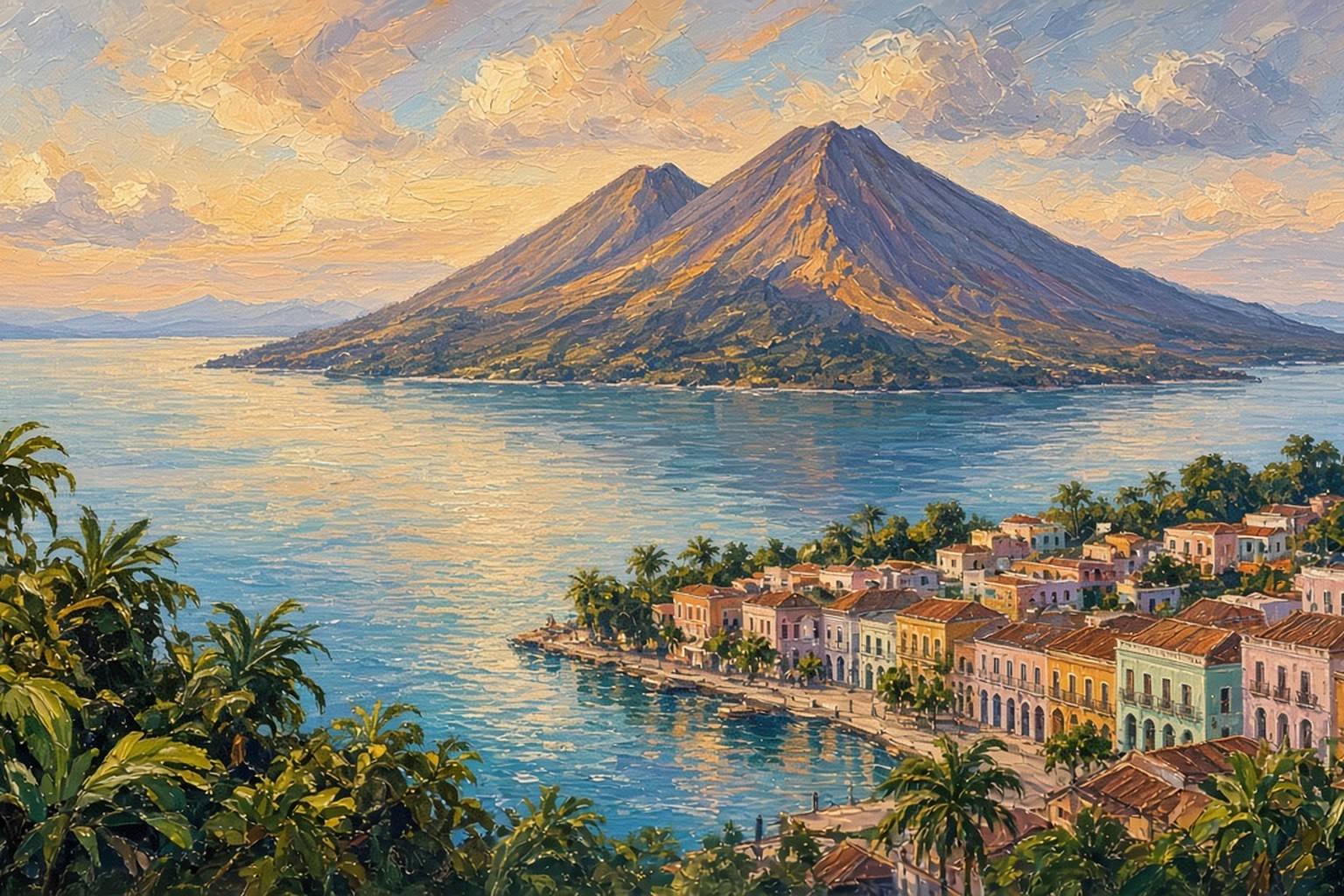
Nicaragua is the largest country in Central America, stretching from the Pacific Ocean to the Caribbean Sea. Often called the “Land of Lakes and Volcanoes,” it is known for its smoking volcanic peaks, vast freshwater lakes, colorful colonial cities, and quiet beaches. With a rich literary heritage, lively festivals, and friendly people, Nicaragua offers travelers an authentic and memorable glimpse of Central America.
Geography and Climate
Nicaragua covers about 130,000 square kilometers and is bordered by Honduras to the north and Costa Rica to the south. Its long coastlines face the Pacific Ocean to the west and the Caribbean Sea to the east, where the Corn Islands lie offshore.
The Pacific lowlands are dotted with a chain of volcanoes, including Masaya, Momotombo, San Cristóbal, and Concepción, several of which remain active. Lake Nicaragua, also called Cocibolca, is the largest lake in Central America and contains hundreds of small islands, as well as Ometepe, an island formed by two volcanoes. The eastern half of the country is covered by rainforests, rivers, and wetlands along the Mosquito Coast.
The climate is tropical, with a dry season from about November to April and a rainy season from May to October. The Pacific side is warm and relatively dry, the central highlands are cooler and greener, and the Caribbean side receives heavy rainfall almost all year. Large nature reserves such as Bosawás protect jaguars, monkeys, toucans, and many other species.
History and Independence
Before the arrival of Europeans, Nicaragua was home to Indigenous peoples such as the Nicarao, who gave the country its name, as well as the Chorotega and groups along the Caribbean coast. Spanish conquistadors arrived in the early sixteenth century and founded the cities of Granada and León in 1524.
The ruins of León Viejo, the original colonial settlement abandoned after earthquakes and volcanic activity, are now a UNESCO World Heritage Site. Nicaragua gained independence from Spain in 1821 as part of Central America and became a separate republic in 1838, while the Caribbean coast long remained under British influence.
The twentieth century brought decades of rule by the Somoza family, followed by the Sandinista revolution in 1979 and a civil conflict during the 1980s. Peace agreements and elections in 1990 opened a new chapter, and in that year Violeta Chamorro became the first woman elected president in the Americas.
Economy and Natural Resources
Agriculture is central to Nicaragua’s economy, and the country exports coffee, beef, sugar, peanuts, bananas, and dairy products. The northern highlands around Matagalpa and Jinotega are known for high-quality coffee grown in the shade of forest trees.
Gold mining has become one of the leading export industries, and manufacturing in free trade zones produces clothing and car wiring for international markets. Remittances from Nicaraguans living abroad support many families.
The country has strong potential for renewable energy, with geothermal plants near its volcanoes as well as wind farms along the shores of Lake Nicaragua. Fishing for shrimp and lobster is important on the Caribbean coast, and tourism has grown steadily around beaches, lakes, and colonial towns.
Culture and Language
Spanish is the official language, while English Creole, Miskito, and other Indigenous languages are spoken along the Caribbean coast. Most Nicaraguans are Roman Catholic, and religious festivals such as La Purísima in December are celebrated with music, fireworks, and sweets shared among neighbors.
Nicaragua is famous for its love of poetry, and Rubén Darío, born in 1867, is celebrated as the father of the modernist movement in Spanish literature. Poetry festivals, especially in Granada, attract writers from around the world.
Traditional music features the marimba, and folk dances are performed at local fiestas. El Güegüense, a satirical drama combining theater, music, and dance from the colonial era, is recognized by UNESCO as part of the intangible cultural heritage of humanity. Baseball is the most popular sport, followed with great passion across the country.
Food and Cuisine
Nicaraguan cuisine is based on corn, beans, rice, plantains, and fresh tropical fruit. Gallo pinto, a dish of rice and red beans fried together, is eaten at almost every meal, often with eggs, fresh cheese, and tortillas.
Nacatamal, a large tamale filled with pork, rice, potatoes, and spices wrapped in banana leaves, is a weekend tradition. Vigorón, made with yuca, pork crackling, and cabbage salad, is a famous street food from Granada, while quesillo combines tortilla, soft cheese, pickled onions, and cream.
Indio viejo, a thick stew of shredded beef, corn dough, and sour orange, has roots in Indigenous cooking. Refreshing drinks made from tropical fruits, cacao, or corn, such as pinolillo, are enjoyed throughout the day, and the country’s aged rum is known internationally.
Tourism and Attractions
Granada, with its colorful colonial houses, grand cathedral, and nearby islets in Lake Nicaragua, is one of the oldest European-founded cities in the Americas. León is known for its lively university atmosphere and the Cathedral of León, a UNESCO World Heritage Site, while nearby Cerro Negro invites visitors to sandboard down a young volcano.
Ometepe Island offers hikes, waterfalls, and lakeside villages, and at Masaya Volcano National Park visitors can sometimes glimpse a glowing lava lake. Surfers enjoy the Pacific beaches around San Juan del Sur, while the Corn Islands offer turquoise water and coral reefs.
Challenges and Opportunities
Nicaragua faces challenges such as poverty, vulnerability to hurricanes and earthquakes, deforestation, and emigration in search of work. Strengthening infrastructure, education, and health services remain important goals.
At the same time, its fertile land, renewable energy resources, and spectacular landscapes offer great potential. Sustainable tourism, specialty coffee, and conservation of its forests and lakes could help build a more prosperous future for its people.
Where Lakes Cradle Volcanoes
Nicaragua is a land of fire and water, where volcanoes rise from shimmering lakes and colonial streets echo with poetry and song. From the cobblestones of Granada to the volcanic slopes of Ometepe and the reefs of the Corn Islands, it rewards curious travelers with natural wonder and heartfelt hospitality. Vibrant and welcoming, Nicaragua is a true treasure of Central America.