
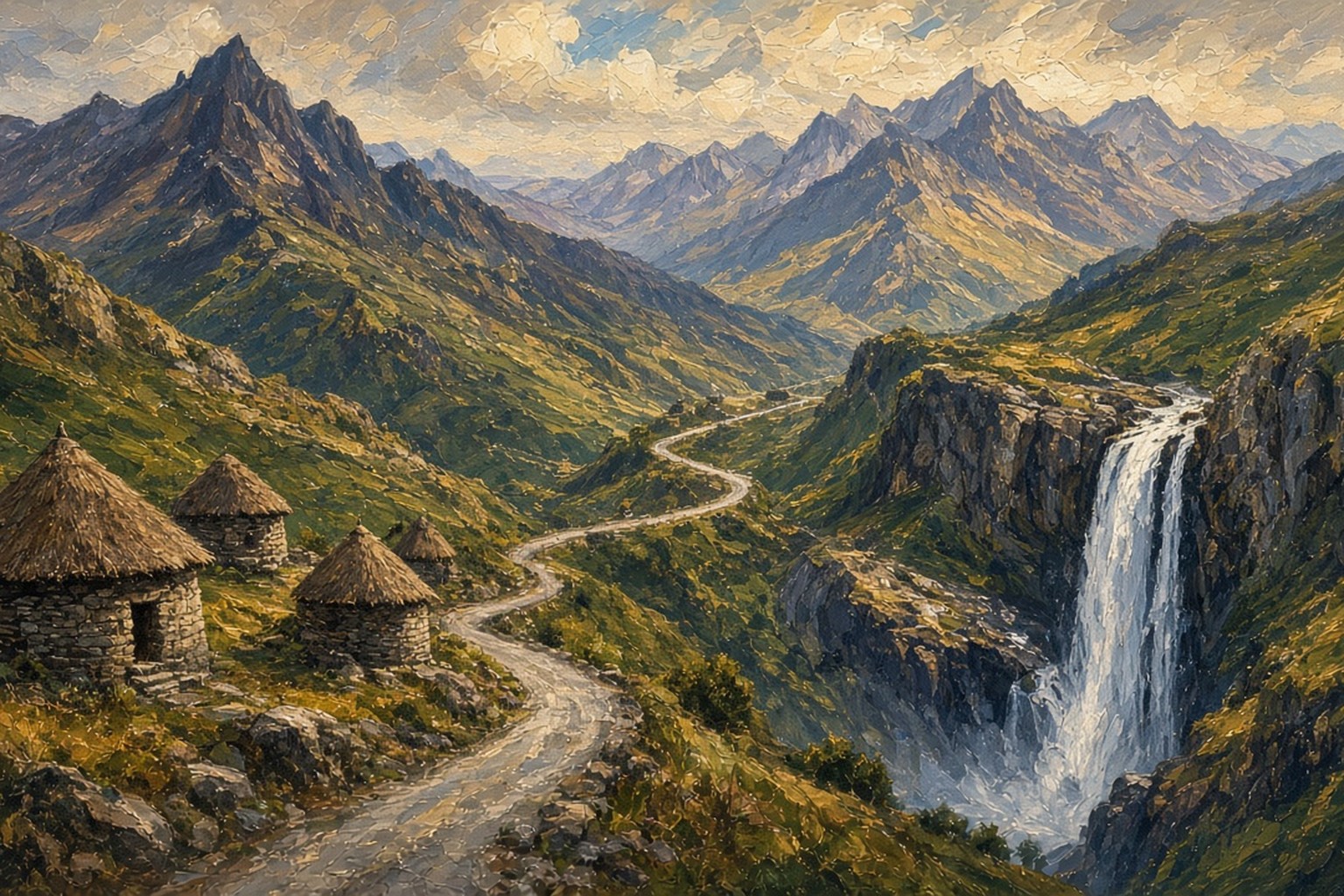
Lesotho is a small, mountainous kingdom in southern Africa, completely surrounded by South Africa. Known as the “Kingdom in the Sky,” it is the only independent country whose entire territory lies above 1,000 meters in elevation. With its dramatic highlands, colorful blankets, and proud Basotho heritage, Lesotho offers a unique and unforgettable experience.
Geography and Climate
Lesotho covers about 30,000 square kilometers and is one of only three countries in the world entirely surrounded by another country. Its lowest point, at around 1,400 meters, is higher than the lowest point of any other country. The capital, Maseru, lies in the western lowlands along the Caledon River, which forms part of the border with South Africa.
The Maloti Mountains and the Drakensberg range dominate the landscape, especially in the east and center. Thabana Ntlenyana, at 3,482 meters, is the highest peak in southern Africa. The country is the source of several important rivers, including the Senqu, which becomes the Orange River in South Africa.
Because of its altitude, Lesotho has a cooler climate than much of the region. Summers are warm and rainy, with frequent thunderstorms, while winters are cold and dry, and snow often falls in the highlands, sometimes even closing mountain passes.
History and Independence
The Basotho nation was founded in the early nineteenth century by King Moshoeshoe I, who gathered people fleeing conflict and warfare in the region. He established his stronghold on the flat-topped mountain of Thaba Bosiu, which was never conquered by force.
Facing pressure from Boer settlers, Moshoeshoe sought British protection, and in 1868 the territory became known as Basutoland. It remained under British rule for nearly a century, which helped it avoid incorporation into South Africa.
Lesotho gained independence on 4 October 1966 as a constitutional monarchy. The years after independence included periods of political tension and military rule, but the country has held multiparty elections since 1993. King Letsie III serves as head of state, while the prime minister leads the government.
Moshoeshoe is remembered as a wise and diplomatic leader who welcomed missionaries and used negotiation as well as defense to protect his people. His legacy remains a source of great national pride today.
Economy and Natural Resources
Water is one of Lesotho’s most valuable resources, and the Lesotho Highlands Water Project transfers water to South Africa’s industrial heartland while generating hydroelectric power. The project includes large dams such as the Katse Dam, one of the highest in Africa.
The country also mines diamonds, and the Letšeng mine is known for producing some of the largest and most valuable stones in the world. Textile and clothing factories employ many workers and export garments abroad.
Many rural families rely on farming and herding sheep and goats, and Lesotho is a notable producer of wool and mohair. Remittances from Basotho working in South Africa have long been an important source of household income.
Culture and Language
Sesotho and English are the official languages, and the vast majority of the population is Basotho, giving the country a strong sense of shared identity. Christianity is widely practiced alongside traditional beliefs and customs.
The Basotho blanket is a national symbol, worn as a cloak in the cool mountain air and decorated with distinctive patterns. The mokorotlo, a conical straw hat, is another iconic emblem of the nation. Herders on horseback wrapped in blankets are a common sight in the highlands.
Music is an important part of life, from choral singing to famo, a popular style featuring the accordion and expressive lyrics. The lesiba, a unique instrument played by blowing across a feather attached to a string, is traditionally used by herders.
Food and Cuisine
Basotho cuisine is simple and hearty, based on locally grown crops. The staple food is papa, a stiff maize porridge eaten with moroho, a dish of cooked leafy greens, or with meat and gravy. Sorghum, beans, and potatoes are also common.
Meat such as mutton, beef, and chicken is often prepared for special occasions and celebrations. Traditional sorghum beer is brewed at home and shared at gatherings, while bread baked in outdoor ovens is enjoyed throughout the country.
Many families grow their own vegetables and keep livestock, so meals often reflect the seasons and the harvest. Sharing food with neighbors and visitors is an important expression of hospitality in Basotho culture.
Hot drinks such as tea are especially welcome during the chilly highland winters. In towns and cities, small eateries serve grilled meat, stews, and fried bread, offering a taste of everyday Basotho life.
Tourism and Attractions
Lesotho is a paradise for outdoor adventure, with pony trekking, hiking, and mountain biking across rugged highlands. The famous Sani Pass, a steep winding road from South Africa, leads to spectacular views, while Maletsunyane Falls near Semonkong plunges nearly 200 meters into a deep gorge.
Sehlabathebe National Park forms part of the Maloti-Drakensberg Park, a UNESCO World Heritage Site known for its scenery and ancient rock art. Visitors can also explore Thaba Bosiu, admire the Katse Dam, and even ski in winter at Afriski in the northern highlands.
Rural villages offer cultural experiences, from traditional round stone houses with thatched roofs to local crafts such as weaving and pottery. Dinosaur footprints preserved in rocks at several sites reveal the land’s ancient past, while the Ts’ehlanyane National Park protects rare indigenous forest.
Challenges and Opportunities
Lesotho faces challenges including high unemployment, poverty, and one of the highest rates of HIV in the world. Soil erosion, drought, and economic dependence on South Africa also affect livelihoods.
At the same time, its abundant water, hydropower potential, and breathtaking landscapes offer real opportunities. Investments in renewable energy, sustainable farming, and eco-tourism could help Lesotho build a stronger future.
Lesotho’s young population and strong sense of national identity are important assets. Expanding access to education, health care, and jobs remains central to the country’s development goals.
A Kingdom Above the Clouds
Lesotho is a land of soaring peaks, deep valleys, and proud traditions carried through generations. From the windswept heights of Sani Pass to the historic plateau of Thaba Bosiu and the thundering Maletsunyane Falls, it offers adventures found nowhere else. Warm and welcoming, Lesotho truly lives up to its name as the Kingdom in the Sky.