
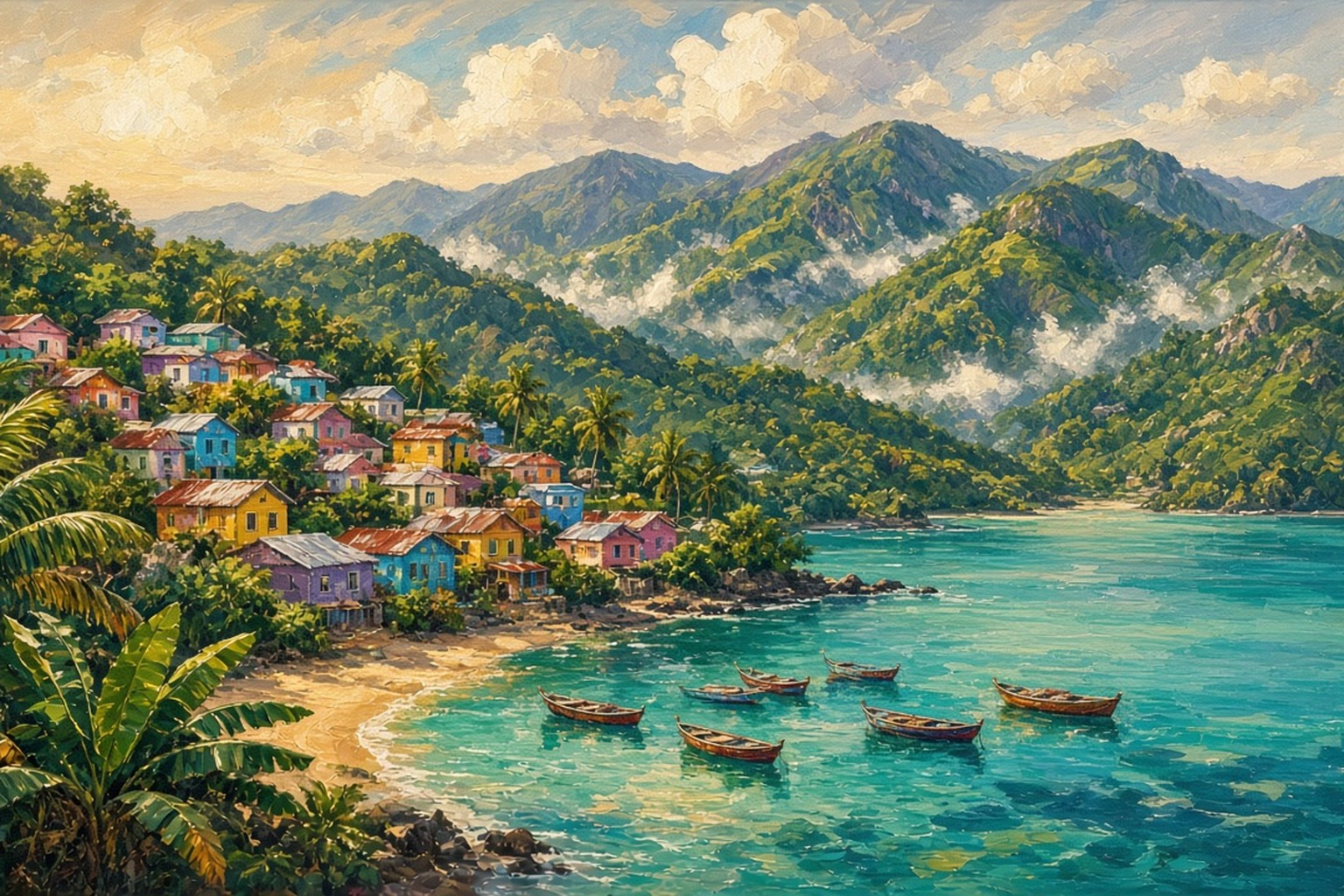
Haiti, a mountainous nation occupying the western third of the island of Hispaniola, was once known as the “Pearl of the Antilles” for the remarkable wealth of its colonial plantations. Today it is celebrated as the world’s first Black-led republic and the first nation in Latin America and the Caribbean to win its independence. With its dramatic landscapes, vibrant art, and resilient people, Haiti holds a unique and powerful place in the history of the Americas.
Geography and Climate
Haiti shares the island of Hispaniola with the Dominican Republic to the east and is bordered by the Atlantic Ocean to the north and the Caribbean Sea to the south. Covering an area of roughly 27,750 square kilometers, the country is shaped like a horseshoe around the Gulf of Gonâve. Offshore islands such as Île de la Gonâve and Île de la Tortue add to its long coastline.
The name Haiti comes from the Taíno word “Ayiti,” often translated as “land of high mountains,” and it is a fitting description. Haiti is the most mountainous country in the Caribbean, with ranges such as the Massif de la Selle, home to Pic la Selle, the nation’s highest peak. Between the mountains lie fertile plains and valleys, including the Artibonite Valley, watered by the Artibonite River, the longest river on Hispaniola.
Haiti has a tropical climate, with warm temperatures year-round and cooler conditions in the highlands. The country lies in the path of Atlantic hurricanes, and the season from June to November can bring powerful storms and flooding.
History and Independence
Before European contact, Hispaniola was home to the Taíno people, who lived in several chiefdoms. Christopher Columbus arrived in 1492, and Spanish colonization soon devastated the indigenous population through violence, forced labor, and disease. In 1697, Spain ceded the western part of the island to France, which named its colony Saint-Domingue.
Saint-Domingue became one of the world’s most profitable colonies, producing sugar and coffee through the labor of hundreds of thousands of enslaved Africans. In 1791, enslaved people rose up in a revolt that grew into the Haitian Revolution, led by figures such as Toussaint Louverture and Jean-Jacques Dessalines. On January 1, 1804, Dessalines declared independence, and the new nation took the name Haiti.
Haiti’s independence came at a heavy price. In 1825, France demanded a large indemnity in exchange for recognition, a debt that burdened the country for generations. The twentieth century brought a United States occupation from 1915 to 1934 and the Duvalier dictatorship from 1957 to 1986, followed by a difficult transition toward democracy.
Economy and Natural Resources
Haiti is the poorest country in the Western Hemisphere, and a large part of the population depends on small-scale agriculture. Farmers grow crops such as coffee, mangoes, cocoa, rice, sugarcane, and plantains. Haiti is also one of the world’s leading producers of vetiver, an aromatic root whose essential oil is prized by the perfume industry.
Garment assembly is an important source of export earnings, mainly for the United States market. Remittances from the large Haitian diaspora play a vital role in supporting households. Deforestation and soil erosion have reduced the productivity of the land, making reforestation and sustainable farming key priorities for the country’s future.
Culture and Language
Haiti’s culture is a rich fusion of African, French, and Taíno influences. The country has two official languages, Haitian Creole and French, with Haitian Creole spoken by virtually the entire population. Religious life combines Catholicism and Protestantism with Vodou, a spiritual tradition rooted in West African beliefs that has deeply shaped Haitian music, art, and identity.
Haitian art is internationally renowned, from colorful naïve paintings to the intricate metal sculptures of Croix-des-Bouquets. Music is central to daily life, with kompa serving as the country’s signature dance music and rara bands filling the streets during the Lenten season. Carnival is a major celebration, and the town of Jacmel is famous for its elaborate papier-mâché masks.
Food and Cuisine
Haitian cuisine is bold and flavorful, drawing on African, French, and Caribbean traditions. Griot, chunks of marinated pork that are fried until crisp, is one of the most beloved dishes and is often served with pikliz, a spicy pickled cabbage relish. Fried plantains, known as bannann peze, and rice with beans are common accompaniments.
Diri djon djon, rice cooked with native black mushrooms, is a distinctive specialty with a dark color and earthy flavor. Soup joumou, a hearty pumpkin soup, is traditionally eaten on January 1 to celebrate independence and was added to UNESCO’s list of the Intangible Cultural Heritage of Humanity in 2021. Haiti is also known for its rum, with Barbancourt among the most famous names in the Caribbean.
Tourism and Attractions
Haiti’s most iconic landmark is the Citadelle Laferrière, a massive mountaintop fortress built in the early nineteenth century under Henri Christophe to defend the young nation. Together with the nearby ruins of the Sans-Souci Palace and the Ramiers site, it forms the National History Park, a UNESCO World Heritage Site. The northern city of Cap-Haïtien serves as the gateway to these historic sites.
On the southern coast, Jacmel charms visitors with its historic architecture and artisan workshops, while the turquoise pools of Bassin Bleu lie in the hills nearby. Île-à-Vache offers quiet beaches and clear waters, and Labadee on the northern coast has long served as a cruise port. In Port-au-Prince, the capital, landmarks such as the Iron Market and the national museum showcase Haiti’s history and creativity.
Challenges and Opportunities
Haiti faces serious challenges, including political instability, insecurity, widespread poverty, and limited infrastructure. The country is highly vulnerable to natural disasters, including the devastating earthquake that struck near Port-au-Prince on January 12, 2010. Hurricanes, floods, and environmental degradation continue to test communities across the country.
Despite these difficulties, Haiti has significant potential. Its young population, vibrant cultural industries, fertile land, and global diaspora are valuable assets for development. Investments in agriculture, education, reforestation, and responsible tourism could help unlock new opportunities and build a more stable and prosperous future.
A Land of Pride and Resilience
Haiti is a nation whose history of freedom and courage has inspired people around the world. From the towering walls of the Citadelle Laferrière to the colorful streets of Jacmel and the rhythms of kompa, every corner of Haiti reflects the creativity and spirit of its people. As it works to overcome its challenges, Haiti remains a land of extraordinary heritage and enduring hope.