
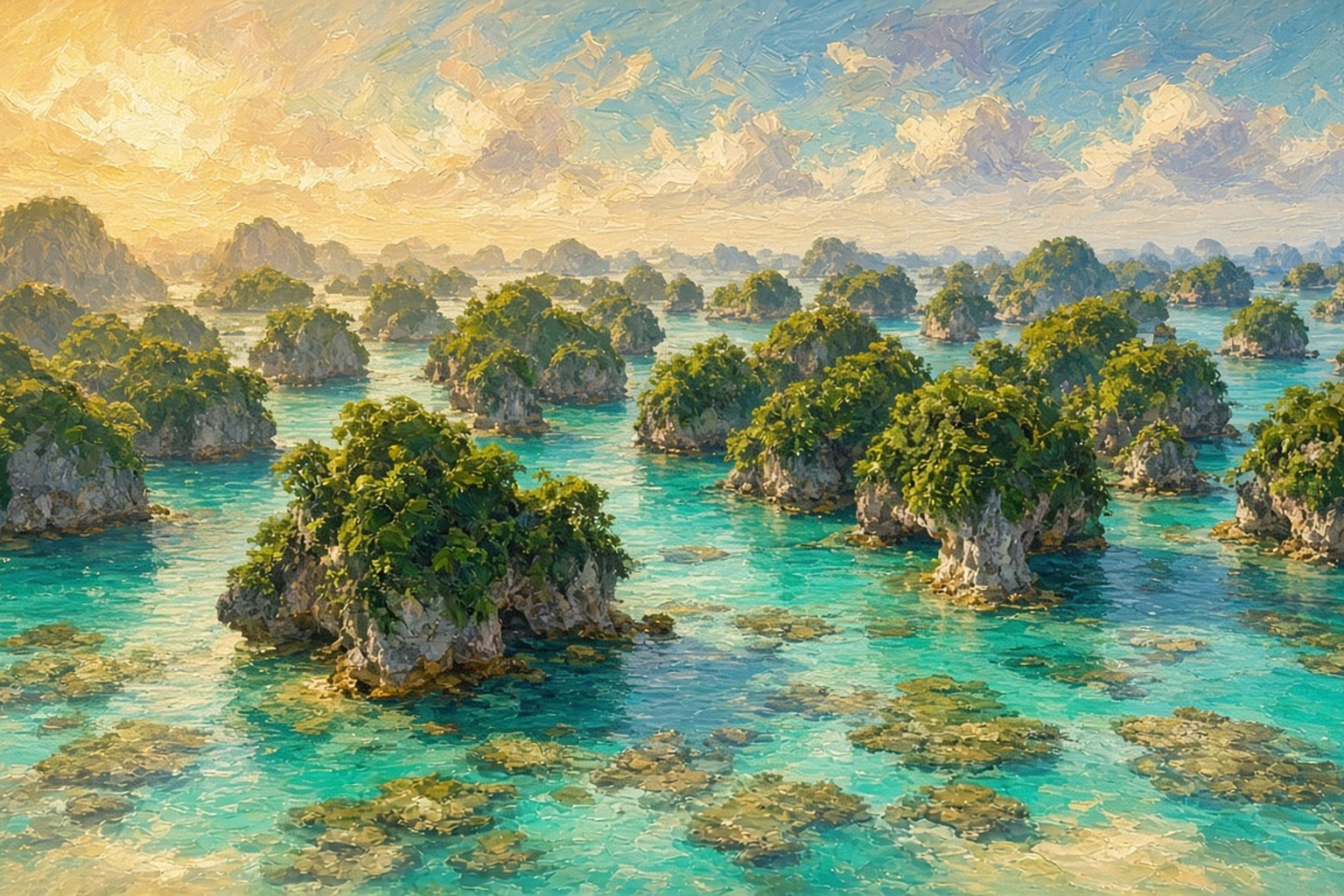
Palau is a small island nation in the western Pacific Ocean, part of the wider Micronesia region. Famous for its emerald Rock Islands, crystal-clear lagoons, and some of the richest coral reefs on the planet, it is often described as an “underwater wonder of the world.” With its proud island traditions, pioneering ocean conservation, and warm hospitality, Palau is a true paradise for nature lovers and divers.
Geography and Climate
Palau consists of around 340 islands with a total land area of about 460 square kilometers, scattered across a vast stretch of ocean east of the Philippines. Only a handful of the islands are inhabited, and most of the population lives on Koror and the nearby large island of Babeldaob.
Babeldaob is the largest island, with rolling hills, rivers, and waterfalls, and it is home to the capital, Ngerulmud, which became the seat of government in 2006. To the south lie the famous Rock Islands, hundreds of small limestone islands covered in lush forest and shaped like green mushrooms rising from turquoise water. The atoll of Kayangel lies in the far north, while small remote islands stretch far to the southwest.
The climate is tropical, warm, and humid throughout the year, with temperatures that rarely change much between seasons. Rain falls frequently, especially between May and November, and the islands lie mostly outside the main typhoon belt, although storms occasionally pass through. Surrounding reefs host hundreds of species of coral and fish, as well as sharks, manta rays, turtles, and dugongs.
History and Independence
People first settled in Palau around three thousand years ago, arriving by canoe from islands to the west. They developed a complex society of villages and clans, building stone pathways, terraced hillsides, and traditional meeting houses, and the mysterious stone monoliths of Badrulchau on Babeldaob are among the oldest remains.
European ships visited in the following centuries, and Spain claimed the islands before selling them to Germany in 1899. After the First World War, Japan administered Palau, making Koror the administrative center of its Pacific territories. The islands became a battleground during the Second World War, most famously at Peleliu in 1944.
After the war, Palau became part of the United Nations Trust Territory of the Pacific Islands administered by the United States. It adopted its own constitution in 1981 and gained independence on 1 October 1994, entering into a Compact of Free Association with the United States.
Economy and Natural Resources
Tourism is the backbone of Palau’s economy, with visitors drawn by world-class diving, snorkeling, and island scenery. Hotels, dive operators, restaurants, and tour boats provide many jobs, especially in Koror.
Fishing has long been important, both for local food and for income, and small-scale farming produces taro, cassava, coconuts, and fruit. The United States dollar is the official currency, and financial support under the Compact of Free Association helps fund public services and infrastructure.
Palau’s greatest natural resource is its healthy marine environment. The country created one of the world’s first shark sanctuaries in 2009, and the Palau National Marine Sanctuary now protects the large majority of its ocean territory from commercial fishing.
Culture and Traditions
Palauan and English are the official languages, while Sonsorolese and Hatohobei are spoken on the southwestern islands and Japanese is also recognized in Angaur. Most people are Christians, and traditional beliefs and customs remain an important part of community life.
Palauan society is matrilineal, meaning that family lines, land, and clan titles pass through the mother’s side, and women play an important role in choosing traditional chiefs. Customary ceremonies mark births, first childbirth, and funerals, often with the exchange of traditional money and food.
The bai, a traditional meeting house with a high, steep roof, is decorated with carved and painted beams that tell legends and historical events. These stories inspired storyboards, carved wooden panels that are a famous Palauan craft today, and giant stone money discs were once quarried in Palau and carried by canoe to Yap.
Food and Cuisine
Palauan cuisine is based on fresh fish, seafood, taro, cassava, and coconut. Taro is especially important, grown in wetland gardens tended by women, and it is served boiled or made into puddings for family gatherings and ceremonies.
Reef fish, clams, crabs, and coconut crabs are prepared grilled, steamed, or raw, often with lemon and coconut milk. Japanese and American influences can be seen in popular dishes such as sashimi, rice bowls, and barbecue, and tropical fruits like papaya, mango, and banana are enjoyed every day.
Tourism and Attractions
The Rock Islands Southern Lagoon, a UNESCO World Heritage Site recognized for both its natural beauty and cultural history, is the heart of Palau’s tourism. Kayakers and boaters explore hidden coves, white beaches, and the Milky Way, a lagoon with soft white limestone mud.
Divers come from around the world to explore Blue Corner, German Channel, and Ngemelis Wall, where sharks, rays, and colorful corals abound. Jellyfish Lake on Eil Malk is famous for its golden jellyfish, while Babeldaob offers the Ngardmau Waterfall and the stone monoliths of Badrulchau.
History enthusiasts can visit Peleliu, where tanks, aircraft wrecks, and memorials recall the Second World War. The quiet atoll of Kayangel, with its powdery beaches and calm lagoon, offers a peaceful escape far from the busier waters around Koror.
Challenges and Opportunities
Palau faces challenges such as rising sea levels, coral bleaching, a small and remote economy, and dependence on imported goods and outside assistance. Balancing tourism with environmental protection is an ongoing priority.
At the same time, its global leadership in ocean conservation offers real opportunities. Through the Palau Pledge, signed by visitors upon arrival, and investment in sustainable tourism and renewable energy, Palau is showing how a small nation can protect its paradise.
A Lagoon of Emerald Islands
Palau is a land of emerald islands, glowing coral gardens, and ancient island traditions. From the mushroom-shaped Rock Islands to the deep blue walls of its reefs and the carved meeting houses of its villages, it offers unforgettable beauty above and below the waves. Pristine, peaceful, and inspiring, Palau is a true jewel of the Pacific.