
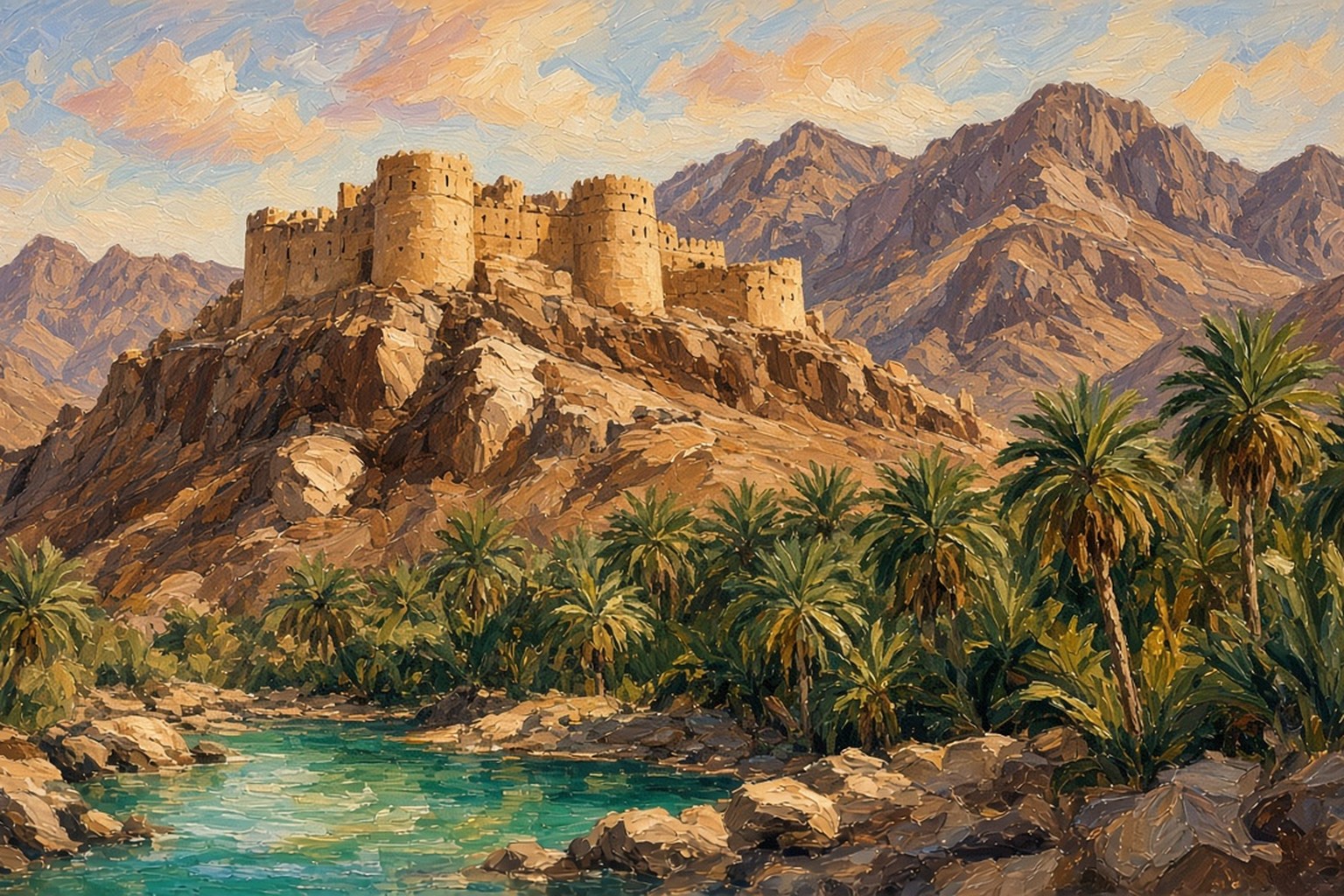
Oman is a sultanate on the southeastern corner of the Arabian Peninsula, facing the Arabian Sea and the Gulf of Oman. Known for its rugged mountains, golden deserts, turquoise coves, and ancient forts, it is one of the most scenic and traditional countries in the Middle East. With its legendary frankincense trade, seafaring heritage, and famously warm hospitality, Oman is often described as the “Jewel of Arabia.”
Geography and Climate
Oman covers about 309,500 square kilometers and is bordered by the United Arab Emirates to the northwest, Saudi Arabia to the west, and Yemen to the southwest. Its long coastline of more than 3,000 kilometers stretches from the Strait of Hormuz, where the exclave of Musandam juts into the sea, to the Arabian Sea in the south.
The Al Hajar Mountains arc across the north, with Jebel Shams rising to about 3,000 meters as the highest peak, and deep canyons and green wadis cut through the rock. Inland, gravel plains give way to the sand dunes of the Sharqiya Sands, also known as the Wahiba Sands, and the edge of the vast Rub’ al Khali, or Empty Quarter.
The climate is mostly hot and dry, with very warm summers and pleasant winters along the coast. The southern region of Dhofar is a remarkable exception, as the summer monsoon, known as the khareef, brings mist, drizzle, and green hills to the area around Salalah. Oman’s waters are home to sea turtles, dolphins, and whales, while the mountains shelter Arabian tahr and rare Arabian leopards.
History and Independence
Thousands of years ago, the land known in ancient Mesopotamian texts as Magan traded copper with distant civilizations. The beehive-shaped stone tombs of Bat, Al-Khutm, and Al-Ayn date from this early period and are now a UNESCO World Heritage Site.
Oman became famous for frankincense, harvested from trees in Dhofar and carried by caravan and ship to markets across the ancient world. Islam arrived in the seventh century, and Omani sailors became renowned navigators of the Indian Ocean. The Portuguese controlled Muscat and other coastal towns from the early sixteenth century until they were expelled in 1650.
Omani rulers later built a maritime empire that stretched to Zanzibar and the coast of East Africa. The Al Said dynasty has ruled since the mid-eighteenth century, and under Sultan Qaboos bin Said, who came to power in 1970, Oman modernized rapidly with new roads, schools, and hospitals. Sultan Haitham bin Tarik has led the country since 2020.
Economy and Natural Resources
Oil and natural gas have been the foundation of Oman’s economy since exports began in 1967, funding much of its development. Liquefied natural gas, refining, and petrochemicals are important industries.
Under its long-term plan known as Oman Vision 2040, the country is working to diversify into tourism, logistics, manufacturing, fisheries, and renewable energy. Ports such as Sohar, Salalah, and Duqm connect Oman to international shipping routes.
Agriculture thrives in oases watered by ancient irrigation channels called aflaj, producing dates, limes, bananas, and vegetables. Fishing remains a traditional livelihood along the coast, and frankincense is still harvested in Dhofar.
Culture and Traditions
Arabic is the official language, and English is widely used in business and tourism, while languages such as Balochi, Swahili, and Mehri are also spoken. Islam is the state religion, and most Omanis follow the Ibadi school, known for its tradition of moderation and tolerance.
Men often wear a long white robe called a dishdasha with an embroidered cap, and on formal occasions a curved silver dagger known as the khanjar, which appears on the national emblem. Hospitality is central to Omani life, and guests are welcomed with cardamom-flavored coffee called kahwa and fresh dates.
Traditional music and poetry are cherished, and the Al-Bar’ah dance of Dhofar and the Al-Azi recitation of poetry are recognized by UNESCO as intangible cultural heritage. In the coastal town of Sur, craftsmen continue the centuries-old art of building wooden dhows.
Food and Cuisine
Omani cuisine combines Arabian, Persian, Indian, and East African influences, using rice, meat, fish, and fragrant spices. Shuwa, lamb or goat marinated in spices, wrapped in banana or palm leaves, and slow-cooked for many hours in an underground oven, is the most celebrated festive dish.
Majboos, spiced rice with meat or chicken, and mashuai, grilled kingfish served with lemon rice, are everyday favorites. Omani halwa, a sticky sweet made with sugar, ghee, rosewater, saffron, and nuts, is served on special occasions with kahwa.
Harees, a creamy dish of wheat and meat cooked slowly together, is especially popular during Ramadan and Eid. Fresh fish, grilled lobster, and spicy curries are common along the coast, reflecting centuries of trade with India and East Africa.
Tourism and Attractions
Muscat offers the magnificent Sultan Qaboos Grand Mosque, the Royal Opera House, and the bustling Mutrah Souq along the corniche. Nizwa, with its great round fort and lively market, and the vast Bahla Fort, a UNESCO World Heritage Site, reflect the country’s rich history. In Dhofar, the Land of Frankincense, a UNESCO World Heritage Site, preserves frankincense trees and ruined trading ports near Salalah.
Nature lovers can swim in the turquoise pools of Wadi Shab and Wadi Bani Khalid, hike Jebel Shams and the terraced villages of Jebel Akhdar, or camp in the Sharqiya Sands. At Ras al Jinz, green turtles nest on the beach, and the fjord-like inlets of Musandam are ideal for dhow cruises.
Challenges and Opportunities
Oman faces challenges such as its dependence on oil and gas revenues, the need to create jobs for a young population, and limited water resources. Adapting to rising temperatures and protecting fragile ecosystems are also important priorities.
At the same time, its stability, strategic location, natural beauty, and authentic culture offer great opportunities. Investment in tourism, green hydrogen, solar power, and logistics could help Oman build a diverse and sustainable economy.
A Sultanate of Frankincense and Forts
Oman is a land of fragrant frankincense, towering forts, and timeless hospitality. From the misty hills of Dhofar to the canyons of the Al Hajar Mountains and the elegant waterfront of Muscat, it offers journeys filled with beauty and tradition. Graceful, peaceful, and welcoming, Oman is a true jewel of Arabia.