
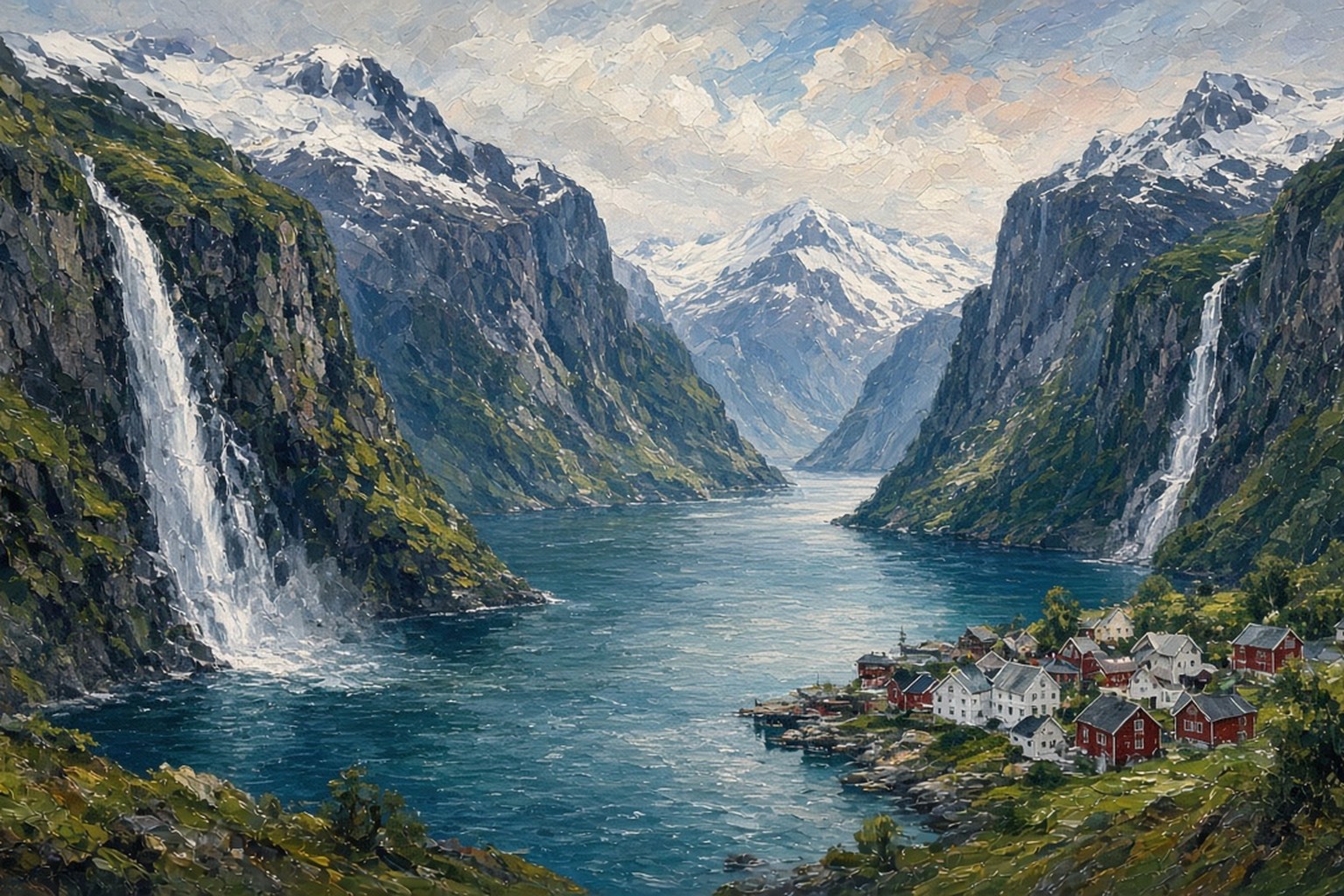
Norway is a Scandinavian country in Northern Europe, stretching along the western edge of the Scandinavian Peninsula to well beyond the Arctic Circle. Famous for its dramatic fjords, snow-capped mountains, midnight sun, and dancing northern lights, it is often called the “Land of the Midnight Sun.” With its Viking heritage, colorful fishing villages, and strong love of the outdoors, Norway is one of the most breathtaking destinations in the world.
Geography and Climate
Mainland Norway covers about 324,000 square kilometers and is bordered by Sweden to the east and Finland and Russia to the northeast. Its long, deeply indented coastline faces the North Sea, the Norwegian Sea, and the Barents Sea, and it includes tens of thousands of islands, as well as the Arctic archipelago of Svalbard.
The country is dominated by mountains, plateaus, and glaciers, with Galdhøpiggen rising to about 2,469 meters as the highest peak in Scandinavia. Ice Age glaciers carved hundreds of fjords into the coast, including the Sognefjord, the longest and deepest in Norway, which reaches more than 200 kilometers inland. Jostedalsbreen is the largest glacier in mainland Europe.
Thanks to the warm waters of the North Atlantic Current, the coast enjoys a milder climate than other places at the same latitude, while the interior has colder winters. North of the Arctic Circle, the sun never sets for weeks in summer and barely rises in midwinter, when the aurora borealis often lights up the sky. Reindeer, moose, musk oxen, and sea eagles are among its iconic wildlife.
History and Independence
From the late eighth to the eleventh century, Norse seafarers known as Vikings sailed from Norway to trade, raid, and settle across Europe and the North Atlantic, reaching Iceland, Greenland, and even North America. King Harald Fairhair is traditionally credited with first uniting Norway in the late ninth century, and Christianity spread in the following centuries.
In 1397, Norway joined Denmark and Sweden in the Kalmar Union, and it later remained in a union with Denmark for about four centuries. In 1814, Norway adopted its own constitution at Eidsvoll on 17 May, now celebrated as National Day, before entering a union with Sweden.
The union with Sweden was peacefully dissolved in 1905, and Norway became a fully independent kingdom with its own monarch. The country was occupied during the Second World War from 1940 to 1945 and afterward became a founding member of NATO, while choosing to remain outside the European Union.
Economy and Natural Resources
Norway has one of the world’s most prosperous economies, built largely on oil and natural gas discovered in the North Sea in 1969. Revenue from petroleum is invested in the Government Pension Fund Global, one of the largest sovereign wealth funds in the world.
The sea has always been central to Norwegian life, and the country is a leading exporter of seafood, especially Atlantic salmon from fish farms and cod from the northern waters. Shipping, shipbuilding, and maritime technology are also important industries.
Hydropower from mountain rivers and lakes produces almost all of Norway’s electricity, and the country has one of the highest shares of electric cars in the world. Aluminum production, forestry, and tourism further strengthen the economy.
Culture and Language
Norwegian is the official language and has two written forms, Bokmål and Nynorsk, while Sámi languages are official in parts of the north. The Sámi, the Indigenous people of northern Scandinavia, are known for reindeer herding, colorful traditional dress called gákti, and the distinctive singing style known as joik.
Norway has produced world-famous cultural figures, including the playwright Henrik Ibsen, the composer Edvard Grieg, and the painter Edvard Munch, whose work The Scream is one of the most recognized artworks in history. Folk music often features the Hardanger fiddle, with its extra resonating strings.
On National Day, people wear traditional costumes called bunad, and children’s parades fill the streets with flags and music. The love of the outdoors, known as friluftsliv, is a cornerstone of daily life, and skiing is so popular that Norwegians are often said to be born with skis on their feet.
Food and Cuisine
Norwegian cuisine is simple and hearty, based on fish, lamb, potatoes, and dairy. Fårikål, a slow-cooked stew of mutton and cabbage seasoned with black pepper, is considered the national dish, and fresh or smoked salmon is enjoyed in many forms.
Brunost, a sweet brown cheese, is a beloved topping for bread and waffles, and dried cod known as stockfish has been produced in the Lofoten Islands for centuries. At Christmas, families serve dishes such as pinnekjøtt, cured lamb ribs, and lutefisk, along with cookies and cinnamon buns.
Tourism and Attractions
The Geirangerfjord and Nærøyfjord, recognized together by UNESCO as the West Norwegian Fjords, offer sheer cliffs, waterfalls, and mountain farms above deep blue water. Hikers can climb to the Pulpit Rock above Lysefjord or Trolltunga, while the Flåm Railway winds through spectacular valleys.
Bergen’s colorful wooden wharf of Bryggen and the old copper-mining town of Røros are UNESCO World Heritage Sites, as is the medieval Urnes Stave Church. The Lofoten Islands, Tromsø, and the North Cape draw visitors for the midnight sun and northern lights, while Oslo offers the Vigeland sculpture park, the Opera House, and Viking ship heritage.
Challenges and Opportunities
Norway faces challenges such as the gradual shift away from oil and gas, protecting fragile Arctic environments, an aging population, and the high cost of living. Balancing fish farming with the health of wild salmon is also an important issue.
At the same time, its wealth, clean energy, and innovative industries give it strong foundations for the future. Investments in offshore wind, carbon capture, and green shipping could make Norway a leader in the global energy transition.
A Kingdom of Fjords and Northern Lights
Norway is a land of shimmering fjords, rugged peaks, and long summer days that seem never to end. From the wooden wharves of Bergen to the Arctic skies above Tromsø and the quiet beauty of the Lofoten Islands, it offers unforgettable journeys through nature and history. Majestic and welcoming, Norway is a true wonder of the North.