
Nigeria is a large and dynamic country in West Africa, often called the “Giant of Africa” because of its huge population, vibrant economy, and cultural influence. It is home to hundreds of ethnic groups and languages, bustling megacities, rainforests, savannas, and a long Atlantic coastline. With its world-famous music, films, literature, and food, Nigeria is one of the most energetic and creative nations on the continent.
Geography and Climate
Nigeria covers about 924,000 square kilometers and is bordered by Benin to the west, Niger to the north, Chad to the northeast, and Cameroon to the east. Its southern coast faces the Gulf of Guinea, an arm of the Atlantic Ocean.
The Niger River and its largest tributary, the Benue, meet at Lokoja in the center of the country before flowing south into the Niger Delta, one of the largest river deltas in the world. The south is covered by mangrove swamps and tropical rainforest, while the center and north are dominated by savanna and plateaus. The highest point, Chappal Waddi, rises to about 2,419 meters on the mountainous border with Cameroon.
The climate is tropical, with a rainy season and a dry season that vary across regions. The south receives heavy rainfall for much of the year, while the north is hotter and drier, especially when the dusty harmattan wind blows from the Sahara between November and March. National parks such as Yankari, Gashaka-Gumti, and Cross River protect elephants, primates, and many bird species.
History and Independence
The Nok culture, which flourished more than two thousand years ago in central Nigeria, is famous for its expressive terracotta sculptures. Later, powerful states arose, including the Kingdom of Benin, known for its bronze and brass plaques, the Oyo Empire of the Yoruba, the Hausa city-states, and the Kanem-Bornu Empire near Lake Chad.
In the early nineteenth century, the Sokoto Caliphate united much of the north. During the same period, the Atlantic slave trade caused great suffering along the coast until it was abolished. Britain gradually took control of the region, and in 1914 the northern and southern protectorates were joined to form the Colony and Protectorate of Nigeria.
Nigeria gained independence on 1 October 1960 and became a republic in 1963. A civil war from 1967 to 1970 deeply affected the nation, and periods of military rule followed before civilian government was restored in 1999. In 1991, the capital moved from Lagos to Abuja, a planned city in the center of the country.
Economy and Natural Resources
Nigeria has one of the largest economies in Africa, and oil and natural gas from the Niger Delta have long been its main exports and sources of government revenue. The country is a member of OPEC and holds some of the largest gas reserves in the world.
Agriculture employs many Nigerians, and the country is the world’s largest producer of cassava and yams. Cocoa, sesame, cashews, groundnuts, palm oil, and rice are also important crops, and livestock herding is widespread in the north.
Lagos is a major commercial hub with a thriving technology scene, including many fintech startups. Telecommunications, banking, cement, and entertainment have grown rapidly, and Nollywood is one of the most prolific film industries in the world.
Culture and Language
English is the official language, while more than five hundred languages are spoken across the country. The three largest ethnic groups are the Hausa-Fulani in the north, the Yoruba in the southwest, and the Igbo in the southeast, alongside many others such as the Ijaw, Kanuri, Ibibio, and Tiv. Islam and Christianity are the main religions, and traditional beliefs remain important in many communities.
Nigeria has a rich literary tradition, with authors such as Chinua Achebe, whose novel Things Fall Apart is read worldwide, and Wole Soyinka, who won the Nobel Prize in Literature in 1986. Its music is equally influential, from the Afrobeat of Fela Kuti to the modern Afrobeats stars who fill stadiums across the globe.
Festivals showcase the country’s diversity, from the colorful Durbar horse processions in northern cities such as Kano and Katsina to the Argungu Fishing Festival and the New Yam Festival celebrated by the Igbo. Traditional crafts include indigo-dyed adire cloth, woven aso oke, and finely carved wood and bronze.
Food and Cuisine
Nigerian cuisine is bold, spicy, and full of flavor. Jollof rice, cooked in a rich tomato and pepper sauce, is a national favorite, and pounded yam is often served with egusi soup, made from ground melon seeds, leafy greens, and meat or fish.
Suya, spicy grilled meat skewers coated with a peanut spice mix, is a beloved street food, especially in the evening. Moi moi, a steamed bean pudding, pepper soup, fried plantains called dodo, and sweet puff-puff dough balls are enjoyed across the country.
Tourism and Attractions
The Osun-Osogbo Sacred Grove, a UNESCO World Heritage Site, is a forest filled with shrines and sculptures dedicated to the Yoruba river goddess Osun. The Sukur Cultural Landscape in the northeast, also listed by UNESCO, features stone terraces and a hilltop palace.
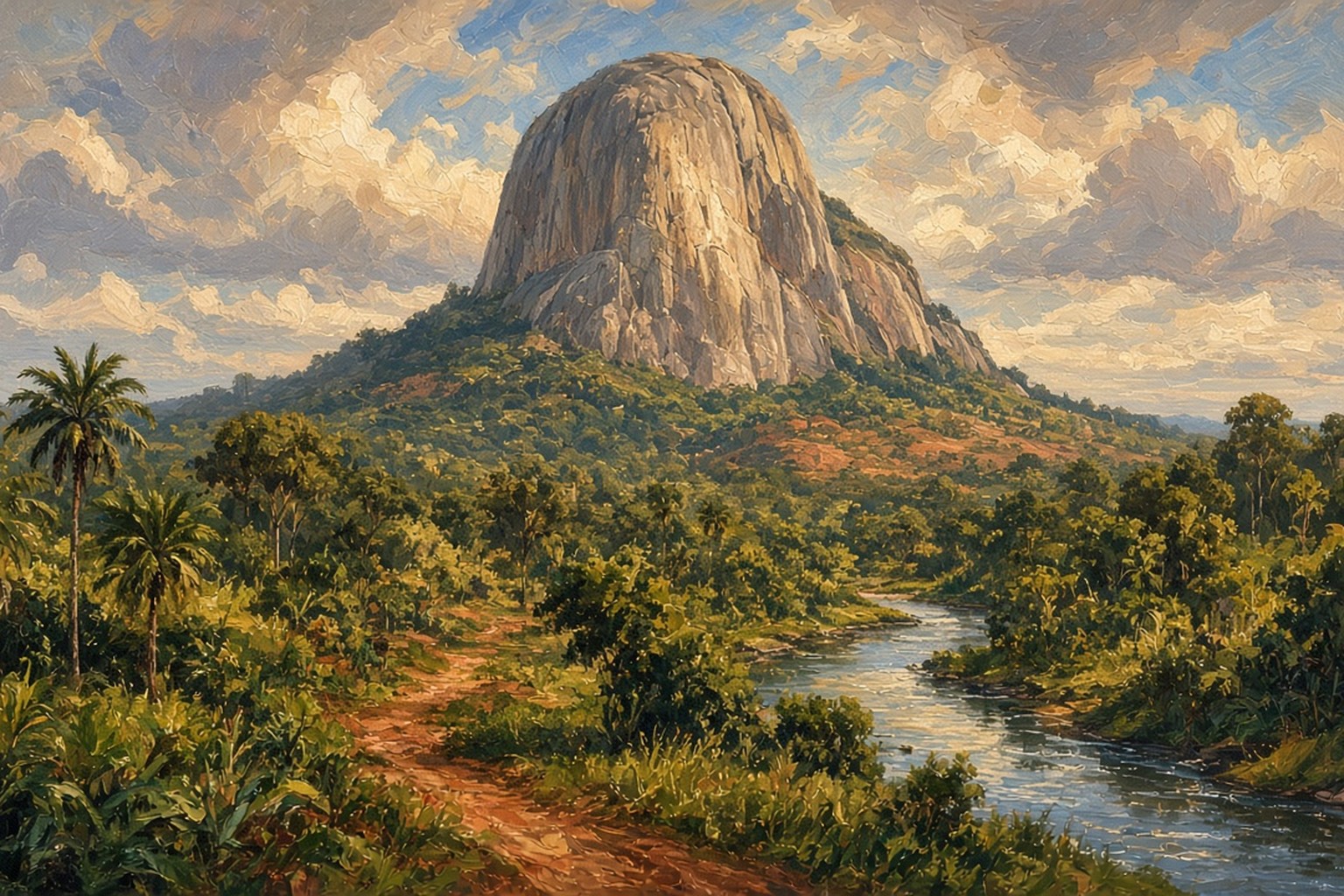
Zuma Rock near Abuja and Olumo Rock in Abeokuta are striking natural landmarks, while Yankari Game Reserve offers wildlife viewing and warm springs. Lagos dazzles visitors with its beaches, art galleries, markets, and nightlife, and the cool highlands of Obudu offer rolling green hills and waterfalls.
Challenges and Opportunities
Nigeria faces challenges such as insecurity in some regions, unemployment, infrastructure gaps, environmental damage in the Niger Delta, and dependence on oil revenues. Improving power supply and education remain key priorities.
At the same time, its young and entrepreneurial population, creative industries, and vast natural resources offer enormous potential. Growth in technology, agriculture, and manufacturing could help Nigeria fulfill its promise as a leading economy in Africa.
A Giant of Rhythm and Enterprise
Nigeria is a land of ancient kingdoms, bustling cities, and irrepressible creativity. From the sacred groves of Osogbo to the lively streets of Lagos and the savannas of the north, it pulses with music, flavor, and ambition. Bold, diverse, and full of energy, Nigeria truly lives up to its name as the Giant of Africa.