
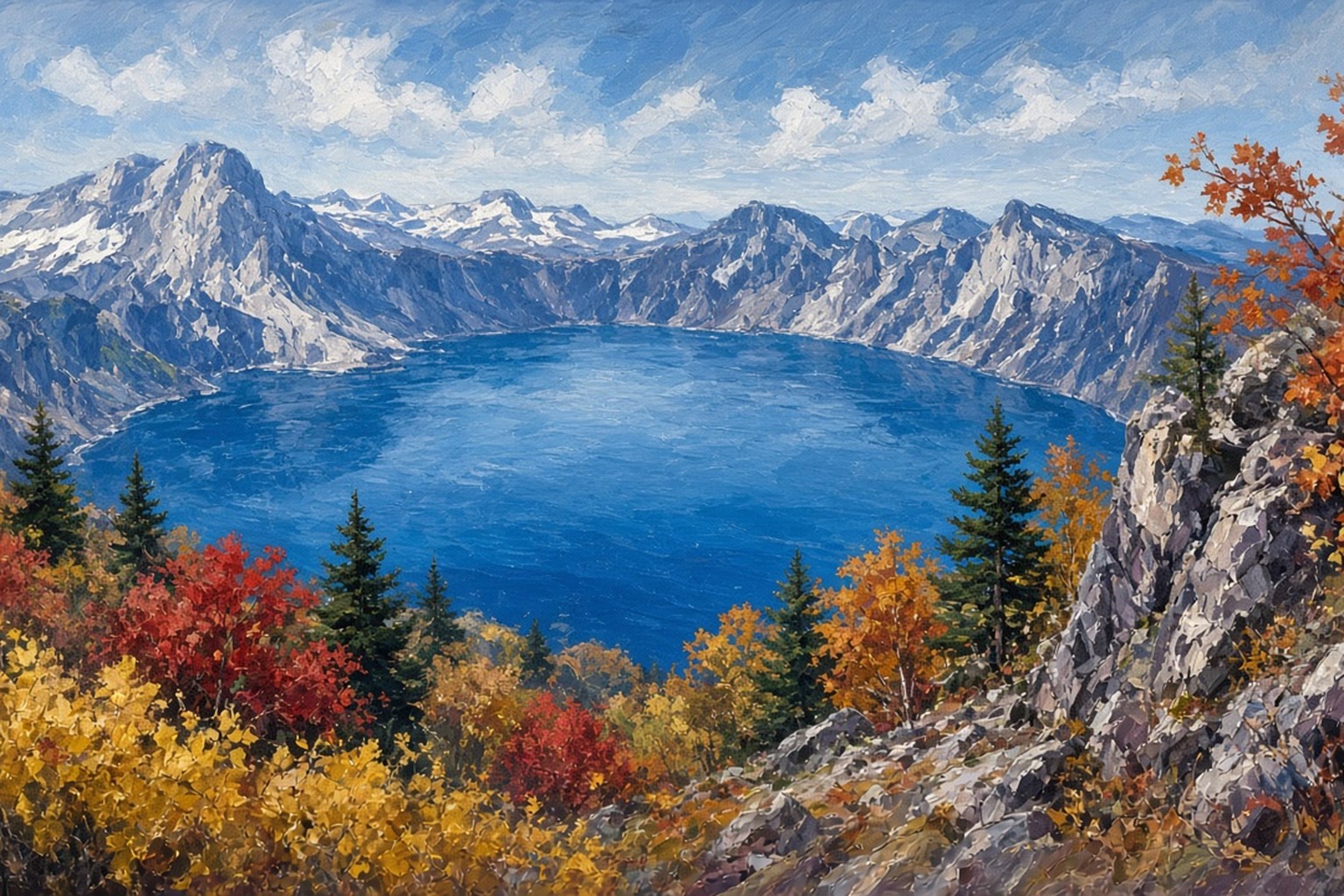
North Korea, officially the Democratic People’s Republic of Korea, occupies the northern half of the Korean Peninsula in East Asia. It is a land of rugged mountains, forested valleys, swift rivers, and long coastlines, crowned by the volcanic summit of Mount Paektu. With a history stretching back thousands of years and a rich shared Korean heritage of language, music, and cuisine, it remains one of the least visited and most intriguing countries in the world.
Geography and Climate
North Korea covers about 120,500 square kilometers and is bordered by China to the north, along the Yalu and Tumen rivers, and shares a short border with Russia in the far northeast. To the south, the Korean Demilitarized Zone separates it from South Korea, while the Yellow Sea lies to the west and the Sea of Japan, known in Korea as the East Sea, to the east.
Mountains and hills cover around four-fifths of the land. Mount Paektu, an ancient volcano on the Chinese border, is the highest point on the peninsula at about 2,744 meters, and its summit holds a striking crater lake called Lake Chon. Other famous ranges include the Kumgang, or Diamond Mountains, near the east coast, and the Myohyang Mountains in the north.
The climate is continental, with long, cold, dry winters and short, hot, humid summers when most of the year’s rain falls during the monsoon season. The western lowlands along rivers such as the Taedong, which flows through the capital, Pyongyang, contain most of the farmland, while the forested northern highlands are home to deer, bears, lynx, and many species of birds.
History and Independence
The Korean Peninsula has been inhabited for many thousands of years, and early states such as Gojoseon arose in the north. The kingdom of Goguryeo, which moved its capital to Pyongyang in the fifth century, left elaborate painted tombs now recognized by UNESCO as the Complex of Koguryo Tombs.
Later dynasties unified the peninsula, including Goryeo, whose capital was Kaesong, and Joseon, which ruled from 1392 to the early twentieth century. The Historic Monuments and Sites in Kaesong, including royal tombs and an old Confucian academy, are also a UNESCO World Heritage Site.
Korea was annexed by Japan in 1910 and remained under Japanese rule until 1945, when the peninsula was divided into Soviet and American zones. The Democratic People’s Republic of Korea was established in the north on 9 September 1948, and the Korean War from 1950 to 1953 ended with an armistice that left the peninsula divided to this day.
Economy and Natural Resources
North Korea has a centrally planned economy in which the state controls most industry and agriculture. Farming focuses on rice, maize, potatoes, and soybeans, though the mountainous terrain and short growing season limit the amount of arable land.
The country has rich mineral deposits, including coal, iron ore, magnesite, zinc, gold, and rare earth elements, and mining has long been a key industry. Hydroelectric dams on its rivers and coal-fired power stations supply much of its energy.
Light industry produces textiles, footwear, and consumer goods, and fishing is important along both coasts. International sanctions and limited trade have restricted economic growth, and most of the country’s remaining trade is conducted with China.
Culture and Language
The Korean language is spoken throughout the country and written in the Korean alphabet, known in the north as Chosŏn’gŭl, which was created in the fifteenth century under King Sejong. Traditional customs such as honoring ancestors, family gatherings at the Lunar New Year, and the autumn harvest festival of Chuseok remain part of life.
Folk music and dance are central to cultural life, and the beloved folk song Arirang is shared by Koreans on both sides of the border and recognized by UNESCO. Large performances with gymnastics, music, and dance, known as mass games, have become well known abroad for their scale and precision.
The tradition of kimchi-making, in which families and neighbors gather to prepare large batches of fermented vegetables for winter, is also listed by UNESCO as intangible cultural heritage of the country. Taekwondo, embroidery, ceramics, and ink painting are other celebrated cultural traditions.
Food and Cuisine
North Korean cuisine shares many dishes with the rest of the Korean Peninsula, based on rice, vegetables, soybeans, and fermented foods. Kimchi, often made from cabbage or radish with chili, garlic, and ginger, accompanies almost every meal.
Pyongyang naengmyeon, buckwheat noodles served in a chilled, tangy broth with slices of meat, egg, and pear, is the country’s most famous dish. Other favorites include Haeju-style bibimbap, mung bean pancakes, rice cakes, and warming soups, as well as dumplings and stews in the colder northern regions.
Tourism and Attractions
Tourism in North Korea is limited and has generally taken place through organized tours. Mount Paektu, with its crater lake and dramatic volcanic scenery, is regarded as the spiritual birthplace of the Korean nation, and the Kumgang Mountains are famous for jagged granite peaks, waterfalls, and forested gorges.
Pyongyang features wide boulevards, large monuments, and riverside parks along the Taedong River, while Kaesong preserves traditional tiled houses and historic sites. The Myohyang Mountains are home to the Buddhist temple of Pohyon, and the eastern coast offers quiet beaches and seaside scenery. In the northeast, Mount Chilbo is known for its strangely shaped rock formations and brilliant autumn colors.
Challenges and Opportunities
North Korea faces challenges such as food shortages, limited energy supplies, international sanctions, and economic isolation. Improving agricultural productivity, transport links, and power infrastructure remains a major need for the country and its people.
At the same time, its mineral resources, natural landscapes, and rich historical heritage hold considerable potential. Greater cooperation and exchange in the region could open new opportunities for its people in the years ahead.
Beneath the Peaks of Paektu
North Korea is a land of misty mountains, ancient tombs, and enduring Korean traditions. From the crater lake of Mount Paektu to the granite peaks of Kumgang and the historic streets of Kaesong, it holds landscapes and heritage that few outsiders have seen. Mysterious and striking, it remains one of the most unusual destinations in East Asia.