
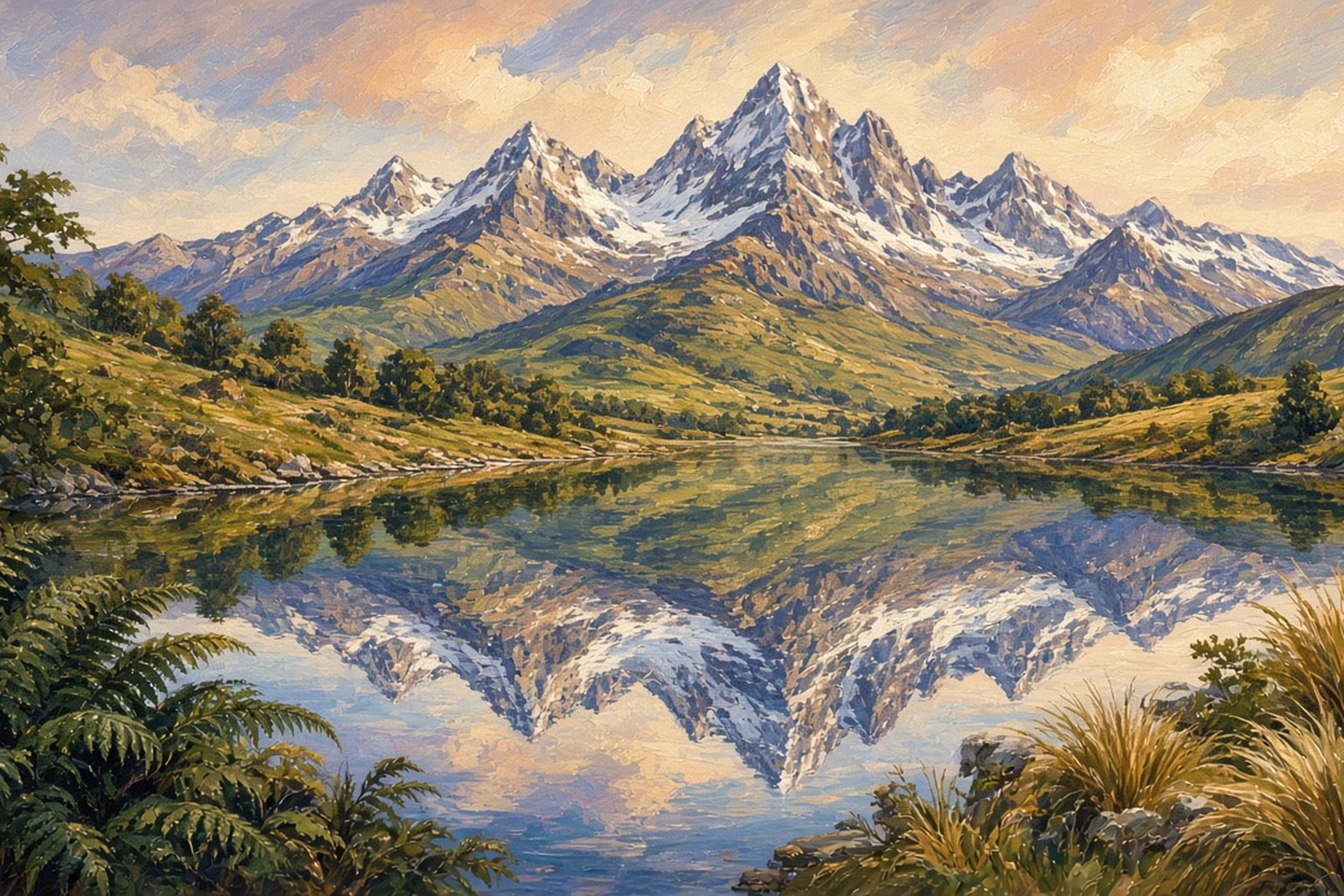
New Zealand is an island nation in the southwestern Pacific Ocean, known in the Māori language as Aotearoa, often translated as the “Land of the Long White Cloud.” Famous for its snow-capped mountains, glacier-carved fjords, steaming volcanic valleys, and golden beaches, it is one of the most scenic countries on Earth. With a proud Māori heritage, a relaxed outdoor lifestyle, and a warm welcome for visitors, New Zealand captures the imagination of travelers from every corner of the globe.
Geography and Climate
New Zealand covers about 268,000 square kilometers and consists of two main landmasses, the North Island and the South Island, along with Stewart Island and hundreds of smaller islands. It lies roughly 2,000 kilometers southeast of Australia across the Tasman Sea, making it one of the most isolated countries in the world.
The South Island is dominated by the Southern Alps, where Aoraki, also known as Mount Cook, rises to about 3,724 meters as the country’s highest peak. The North Island is shaped by volcanic activity, with active volcanoes such as Ruapehu, geothermal areas around Rotorua, and Lake Taupō, the largest lake in the country, which fills an ancient volcanic caldera.
The climate is mostly temperate and maritime, with mild temperatures, plentiful rainfall, and sunshine throughout much of the year. The far north is subtropical, while the mountains of the south receive heavy snow in winter. Because the islands were isolated for millions of years, they are home to unique wildlife, including the flightless kiwi bird, the kea parrot, and the ancient tuatara reptile.
History and Independence
Polynesian voyagers arrived in New Zealand by canoe around the thirteenth century, becoming the ancestors of the Māori people. Over generations they developed a rich culture based on tribal groups called iwi, with skilled navigation, fortified villages, farming, fishing, and a deep spiritual connection to the land and sea.
The Dutch explorer Abel Tasman reached the coast in 1642, and the British navigator James Cook mapped the islands in detail in 1769 and 1770. In 1840, the Treaty of Waitangi was signed between the British Crown and many Māori chiefs, and it is regarded as the founding document of the nation, although differing interpretations led to conflict and land loss in the decades that followed.
New Zealand became a self-governing colony and, in 1893, the first self-governing country in the world to grant women the right to vote in national elections. It became a dominion in 1907 and gradually gained full independence, adopting the Statute of Westminster in 1947. Today it is a parliamentary democracy and a member of the Commonwealth, with the British monarch as head of state.
Economy and Natural Resources
New Zealand has a developed, export-oriented economy built on its fertile pastures and mild climate. Dairy products such as milk powder, butter, and cheese are its largest exports, alongside lamb, beef, wool, timber, kiwifruit, and apples.
Wine has become a major success story, with the Marlborough region world-famous for its crisp sauvignon blanc and Central Otago known for pinot noir. Fishing, forestry, and aquaculture, including green-lipped mussels, also contribute to the economy.
Tourism is one of the country’s largest industries, and international film productions, most famously The Lord of the Rings trilogy, have showcased its landscapes to global audiences. Renewable energy is a strength, as hydroelectric dams and geothermal power stations generate most of the country’s electricity.
Culture and Language
English, Māori, and New Zealand Sign Language are the official languages, and Māori words and greetings such as kia ora are widely used in daily life. New Zealand society is multicultural, shaped by Māori, European, Pacific Islander, and Asian communities, and Auckland has one of the largest Polynesian populations of any city in the world.
Māori culture is central to national identity, expressed through the haka, a powerful ceremonial dance, as well as carving, weaving, tattooing known as tā moko, and gatherings on the marae, the traditional meeting grounds. Waitangi Day on 6 February marks the signing of the founding treaty, while Matariki, the Māori New Year, became a public holiday in 2022.
Sport is a passion for many New Zealanders, and the national rugby team, the All Blacks, is famous for performing the haka before matches. Outdoor activities such as hiking, sailing, and skiing are part of everyday life, and the country has produced celebrated writers, filmmakers, and musicians.
Food and Cuisine
New Zealand cuisine draws on fresh local produce, seafood, and Māori and British traditions. The hāngī is a traditional Māori method of cooking meat and vegetables in an earth oven heated by hot stones, creating tender, smoky dishes for special gatherings.
Roast lamb, meat pies, fish and chips, green-lipped mussels, and whitebait fritters are popular favorites. Pavlova, a meringue dessert topped with cream and fresh fruit such as kiwifruit, is a beloved treat, along with hokey pokey ice cream with crunchy honeycomb toffee.
Tourism and Attractions
Milford Sound in Fiordland National Park is one of the country’s most spectacular sights, with sheer cliffs and waterfalls plunging into a deep fjord. Tongariro National Park, a UNESCO World Heritage Site recognized for both its volcanic landscapes and Māori cultural significance, offers one of the world’s most famous day hikes.
Queenstown is known as an adventure capital for bungee jumping, skiing, and jet boating, while Rotorua offers bubbling mud pools, geysers, and Māori cultural performances. The glowworm caves of Waitomo, the sunny Bay of Islands, and the vibrant harbor cities of Auckland and Wellington round out a memorable journey.
Challenges and Opportunities
New Zealand faces challenges such as housing affordability, the risk of earthquakes and volcanic eruptions, and protecting native species from introduced predators. Addressing historical grievances through Treaty of Waitangi settlements remains an important part of national life.
At the same time, its strong institutions, clean green image, and growing technology and creative sectors offer bright prospects. Conservation projects, sustainable farming, and renewable energy are helping New Zealand protect its natural treasures for future generations.
Beneath the Long White Cloud
New Zealand is a land of towering peaks, quiet fjords, and living Māori traditions. From the geysers of Rotorua to the cliffs of Milford Sound and the lively streets of Auckland, it offers breathtaking beauty and genuine warmth at every turn. Wild, welcoming, and endlessly inspiring, New Zealand is a true jewel of the South Pacific.