
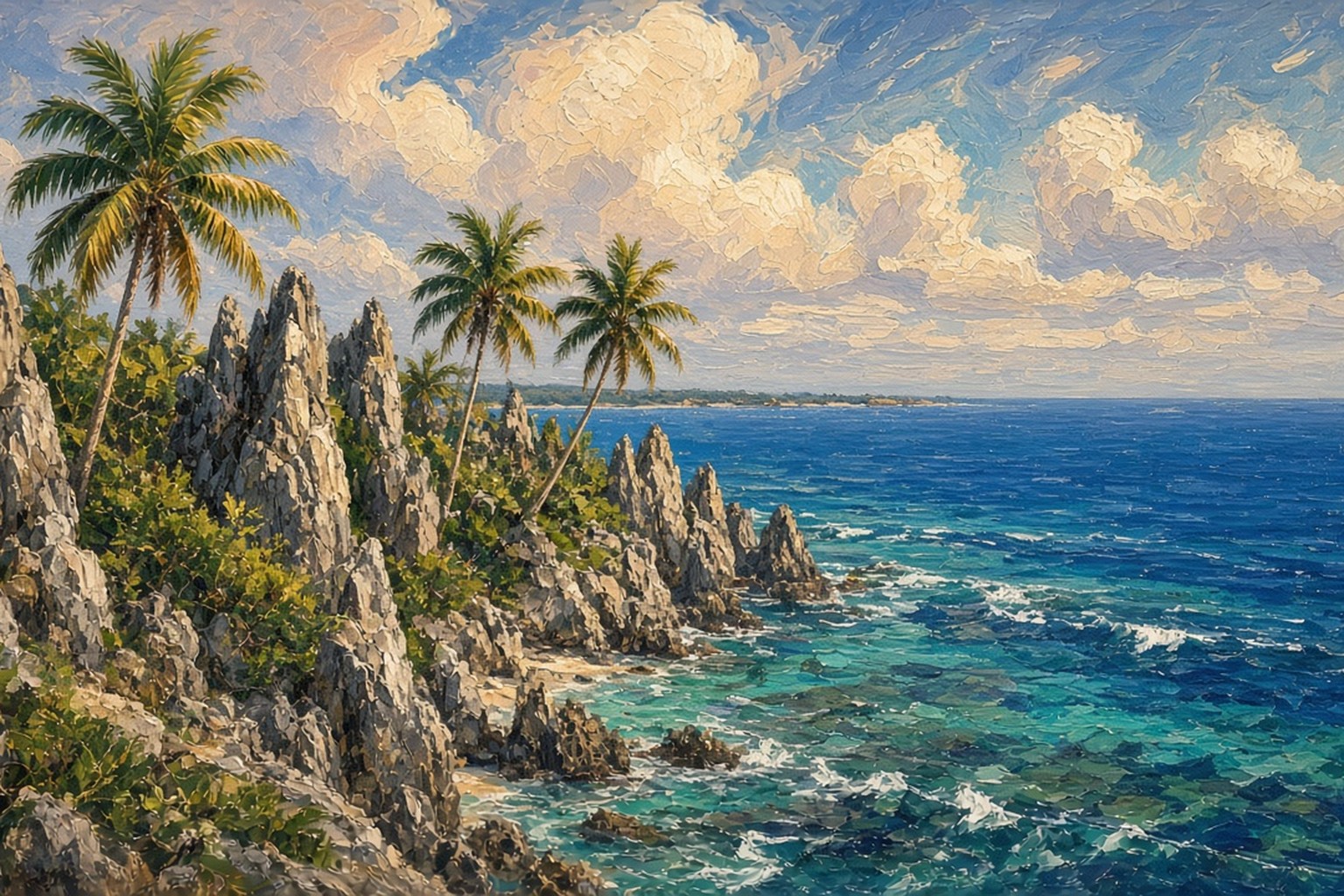
Nauru is a tiny island nation in the central Pacific Ocean, lying just south of the Equator in the region of Micronesia. Once known to sailors as “Pleasant Island,” it is one of the smallest countries in the world and the smallest republic. With its coral-fringed coastline, close-knit community, and remarkable history, Nauru offers a rare glimpse of life on one of the world’s most remote islands.
Geography and Climate
Nauru covers only about 21 square kilometers, making it the third-smallest country in the world after Vatican City and Monaco. It is a single raised coral island, surrounded by a fringing reef, and its nearest neighbor is Banaba Island in Kiribati, about 300 kilometers to the east.
A narrow, fertile coastal belt circles the island, where most people live and where coconut palms and gardens grow. Inland, a central plateau known as Topside rises to about 70 meters at Command Ridge, the highest point. Much of this plateau has been mined for phosphate, leaving a landscape of jagged coral pinnacles.
Nauru has a hot, tropical climate, cooled by ocean breezes. Most rain falls during the monsoon season from about November to February, although rainfall can vary greatly from year to year. Fresh water is limited, and the small Buada Lagoon is the island’s only notable inland body of water.
History and Independence
Nauru was settled long ago by Micronesian and Polynesian voyagers, and its people were traditionally organized into twelve clans. In 1798, the British sea captain John Fearn became the first known European to sight the island and named it Pleasant Island.
Germany annexed Nauru in 1888, and rich deposits of phosphate were discovered at the beginning of the twentieth century, with large-scale mining starting soon after. After the First World War, the island was placed under a League of Nations mandate administered by Australia on behalf of Australia, Britain, and New Zealand.
During the Second World War, Nauru was occupied by Japan, and many islanders were taken to Chuuk, in present-day Micronesia, where many lost their lives. After the war, it became a United Nations trust territory, and on 31 January 1968 Nauru became an independent republic.
Economy and Natural Resources
For much of the twentieth century, phosphate mining made Nauru one of the wealthiest nations per person in the world. As the main deposits were exhausted, the economy declined, and the country has worked to find new sources of income.
Today, revenue comes from fishing licenses for tuna in its large ocean territory, the remaining phosphate exports, and agreements with Australia, including a regional processing centre. Nauru uses the Australian dollar as its currency.
Because the island has little farmland, most food and goods are imported by sea. The government is exploring ways to rehabilitate mined land, expand solar power, and develop small businesses for a more sustainable economy.
Culture and Language
Nauruan is the national language, and English is widely used in government, business, and education. Most people are Christians, and church gatherings and choirs are an important part of community life.
Family and clan ties remain strong, and traditional skills such as fishing, weaving pandanus leaves, and catching frigatebirds are still remembered and celebrated. Angam Day, held on 26 October, marks the times in history when the Nauruan population recovered to the level needed for the community’s survival.
Sport is very popular, especially Australian rules football, which is often considered the national sport. Nauru also has a strong tradition in weightlifting, with athletes competing at international events.
Food and Cuisine
Nauruan cuisine is based on the ocean and the island’s tropical plants. Coconut fish, made with fresh fish and rich coconut milk or cream, is a local favorite, and tuna and other reef fish are often eaten grilled or raw with lime.
Coconuts, breadfruit, pandanus fruit, and bananas are traditional foods, while rice, noodles, and canned goods are common in modern meals due to imports. Asian influences can be found in small restaurants run by Chinese and other communities.
Families gather to share food at church events, birthdays, and national celebrations. Fresh coconut water is a refreshing drink on hot days, and simple home cooking often features fish caught that same morning.
Tourism and Attractions
Nauru is one of the least visited countries in the world, which gives it a peaceful, unhurried charm. A single coastal road circles the island, allowing visitors to see most of the country in a short drive.
Anibare Bay on the eastern coast is the island’s most beautiful beach, with white sand and clear water, while the calm Buada Lagoon is surrounded by palms. On Command Ridge, visitors can see Japanese guns and bunkers from the Second World War, and the Moqua Well lies in caves beneath the island.
The unusual coral pinnacles of Topside offer a striking landscape, and the waters around Nauru are rich in fish, making it a good place for deep-sea fishing. The parliament and government offices are located in the Yaren district.
Challenges and Opportunities
Nauru faces challenges such as limited land and fresh water, dependence on imports, and health problems linked to modern diets. Rising sea levels and climate change are serious concerns for the coastal belt, where most people live.
At the same time, efforts to rehabilitate the mined plateau, expand renewable energy, and manage its fisheries offer new hope. Plans to develop higher ground for future housing could help secure Nauru’s future for generations to come.
Nauru is also an active voice in Pacific regional organizations and the Commonwealth, where it speaks up on climate and ocean issues. Investments in education, healthy lifestyles, and local food production are helping build a stronger, more self-reliant community.
A Pleasant Island in the Heart of the Pacific
Nauru is a small island with a big story, shaped by the ocean, its people, and its remarkable history. From the sandy shores of Anibare Bay and the calm waters of Buada Lagoon to the coral pinnacles of Topside, it offers a unique and peaceful experience. Resilient, friendly, and proud, Nauru truly lives up to its old name, Pleasant Island.