
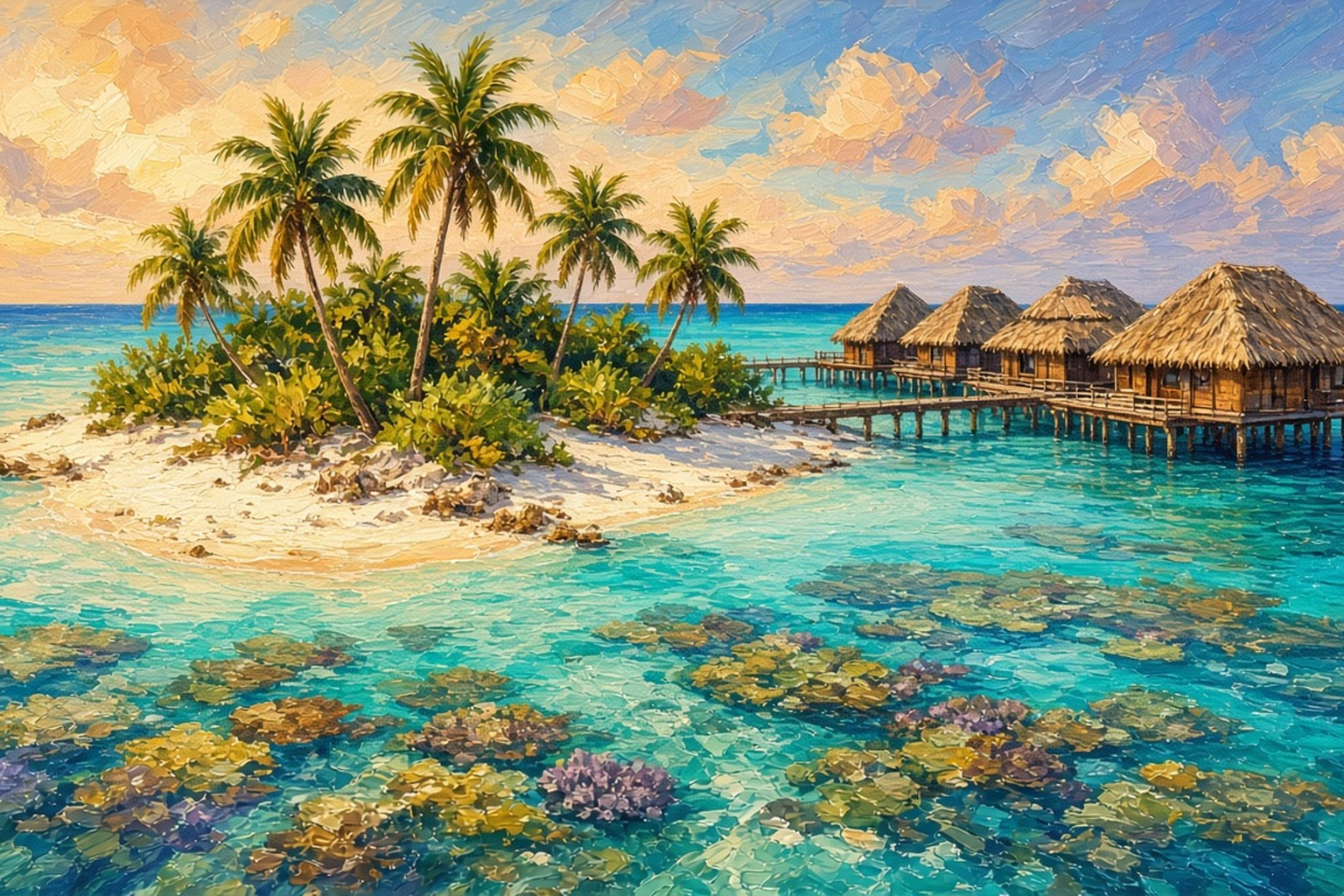
The Maldives is a tropical island nation in the Indian Ocean, made up of a chain of coral atolls southwest of India and Sri Lanka. Famous for its turquoise lagoons, white sand beaches, and luxurious overwater villas, it is one of the world’s most sought-after travel destinations. Beyond its beauty, the Maldives has a rich seafaring culture and a powerful voice in the fight against climate change.
Geography and Climate
The Maldives consists of around 1,190 coral islands grouped into 26 natural atolls, stretching across roughly 800 kilometers of ocean. Only about 200 islands are inhabited, and many others are used for resorts, while the total land area is only about 300 square kilometers, making it the smallest country in Asia.
It is the lowest-lying country in the world, with most of its land just a meter or two above sea level. The islands rest on an underwater mountain range and are surrounded by spectacular coral reefs, lagoons, and channels rich in marine life. The capital, Malé, is one of the most densely populated cities on Earth.
The Maldives has a warm tropical climate throughout the year. The dry northeast monsoon brings sunny weather from about December to April, while the southwest monsoon from May to November brings more rain and wind. Water temperatures remain warm all year round.
History and Independence
The islands were settled more than two thousand years ago by peoples from South Asia, and early Maldivians practiced Buddhism. According to tradition, the islands converted to Islam in 1153, and a series of sultanates ruled for centuries. The Maldives was well known to traders for its cowrie shells, used as currency across the Indian Ocean.
In the sixteenth century, the Portuguese briefly occupied Malé until they were driven out by Muhammad Thakurufaanu, who is honored as a national hero. Later, the Dutch and then the British exercised influence, and the Maldives became a British protectorate in 1887, while keeping its own sultan.
The Maldives gained full independence on 26 July 1965, and it became a republic in 1968. The first resorts opened in the early 1970s, beginning a transformation of the economy. The country adopted a multiparty system in 2008 and has worked to strengthen its democratic institutions.
Economy and Natural Resources
Tourism is the largest industry in the Maldives and a major source of income and employment. The country is known for its “one island, one resort” concept, in which many resorts occupy their own private islands.
Fishing is the second most important sector and an essential part of Maldivian life. Tuna is caught using traditional pole-and-line methods, which are considered more sustainable than many industrial techniques, and fish products are the main exports.
Because land and fresh water are scarce, the country imports much of its food, fuel, and building materials. Investments in airports, bridges, and reclaimed islands such as Hulhumalé aim to support growth and ease crowding in the capital.
Culture and Language
The official language is Dhivehi, which is written in a unique script called Thaana, read from right to left. English is widely spoken, especially in business, education, and tourism. Islam is the state religion and shapes daily life, holidays, and traditions.
Maldivian culture reflects influences from South Asia, Arabia, and East Africa, carried by centuries of maritime trade. Boduberu, a lively form of music and dance performed with large drums, is a popular feature of celebrations.
Traditional crafts include lacquer work, mat weaving, and the building of dhonis, the wooden boats that have long connected the islands. Community life on local islands revolves around the mosque, the harbor, and close family ties.
Food and Cuisine
Maldivian cuisine is based on three main ingredients: fish, coconut, and starches such as rice. Tuna is used in many forms, from fresh grilled fish to dried and smoked tuna that adds flavor to countless dishes.
A classic breakfast is mas huni, a mixture of shredded tuna, grated coconut, onion, and chili, eaten with roshi, a thin flatbread. Garudhiya, a clear fish broth served with rice, lime, and chili, is considered a traditional national dish.
In the afternoon, Maldivians enjoy hedhikaa, a variety of savory and sweet snacks such as fish cakes and samosa-like pastries, served with tea. Fresh tropical fruits, including mangoes, papayas, and bananas, are also popular.
Tourism and Attractions
The Maldives is one of the world’s top destinations for diving and snorkeling, with colorful coral gardens, reef sharks, turtles, and manta rays. Hanifaru Bay in Baa Atoll, part of a UNESCO Biosphere Reserve, attracts large gatherings of manta rays and whale sharks during the southwest monsoon.
In Malé, visitors can explore the Old Friday Mosque, built in the seventeenth century from carved coral stone, as well as busy fish markets and colorful streets. Local island stays, sandbank picnics, sunset dolphin cruises, and the glowing bioluminescent beaches of some islands offer unforgettable experiences.
South Ari Atoll is known for year-round sightings of whale sharks, while channels between the atolls offer thrilling drift dives. For those who prefer to stay dry, glass-bottom boats, fishing trips, and seaplane flights reveal the extraordinary patterns of reefs and islands from above.
Challenges and Opportunities
As the world’s lowest-lying nation, the Maldives faces serious threats from rising sea levels, coastal erosion, and coral bleaching caused by warming oceans. The country has long been a strong advocate for international action on climate change.
At the same time, its natural beauty, thriving tourism industry, and commitment to sustainability offer important opportunities. Investments in renewable energy, marine conservation, and climate-resilient infrastructure aim to protect the islands for future generations.
Guesthouse tourism on local islands is also spreading the benefits of tourism to more communities and allowing visitors to experience everyday Maldivian life. Training young Maldivians for skilled jobs remains an important goal.
A Paradise Worth Protecting
The Maldives is a dazzling world of coral islands, glowing lagoons, and endless ocean horizons. From the bustling streets of Malé to the quiet beaches of remote atolls and the vibrant reefs below the surface, it offers beauty beyond compare. Warm, welcoming, and deeply connected to the sea, the Maldives is a true jewel of the Indian Ocean.