
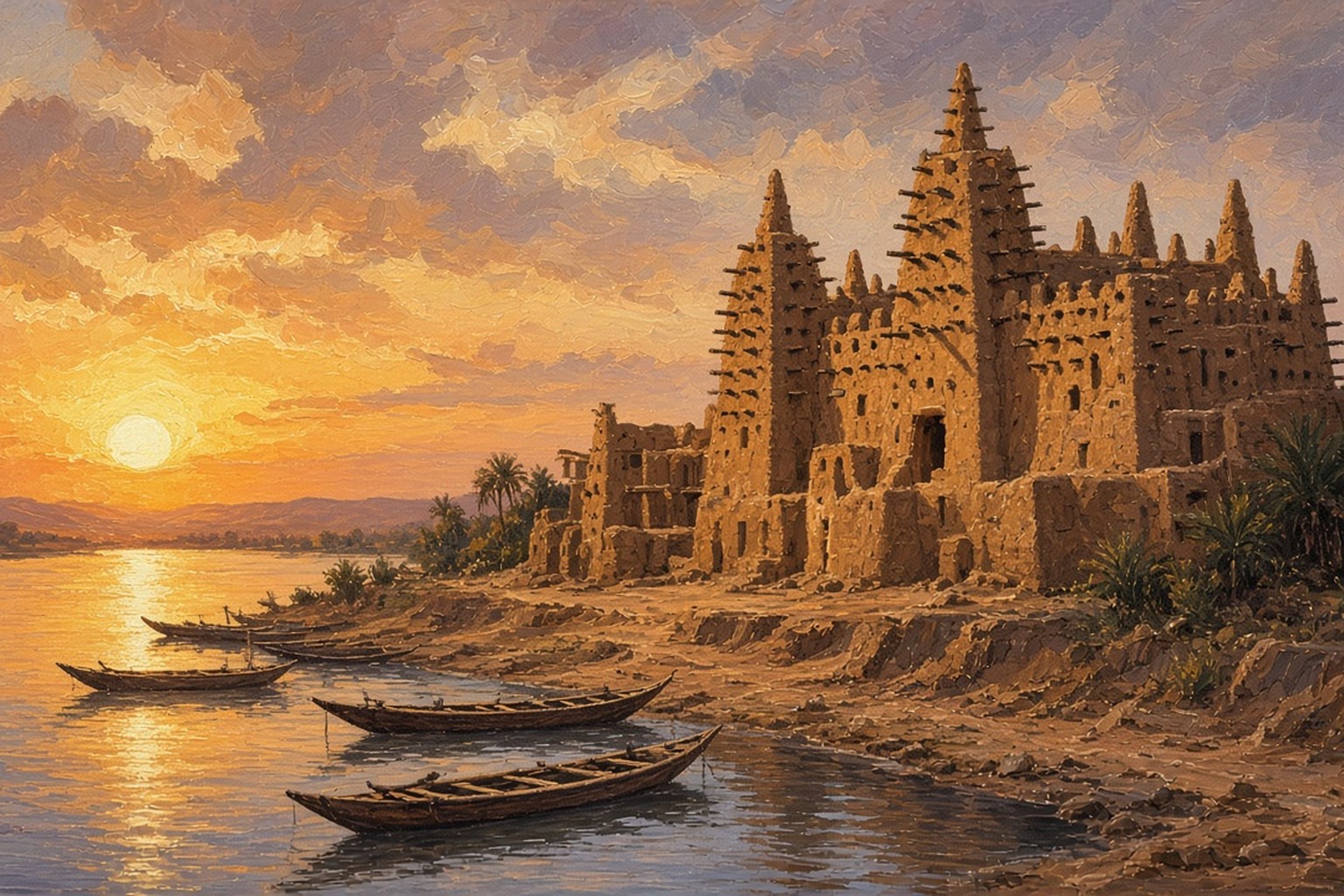
Mali is a large landlocked country in West Africa, stretching from the sands of the Sahara to the fertile banks of the Niger River. It was once the heart of great empires whose wealth and learning were famous across the medieval world. Home to legendary Timbuktu, the mud-brick wonders of Djenné, and some of Africa’s most celebrated musicians, Mali is a land of extraordinary history and culture.
Geography and Climate
Mali covers about 1.24 million square kilometers, making it one of the largest countries in Africa. It is bordered by Algeria to the north, Niger to the east, Burkina Faso and Côte d’Ivoire to the south, Guinea to the southwest, and Senegal and Mauritania to the west.
The northern part of the country lies in the Sahara Desert, while the center belongs to the semi-arid Sahel and the south is covered by savanna. The Niger River flows in a great arc through the country, forming a vast inland delta of lakes, channels, and floodplains that supports farming, fishing, and herding. The Senegal River also flows through the west.
Mali has a hot climate, with temperatures often soaring before the rainy season. Rains fall mainly between June and September, especially in the south, while the north receives very little rainfall. Dry, dusty harmattan winds blow from the Sahara during the cooler months.
History and Independence
The region was part of the ancient Ghana Empire, and in the thirteenth century Sundiata Keita founded the Mali Empire, celebrated in the epic poems of the griots. Under Mansa Musa, who made a famous pilgrimage to Mecca in 1324, the empire became renowned for its wealth in gold.
Timbuktu grew into a major center of trade and Islamic scholarship, with mosques and libraries holding thousands of manuscripts. In the fifteenth and sixteenth centuries, the Songhai Empire, based in Gao, became the dominant power before declining after a Moroccan invasion in 1591.
In the late nineteenth century, France colonized the region, which became known as French Sudan. After a brief federation with Senegal, Mali declared independence on 22 September 1960, with Modibo Keïta as its first president. Since 2012, the country has faced conflict in the north and center, as well as several changes of government.
Economy and Natural Resources
Gold is Mali’s most important export, and the country is one of the largest gold producers in Africa. Large industrial mines operate alongside many small-scale artisanal miners.
Agriculture employs the majority of the population, with cotton as a major cash crop and millet, sorghum, rice, and maize grown for food. The Office du Niger irrigation scheme supports rice farming along the river.
Livestock herding of cattle, sheep, goats, and camels is central to life in the Sahel and the north. Fishing on the Niger, salt mining in the desert, and trade across the region also provide important livelihoods.
Culture and Language
Mali is home to many ethnic groups, including the Bambara, Fulani, Songhai, Soninke, Tuareg, and Dogon. Bambara is the most widely spoken language, and French long served as the official language. Under the 2023 constitution, national languages were given official status, while French became a working language. Islam is practiced by the large majority of the population.
Music is one of Mali’s greatest treasures, and griots, hereditary musicians and storytellers, have preserved history and genealogies for centuries. Artists such as Ali Farka Touré, Salif Keita, Oumou Sangaré, and the kora master Toumani Diabaté have brought Malian music to audiences around the world.
Traditional arts include bogolanfini, or mud cloth, decorated with symbolic patterns using fermented mud. The Dogon people of the Bandiagara Escarpment are known for their striking masks, cliffside villages, and rich cosmology.
Food and Cuisine
Malian cuisine is based on grains such as millet, sorghum, rice, and maize. Tô, a thick porridge made from millet or sorghum, is a staple, usually eaten with sauces made from okra, baobab leaves, or peanuts.
Peanut stew, known locally as tigadegena, is a popular dish made with meat, tomatoes, and groundnut paste. Riz gras, rice cooked in a rich sauce with meat and vegetables, is often served at celebrations, while capitaine, a Nile perch from the Niger River, is a favorite fish.
Street vendors sell grilled meat, fried dough balls, and fresh fruit, especially mangoes in season. Strong green tea, prepared with plenty of sugar and served in several rounds, is an important social ritual shared with friends and guests.
Tourism and Attractions
Mali has four UNESCO World Heritage Sites: the old towns of Djenné and Timbuktu, the Cliff of Bandiagara in Dogon Country, and the Tomb of Askia in Gao. The Great Mosque of Djenné is the largest mud-brick building in the world, and the town’s annual festival to replaster its walls is a remarkable community event.
The Niger River offers scenic journeys past fishing villages and markets, while the capital, Bamako, is known for its lively music scene and the National Museum of Mali. Because of security concerns, travel to many areas is currently restricted, and visitors are advised to follow official guidance.
Challenges and Opportunities
Mali faces serious challenges, including armed conflict, political instability, poverty, and the effects of desertification and climate change on farming and herding. Many people have been displaced from their homes in the north and center.
At the same time, its mineral resources, fertile river lands, young population, and rich cultural heritage offer great potential. Peace, investment in education and agriculture, and protection of its historic sites could help Mali build a brighter future.
Efforts to preserve the ancient manuscripts of Timbuktu, many of which were rescued and protected during the recent conflict, show the deep pride Malians feel for their heritage. Cultural festivals and music continue to unite communities.
A Land of Empires and Melodies
Mali is a land where ancient empires once flourished and the music of the griots still tells their stories. From the mud-brick mosques of Djenné and the manuscripts of Timbuktu to the cliffs of Dogon Country and the flowing Niger River, it holds treasures of global importance. Proud and resilient, Mali remains a beating heart of West African culture.