
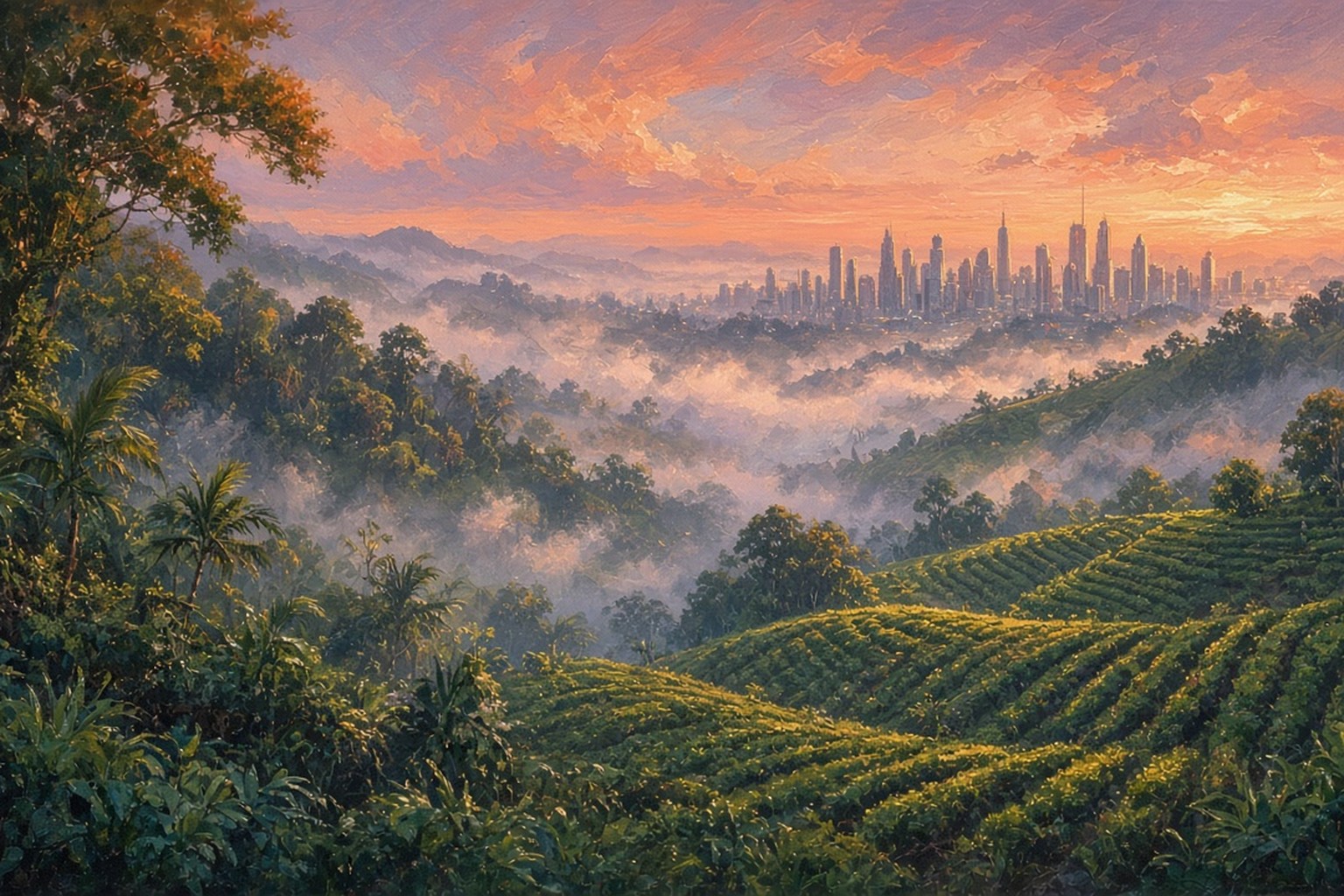
Malaysia is a vibrant nation in Southeast Asia, divided between the Malay Peninsula and the northern part of the island of Borneo. Known for its gleaming skyscrapers, ancient rainforests, and multicultural society, it brings together Malay, Chinese, Indian, and indigenous traditions. Often promoted as “Truly Asia,” Malaysia offers a captivating mix of modern cities, tropical islands, and world-famous street food.
Geography and Climate
Malaysia covers about 330,000 square kilometers and consists of two main regions separated by the South China Sea. Peninsular Malaysia borders Thailand to the north and is linked to Singapore in the south, while East Malaysia, made up of the states of Sabah and Sarawak, shares the island of Borneo with Indonesia and Brunei.
Much of the country is covered by tropical rainforest, some of which is among the oldest in the world. Mountain ranges run through the peninsula and Borneo, and Mount Kinabalu in Sabah rises to about 4,095 meters, making it one of the highest peaks in Southeast Asia. Long coastlines are lined with beaches, mangroves, and coral reefs.
Malaysia has an equatorial climate that is hot and humid throughout the year, with abundant rainfall. Monsoon winds bring heavier rains at different times to the east and west coasts, while cooler temperatures can be found in highland areas such as the Cameron Highlands.
History and Independence
Early kingdoms in the region traded with India, China, and the wider Malay world. Around 1400, the Malacca Sultanate was founded and grew into a powerful trading port that helped spread Islam across the region. Its wealth attracted European powers, and the Portuguese captured Malacca in 1511, followed by the Dutch in 1641.
The British established a presence in Penang in 1786 and gradually extended their control over the Malay states, while Sabah and Sarawak came under British influence through separate arrangements. During World War II, the region was occupied by Japan from 1941 to 1945.
The Federation of Malaya gained independence from Britain on 31 August 1957, now celebrated as National Day. On 16 September 1963, Malaya joined with Sabah, Sarawak, and Singapore to form Malaysia, although Singapore left the federation in 1965. Malaysia is a constitutional monarchy with a king chosen in rotation from among the rulers of nine states.
Economy and Natural Resources
Malaysia has one of the most developed economies in Southeast Asia, transformed over recent decades from a producer of tin and rubber into a center of manufacturing and services. Electronics and semiconductors are major exports, and many global technology companies operate factories in Penang and elsewhere.
The country is one of the world’s largest producers of palm oil, and it also exports petroleum, liquefied natural gas, rubber, and timber. The national energy company, Petronas, plays a major role in the economy.
Tourism, finance, and Islamic banking are also important sectors. Kuala Lumpur, the capital, is a busy commercial hub, while the planned city of Putrajaya serves as the seat of the federal government.
Culture and Language
Malay, known as Bahasa Malaysia, is the national language, and English is widely spoken. Chinese dialects such as Cantonese and Hokkien, along with Tamil and many indigenous languages, are also heard throughout the country.
Islam is the official religion, practiced by the majority of the population, while Buddhism, Christianity, Hinduism, and traditional beliefs are also followed. This diversity is reflected in a busy calendar of festivals, including Hari Raya Aidilfitri, Chinese New Year, Deepavali, and Christmas, which are often celebrated with open houses welcoming friends of all backgrounds.
Traditional arts include batik and songket textiles, shadow puppetry, and silat, a Malay martial art. In Sabah and Sarawak, indigenous groups such as the Iban and Kadazan-Dusun preserve their own languages, longhouse traditions, and harvest festivals.
Food and Cuisine
Malaysian cuisine is a delicious reflection of the country’s many cultures. Nasi lemak, rice cooked in coconut milk and served with spicy sambal, anchovies, peanuts, egg, and cucumber, is considered the national dish. Satay, grilled skewers of marinated meat with peanut sauce, is another favorite.
Chinese-influenced dishes such as char kway teow and Hainanese chicken rice are popular, as are Indian specialties like roti canai and banana leaf rice. Laksa, a spicy noodle soup, comes in many regional varieties, and Penang is especially famous for its street food.
Meals are often accompanied by teh tarik, a frothy pulled tea poured back and forth between cups. Tropical fruits are abundant, and the durian, known for its strong smell and creamy taste, is often called the king of fruits.
Tourism and Attractions
Kuala Lumpur is famous for the Petronas Twin Towers, once the tallest buildings in the world, as well as lively markets and the Batu Caves, a Hindu shrine set inside limestone caves. The historic cities of Melaka and George Town are UNESCO World Heritage Sites known for their colonial buildings, temples, and shophouses.
In Borneo, Kinabalu Park and Gunung Mulu National Park are also on the World Heritage list, offering mountain climbs, vast caves, and rich wildlife. Visitors can see orangutans at Sepilok, dive among turtles at Sipadan, and explore the ancient rainforest of Taman Negara.
Island escapes such as Langkawi, the Perhentian Islands, and Tioman offer clear waters and white sand beaches. The tea plantations of the Cameron Highlands provide a cool retreat from the tropical heat.
Challenges and Opportunities
Malaysia faces challenges such as deforestation linked to plantations and logging, income inequality, and the need to move toward higher-value industries. Balancing development with environmental protection remains an important concern.
At the same time, its strategic location, skilled workforce, and diverse economy offer strong opportunities. Growth in digital technology, renewable energy, and sustainable tourism could help Malaysia reach its goal of becoming a high-income nation.
A Meeting Place of Cultures
Malaysia is a land where gleaming towers rise near ancient rainforests and many cultures share one table. From the bustling streets of Kuala Lumpur to the heritage lanes of George Town and the wild beauty of Borneo, it offers endless variety. Colorful, welcoming, and full of flavor, Malaysia is a true highlight of Southeast Asia.