
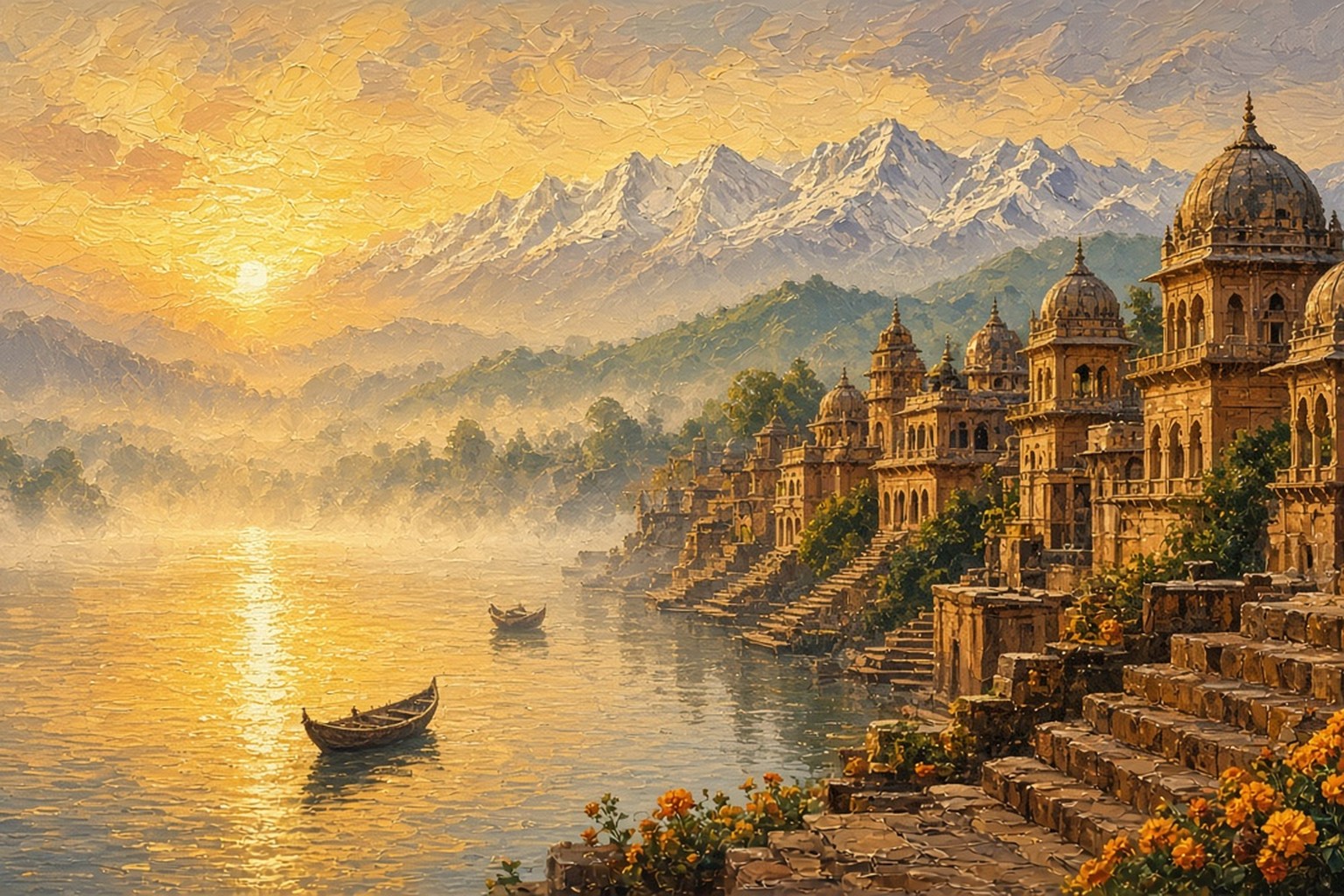
India, officially known as the Republic of India and also called Bharat, is a vast and diverse country in South Asia often described as a “subcontinent” in its own right. Home to one of the world’s oldest civilizations, it is a land of towering mountains, sacred rivers, bustling cities, and countless languages and traditions. As the world’s most populous nation and a rising economic power, India plays a central role on the global stage.
Geography and Climate
India is the seventh largest country in the world by area, covering about 3.29 million square kilometers. It shares borders with Pakistan, China, Nepal, Bhutan, Bangladesh, and Myanmar, while Sri Lanka and the Maldives lie across the sea to the south. The Arabian Sea, the Bay of Bengal, and the Indian Ocean frame its long peninsula.
The country’s landscapes are extraordinarily varied. The Himalayas rise along the northern frontier, while the fertile Indo-Gangetic Plain is watered by great rivers such as the Ganges and the Brahmaputra. To the west lies the Thar Desert, and the Deccan Plateau dominates the south, flanked by the Western and Eastern Ghats.
India’s climate ranges from alpine in the Himalayas to tropical in the south. Much of the country depends on the annual monsoon, which typically arrives in June and brings the heavy rains essential for agriculture.
History and Independence
The Indus Valley Civilization, with cities such as Harappa and Mohenjo-daro, flourished in the region more than four thousand years ago. Over the centuries, great empires rose and fell, including the Maurya Empire under Ashoka, who promoted Buddhism, and the Gupta Empire, often associated with a golden age of science and art.
From the sixteenth century, the Mughal Empire ruled much of the subcontinent, leaving a legacy of magnificent architecture. European traders followed, and the British East India Company gradually expanded its control. After the uprising of 1857, the British Crown assumed direct rule, a period known as the British Raj.
A long independence movement, led by figures such as Mahatma Gandhi and Jawaharlal Nehru, used largely nonviolent resistance to challenge colonial rule. India gained independence on August 15, 1947, accompanied by the painful partition that created Pakistan. On January 26, 1950, India adopted its constitution and became a republic, and it has since grown into the world’s largest democracy.
Economy and Natural Resources
India has one of the largest and fastest-growing economies in the world. Its information technology and services sector, centered in cities such as Bengaluru and Hyderabad, is globally renowned, while pharmaceuticals, automobiles, and textiles are also major industries.
Agriculture employs a large share of the population, producing rice, wheat, sugarcane, cotton, tea, and spices. India is rich in natural resources, including coal, iron ore, and bauxite, and is rapidly expanding its solar and wind power capacity. Its space program has achieved notable milestones, including the Chandrayaan-3 landing near the Moon’s south pole in 2023.
India’s large domestic market and growing middle class have fueled rapid expansion in retail, telecommunications, and digital payments. Major ports along both coasts connect the country to global trade routes. Programs to improve manufacturing, roads, railways, and power supply aim to create jobs for the millions of young people entering the workforce each year.
Culture and Language
India’s cultural diversity is immense. Hindi and English are used as official languages of the central government, and the constitution recognizes twenty-two scheduled languages, with hundreds more spoken across the country. India is the birthplace of Hinduism, Buddhism, Jainism, and Sikhism, and it is also home to large Muslim and Christian communities.
Festivals such as Diwali, Holi, Eid, and Durga Puja fill the calendar with color, light, and music. Classical dance forms such as Bharatanatyam and Kathak, along with Indian classical music, have ancient roots. The Indian film industry, including the Hindi-language cinema known as Bollywood, is one of the most prolific in the world.
Indian art and architecture range from ancient rock-cut temples and intricate miniature paintings to vibrant textiles and handicrafts. Yoga and Ayurveda, traditional practices with deep roots in Indian philosophy, have spread across the globe. Family ties, hospitality, and respect for elders remain important values in everyday life.
Food and Cuisine
Indian cuisine is as varied as the country itself, with each region offering distinct flavors and techniques. In the north, dishes such as butter chicken, tandoori meats, and breads like naan and roti are popular. Southern India is known for rice-based dishes such as dosa, idli, and sambar, often accompanied by coconut chutney.
Spices such as cumin, turmeric, cardamom, and chili are central to Indian cooking. Biryani, a fragrant rice dish layered with meat or vegetables, is loved across the country, while lentil dishes known as dal are everyday staples. Masala chai, a spiced milk tea, and sweets such as gulab jamun and jalebi complete the experience.
Tourism and Attractions
The Taj Mahal in Agra, a white marble mausoleum built by the Mughal emperor Shah Jahan, is one of the most famous buildings in the world. Rajasthan dazzles visitors with the palaces and forts of Jaipur, Udaipur, and Jodhpur, while the holy city of Varanasi on the Ganges offers a profound spiritual experience.
In the south, the backwaters of Kerala and the beaches of Goa offer relaxation, while the ruins of Hampi and the cave temples of Ajanta and Ellora reveal remarkable artistic heritage. The Golden Temple in Amritsar, the hill stations of the Himalayas, and wildlife reserves known for tigers further showcase India’s diversity.
Challenges and Opportunities
India faces significant challenges, including poverty, inequality, air and water pollution, and pressure on infrastructure in its rapidly growing cities. Climate change and extreme weather pose further risks for agriculture and coastal communities.
Yet India’s young population, entrepreneurial spirit, and expanding digital economy offer enormous opportunities. Continued investment in education, healthcare, clean energy, and infrastructure could help millions more share in the country’s growth.
A Tapestry of Timeless Traditions
India is a land where ancient traditions and modern ambitions exist side by side. From the snow-capped Himalayas to the palm-lined shores of Kerala, and from bustling markets to serene temples, every region offers its own story. Rich in history and full of energy, India continues to inspire and amaze all who encounter it.