
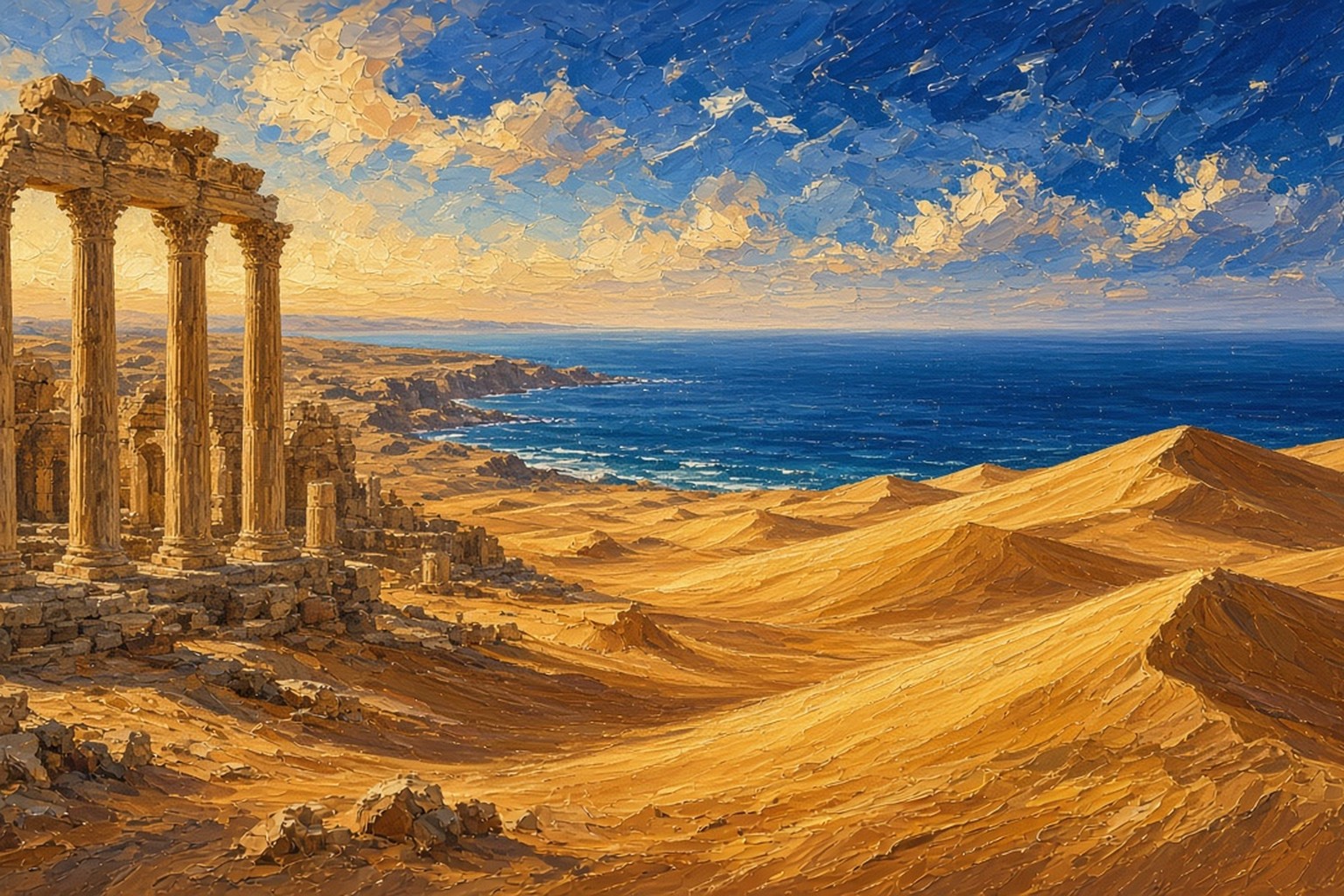
Libya is a large country in North Africa with a long Mediterranean coastline and vast stretches of the Sahara Desert. It is home to some of the best-preserved ancient Greek and Roman cities in the world, as well as desert oases and prehistoric rock art. With a history shaped by Phoenicians, Romans, Arabs, and Ottomans, Libya holds remarkable treasures waiting to be rediscovered.
Geography and Climate
Libya covers about 1.76 million square kilometers, making it the fourth-largest country in Africa. It is bordered by Egypt to the east, Sudan to the southeast, Chad and Niger to the south, and Algeria and Tunisia to the west. Its Mediterranean coastline is the longest of any African country on that sea.
The Sahara Desert covers about 90 percent of the country, with sand seas, rocky plateaus, and mountains such as the Tibesti on the southern border. Most Libyans live along the coast, especially around Tripoli in the west and Benghazi in the east, where the land is more fertile.
The coastal region has a Mediterranean climate with hot summers and mild winters, while the interior is extremely hot and dry. Hot, dusty winds known as the ghibli can blow from the desert, and there are no permanent rivers in the country. Rainfall is scarce and unpredictable, so water has always been precious in daily life and farming.
History and Independence
In ancient times, the Phoenicians founded trading cities in the west, including Oea, Sabratha, and Leptis Magna, while Greek colonists settled in the east around Cyrene. In the southern desert, the Garamantes built a powerful civilization using underground irrigation channels. These regions later became part of the Roman Empire.
Arab armies arrived in the seventh century, bringing Islam and the Arabic language. From the sixteenth century, the region was ruled by the Ottoman Empire until Italy invaded in 1911 and established a harsh colonial rule. During World War II, Libya was the scene of major battles in the North African campaign.
On 24 December 1951, Libya became independent as a kingdom under King Idris I, the first country to gain independence through the United Nations. In 1969, Muammar Gaddafi seized power and ruled for over four decades until an uprising in 2011 ended his regime. Since then, the country has struggled with political division and conflict.
Economy and Natural Resources
Libya’s economy depends heavily on oil and natural gas, which were discovered in 1959 and transformed the country. It has the largest proven oil reserves in Africa, and hydrocarbons account for the vast majority of export earnings and government revenue.
To bring water to its coastal cities, Libya built the Great Man-Made River, a vast network of pipelines that carries ancient groundwater from aquifers deep beneath the Sahara. Agriculture along the coast produces olives, dates, citrus fruits, and grains.
Political instability has frequently disrupted oil production and limited investment in other sectors. Diversifying the economy, rebuilding infrastructure, and creating jobs for young people are major priorities for the country’s future.
Culture and Language
Arabic is the official language, and Islam is practiced by almost the entire population. The Amazigh, or Berber, people have their own language and traditions, especially in the Nafusa Mountains and coastal towns such as Zuwara. In the southern desert, the Tuareg and Tebu peoples maintain distinct cultures.
Family and tribal ties are an important part of Libyan society, and hospitality is highly valued. Guests are often welcomed with tea, dates, and generous meals, and religious holidays such as Eid are celebrated with family gatherings.
Traditional music, poetry, and crafts such as weaving, leatherwork, and silver jewelry reflect the country’s Arab, Amazigh, and Mediterranean heritage. The historic medinas of Tripoli and other cities preserve old mosques, souks, and courtyard houses.
Food and Cuisine
Libyan cuisine combines North African, Mediterranean, and Ottoman influences, with Italian touches from the colonial era. Couscous, often served with lamb and vegetables, is a beloved dish, and pasta dishes such as spicy macaroni are popular throughout the country.
Bazeen, a dough made from barley flour served with a rich tomato and meat stew, is a traditional specialty. Shorba, a spiced soup with lamb and orzo, is especially popular during Ramadan, when families gather to break their fast at sunset.
Dates, olives, and flatbreads are everyday staples, and sweet pastries are made for celebrations. Strong mint tea, often served in small glasses and topped with roasted peanuts or almonds, is enjoyed after meals and with friends.
Tourism and Attractions
Libya has five UNESCO World Heritage Sites, including the magnificent Roman city of Leptis Magna, the seaside ruins of Sabratha, and the ancient Greek city of Cyrene. In the desert, the Tadrart Acacus mountains preserve thousands of prehistoric rock paintings and carvings.
The old town of Ghadames, known as the “Pearl of the Desert,” features whitewashed mud-brick houses linked by covered alleys. The medina of Tripoli, the Ubari sand dunes with their palm-fringed lakes, and the green hills of Jebel Akhdar also showcase the country’s diversity.
Many of these treasures remain little visited because of security concerns, which means travelers who do come often find them almost empty. Experienced local guides help visitors explore the desert safely and share stories of the region’s long history.
Challenges and Opportunities
Libya faces serious challenges, including divided governments, armed groups, and damaged infrastructure. Heavy dependence on oil, water scarcity, and the impact of extreme weather, such as the devastating floods in Derna in 2023, add further difficulties.
Yet the country’s energy wealth, strategic location, and extraordinary heritage offer great potential. With lasting peace and stable institutions, Libya could develop renewable energy, rebuild its cities, and welcome visitors once again.
A Land of Desert and Antiquity
Libya is a land where Roman columns stand beside the blue Mediterranean and golden dunes stretch to the horizon. From the grand ruins of Leptis Magna to the timeless lanes of Ghadames and the rock art of the Acacus, it holds stories spanning thousands of years. Rich in history and resilience, Libya awaits a brighter and more peaceful chapter.