
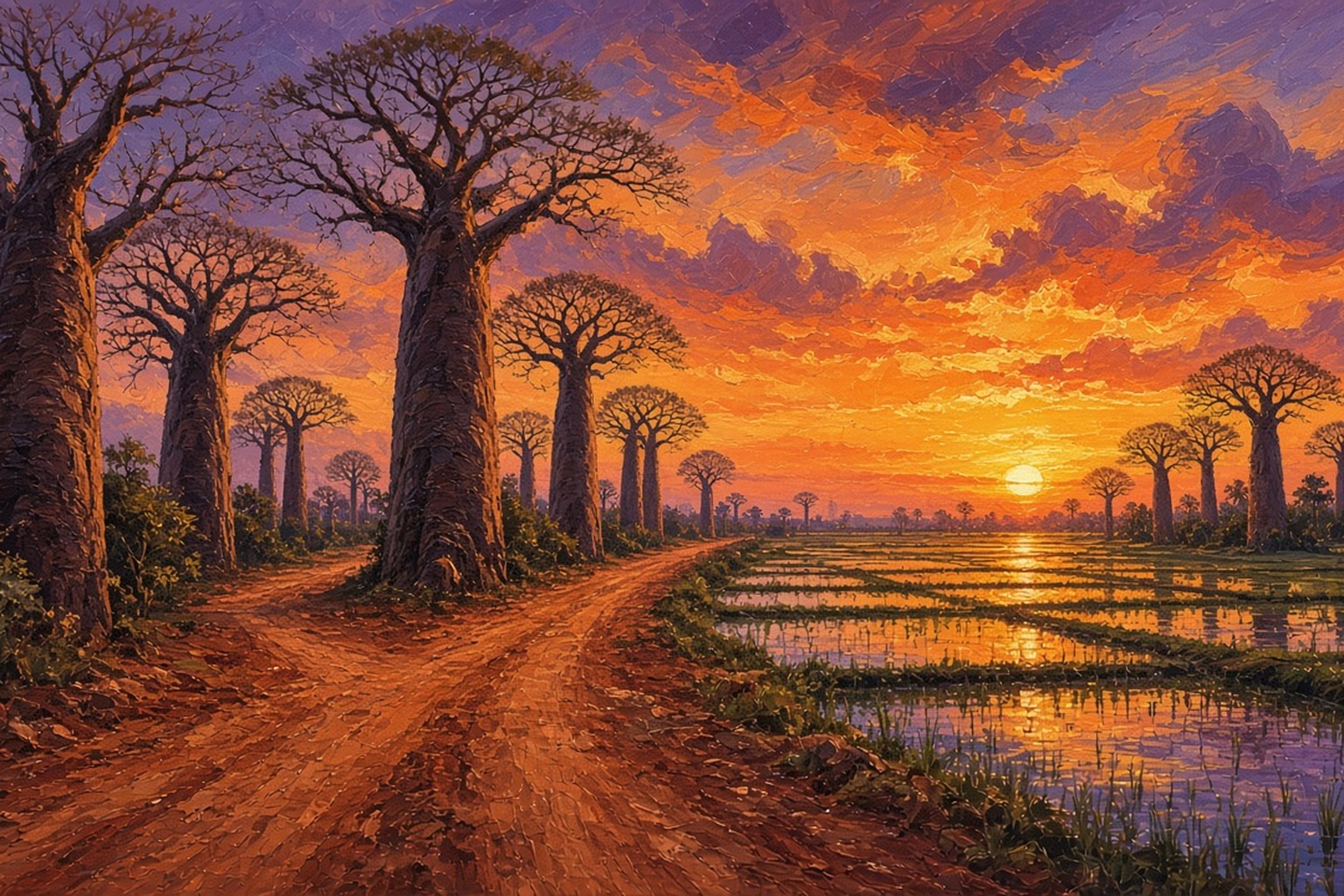
Madagascar is a vast island nation in the Indian Ocean, lying off the southeastern coast of Africa. Often described as the “eighth continent,” it is famous for its extraordinary wildlife, including lemurs, chameleons, and towering baobab trees found almost nowhere else on Earth. With its rainforests, limestone pinnacles, and rich blend of African and Asian heritage, Madagascar is truly one of a kind.
Geography and Climate
Madagascar covers about 587,000 square kilometers and is the fourth-largest island in the world. It is separated from mainland Africa by the Mozambique Channel and has been isolated from other landmasses for many millions of years, allowing unique plants and animals to evolve.
A central highland plateau runs down the length of the island, with the capital, Antananarivo, located in its heart. The highest peak, Maromokotro in the Tsaratanana Massif, rises to about 2,876 meters. The eastern side is covered by steep slopes and tropical rainforest, while the west has dry forests and grasslands, and the far south is home to the remarkable spiny forest.
The climate is tropical along the coasts and more temperate in the highlands. A hot, rainy season runs from about November to April, while the cooler dry season lasts from May to October. Cyclones from the Indian Ocean sometimes strike the island, especially along the east coast. The southwest is the driest region, receiving very little rainfall in most years.
History and Independence
Madagascar was one of the last major landmasses to be settled by humans. The first inhabitants are believed to have been Austronesian seafarers who sailed from the region of present-day Indonesia, later joined by migrants from East Africa, as well as Arab and other traders.
In the early nineteenth century, the Merina Kingdom of the central highlands, under rulers such as Andrianampoinimerina and Radama I, unified much of the island. France invaded in the 1890s and made Madagascar a colony in 1896, abolishing the monarchy the following year.
A major uprising against colonial rule in 1947 was harshly suppressed, but the movement for self-rule continued. Madagascar gained independence on 26 June 1960. Since then, it has experienced periods of political change and instability, alongside steady efforts to build democratic institutions.
Economy and Natural Resources
Agriculture employs most of the population, with rice as the main staple crop grown on terraces and paddies across the island. Madagascar is the world’s leading producer of vanilla, and it also exports cloves, coffee, lychees, and ylang-ylang used in perfumes.
The island is rich in minerals, including nickel, cobalt, ilmenite, graphite, and precious stones such as sapphires. The textile and clothing industry, fishing, and shrimp farming are also important sources of jobs and exports.
Tourism, centered on the island’s unique wildlife and landscapes, has great potential and brings income to many local communities. Improving roads, electricity, and access to markets remains essential for future economic development.
Culture and Language
Malagasy and French are the official languages, and Malagasy is spoken throughout the island in many regional dialects. The population includes around eighteen main ethnic groups, such as the Merina, Betsimisaraka, and Sakalava, and the culture blends Southeast Asian, African, and Arab influences.
Respect for ancestors is central to Malagasy life, and many families observe famadihana, or the turning of the bones, a ceremony in which relatives rewrap the remains of the dead in fresh cloth and celebrate with music and dancing. Local taboos called fady guide behavior in many communities.
Music is an important part of daily life, and the valiha, a tube zither made from bamboo, is considered a national instrument. Hiragasy performances, combining music, dance, and storytelling, are popular in the highlands, and the Royal Hill of Ambohimanga is a sacred site of great cultural importance.
Food and Cuisine
Rice is at the center of Malagasy cuisine and is eaten at nearly every meal, often accompanied by a side dish called laoka. Romazava, a stew of beef and leafy greens, is often considered the national dish, while ravitoto, made from pounded cassava leaves and pork, is another favorite.
Zebu, the humped cattle found throughout the island, are highly valued and provide meat for special occasions. Along the coasts, fish, shrimp, and other seafood are prepared with coconut milk, ginger, and garlic.
Snacks such as mofo gasy, small rice cakes, are sold at street stalls in the morning, and fresh tropical fruits are abundant. Vanilla often flavors desserts and drinks, and ranovola, a drink made from the toasted rice at the bottom of the pot, is commonly served with meals.
Tourism and Attractions
The Avenue of the Baobabs near Morondava, with its giant trees lining a dirt road, is one of Madagascar’s most iconic sights. The Tsingy de Bemaraha, a UNESCO World Heritage Site, features dramatic forests of sharp limestone pinnacles crossed by suspension bridges.
The Rainforests of the Atsinanana, another UNESCO site, include parks such as Ranomafana, where visitors can spot rare lemurs. In Andasibe-Mantadia National Park, the haunting calls of the indri, the largest living lemur, echo through the trees.
Isalo National Park offers sandstone canyons and natural swimming pools, while the island of Nosy Be is famous for its beaches, coral reefs, and the scent of ylang-ylang. Whale watching off Île Sainte-Marie is a highlight from July to September.
Challenges and Opportunities
Madagascar faces serious challenges, including widespread poverty, deforestation, soil erosion, and the effects of cyclones and drought, especially in the south. Protecting its unique ecosystems while meeting the needs of a growing population is a major concern.
At the same time, its extraordinary biodiversity, natural resources, and young population offer great opportunities. Sustainable agriculture, eco-tourism, and conservation programs could help improve livelihoods while preserving the island’s treasures.
An Island Like No Other
Madagascar is a world apart, where lemurs leap through misty forests and ancient baobabs stand tall against glowing sunsets. From the limestone wonders of the Tsingy to the beaches of Nosy Be and the terraced rice fields of the highlands, it offers endless discoveries. Rich in nature and culture, Madagascar is a true treasure of the Indian Ocean.