
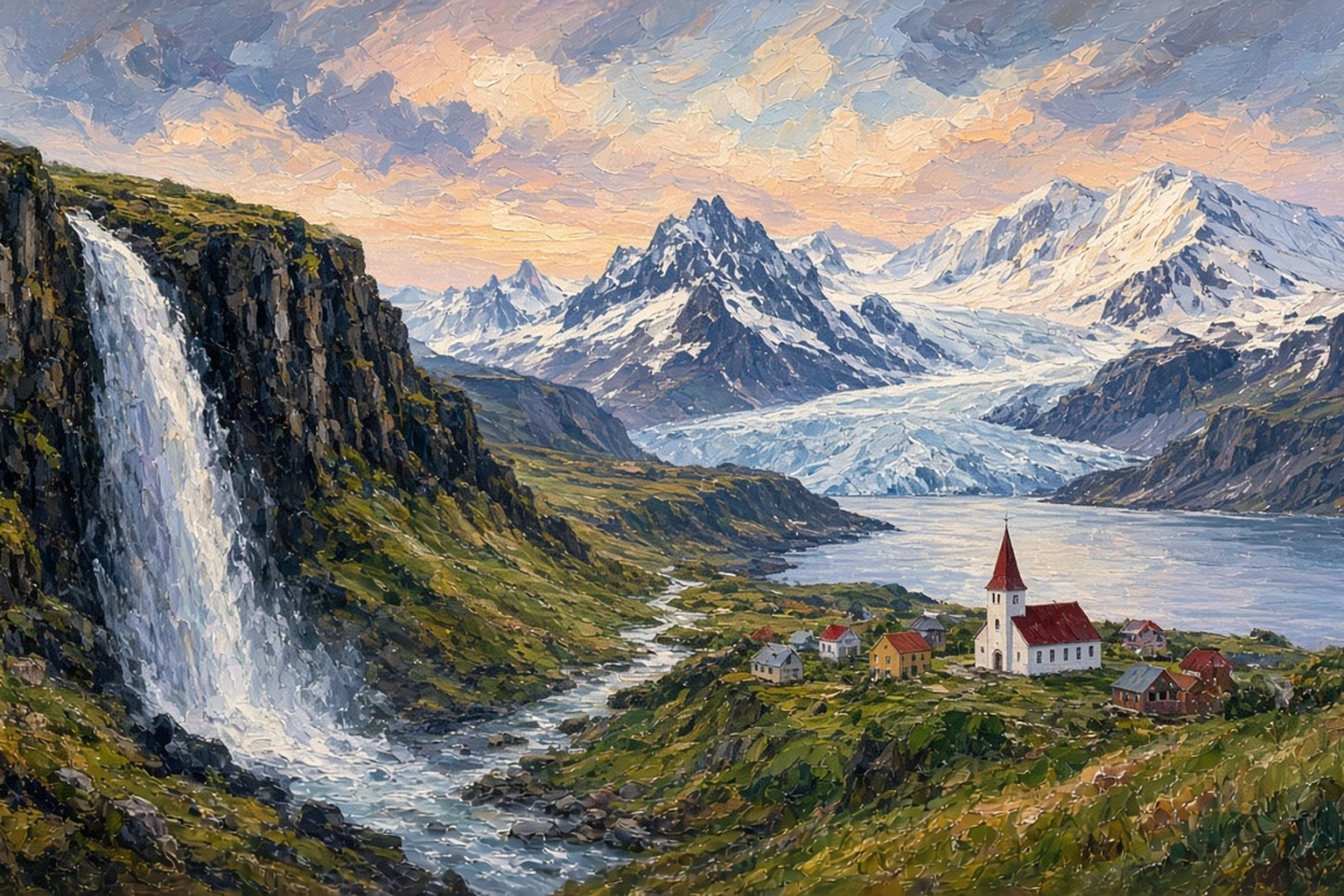
Iceland, a rugged island nation in the North Atlantic, is often called the “Land of Fire and Ice” for its remarkable combination of active volcanoes and vast glaciers. Lying just south of the Arctic Circle, it is a place of thundering waterfalls, steaming geothermal fields, black sand beaches, and shimmering northern lights. With a small but proud population, a literary heritage stretching back a thousand years, and a deep connection to nature, Iceland captivates travelers from around the world.
Geography and Climate
Iceland covers about 103,000 square kilometers and sits on the Mid-Atlantic Ridge, where the North American and Eurasian tectonic plates are slowly pulling apart. This geological setting gives the island its frequent volcanic activity, earthquakes, and abundant geothermal energy. The country’s interior is a largely uninhabited highland plateau of lava fields, mountains, and glaciers.
Glaciers cover roughly a tenth of the land, with Vatnajökull ranking among the largest ice caps in Europe. Famous volcanoes include Hekla, Katla, and Eyjafjallajökull, whose 2010 eruption disrupted air travel across Europe. Rivers fed by glacial meltwater create dramatic waterfalls, while fjords carve deeply into the coastline in the north, east, and west.
Despite its northern latitude, Iceland has a relatively mild subarctic maritime climate thanks to the North Atlantic Current. Winters are long and dark but often less severe than expected, while summers are cool, with nearly continuous daylight around the June solstice.
History and Independence
Iceland was settled by Norse seafarers in the late ninth century, with Ingólfur Arnarson traditionally regarded as the first permanent settler, establishing his farm at Reykjavík around 874. In 930, the settlers founded the Althing, a national assembly that met at Þingvellir and is one of the oldest parliamentary institutions in the world.
In 1262, Iceland came under the Norwegian crown, and it later passed to Danish rule. A national independence movement grew during the nineteenth century, and in 1918 Iceland became a sovereign kingdom in union with Denmark. On June 17, 1944, Iceland became a fully independent republic.
Iceland was a founding member of NATO in 1949, although it has no standing army. During the twentieth century, it extended its fishing limits in a series of disputes with the United Kingdom known as the Cod Wars. The 2008 collapse of its major banks caused a deep crisis, from which the country gradually recovered.
Economy and Natural Resources
Fishing has long been the backbone of Iceland’s economy, and seafood remains one of its most important exports. In recent decades, tourism has grown rapidly to become a leading industry, drawing visitors to the island’s spectacular natural attractions.
Iceland generates nearly all of its electricity from renewable sources, mainly hydropower and geothermal energy. Geothermal water also heats the vast majority of homes. This abundant clean energy has attracted energy-intensive industries such as aluminum smelting and data centers, while a growing technology and creative sector adds further diversity to the economy.
Culture and Language
Icelandic is the national language and has changed relatively little since medieval times, allowing modern Icelanders to read the old sagas with relative ease. These sagas, written in the thirteenth and fourteenth centuries, tell stories of early settlers, feuds, and heroism. Icelanders traditionally use patronymic surnames, based on a parent’s first name, rather than family names.
Literature remains central to Icelandic life, and the tradition of giving books as Christmas gifts is known as the Jólabókaflóð, or “Christmas book flood.” The country also has a thriving music scene that has produced internationally known artists. Folklore about elves and hidden people adds a touch of mystery to the landscape.
Icelanders take pride in their strong traditions of equality and community, and the country has frequently ranked at the top of global gender equality indexes. Swimming in outdoor geothermal pools is a daily social ritual in towns across the island. Sports such as handball and football enjoy passionate support, and the national teams have achieved notable success for such a small nation.
Food and Cuisine
Icelandic cuisine reflects the island’s maritime environment and farming traditions. Fresh fish such as cod, haddock, and Arctic char are staples, and plokkfiskur, a comforting fish and potato stew, is a household favorite. Free-roaming Icelandic lamb is prized for its flavor and is often served roasted or in hearty soups.
Skyr, a thick cultured dairy product, has been eaten for centuries and is now enjoyed around the world. During the midwinter festival of Þorrablót, Icelanders gather to eat traditional foods such as fermented shark, known as hákarl, and cured meats. Rye bread baked slowly in geothermal ground and the popular Icelandic hot dog are also local specialties.
Tourism and Attractions
The Golden Circle route is one of Iceland’s most popular journeys, linking Þingvellir National Park, a UNESCO World Heritage Site, with the Geysir geothermal area and the mighty Gullfoss waterfall. In Reykjavík, the striking Hallgrímskirkja church and the Harpa concert hall are notable landmarks.
Along the south coast, visitors encounter the waterfalls of Seljalandsfoss and Skógafoss, the black sand beach of Reynisfjara, and the Jökulsárlón glacier lagoon filled with floating icebergs. The geothermal Blue Lagoon is world famous, while the Snæfellsnes Peninsula, the Westfjords, and whale watching from Húsavík offer further adventures. In winter, the northern lights draw travelers seeking the aurora borealis.
Challenges and Opportunities
Iceland faces challenges linked to its environment and size, including volcanic eruptions, such as the series of eruptions on the Reykjanes Peninsula since 2021, and the effects of climate change on its glaciers. Rapid tourism growth has also placed pressure on fragile natural sites and housing.
At the same time, Iceland’s expertise in geothermal energy, sustainable fisheries, and gender equality makes it a model for other nations. Investments in innovation, green technology, and responsible tourism offer promising paths for the future.
A Land Forged by Fire and Ice
Iceland is a land where the forces of nature are on constant display, from erupting volcanoes to glistening glaciers and dancing auroras. Its people have built a resilient and creative society on the edge of the Arctic, guided by a deep respect for their history and environment. For anyone seeking wonder and wild beauty, Iceland is an unforgettable destination.