
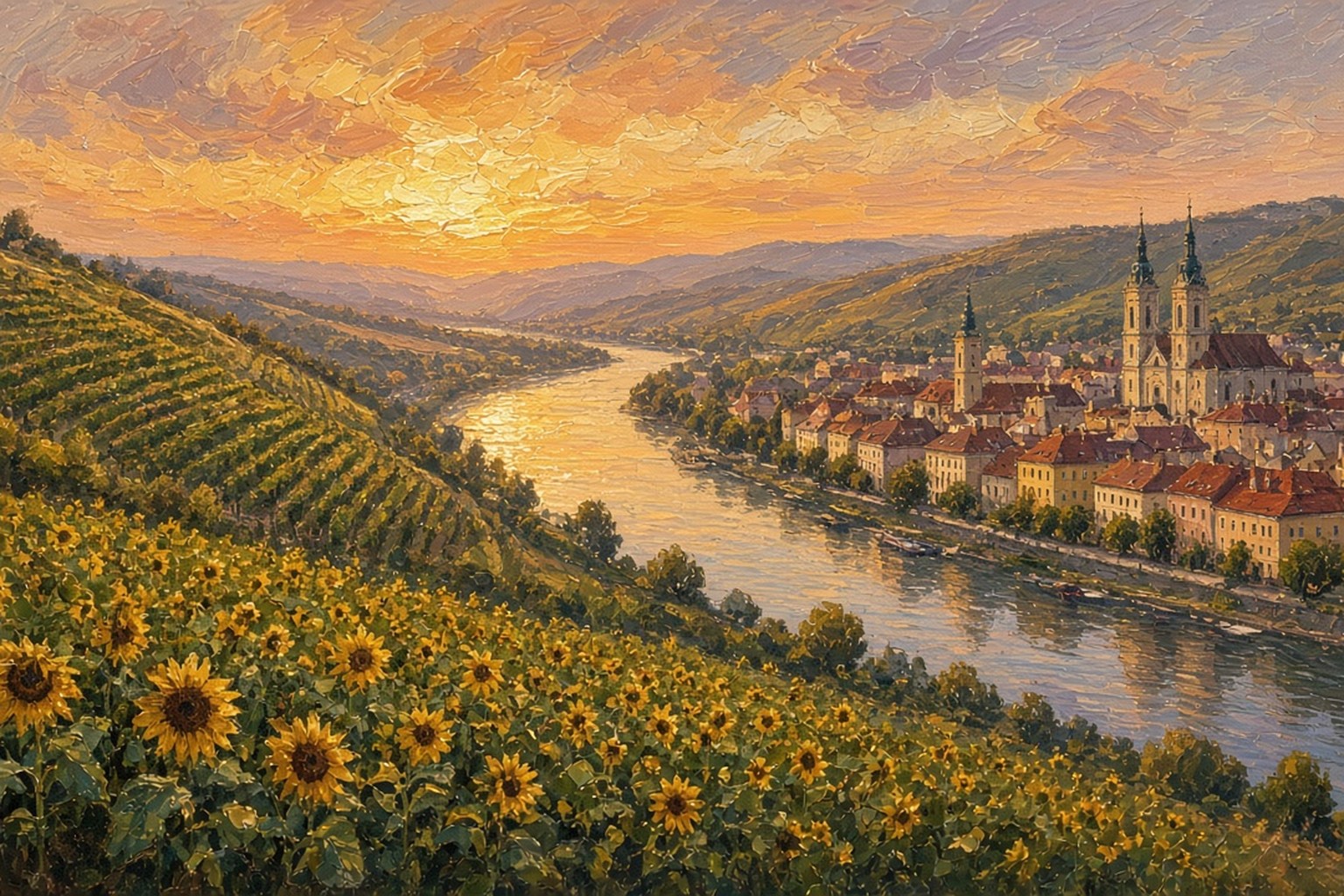
Hungary, a landlocked country in the heart of Central Europe, is often celebrated for its thermal springs, grand architecture, and rich musical heritage. Its capital, Budapest, is frequently called the “Pearl of the Danube” for the elegant way it spans both banks of the river. With a distinctive language, centuries of history, and a famously flavorful cuisine, Hungary offers a unique and memorable window into European culture.
Geography and Climate
Hungary is bordered by Slovakia to the north, Ukraine to the northeast, Romania to the east, Serbia to the south, Croatia and Slovenia to the southwest, and Austria to the west. Covering about 93,000 square kilometers, the country lies largely within the Carpathian Basin. The Danube River flows from north to south, dividing the country, while the Tisza River crosses the eastern plains.
Much of Hungary is flat or gently rolling, with the Great Hungarian Plain stretching across the east and south. Low mountain ranges in the north include the Mátra, home to Kékes, the country’s highest peak. Lake Balaton, the largest lake in Central Europe, is a beloved summer destination.
Hungary has a continental climate with warm summers and cold winters. Rainfall is moderate, and the country’s fertile soils and sunny summers support a strong agricultural tradition, including vineyards in many regions.
History and Independence
The Magyars, ancestors of today’s Hungarians, settled in the Carpathian Basin in the late ninth century. In the year 1000, Stephen I was crowned the first King of Hungary and introduced Christianity, laying the foundations of the Hungarian state. Over the following centuries, the kingdom became a significant power in Central Europe.
After the Battle of Mohács in 1526, much of Hungary fell under Ottoman rule, while other parts came under the Habsburgs. The Habsburgs later controlled the whole territory, and the failed revolution of 1848 was followed by the Compromise of 1867, which created the Austro-Hungarian Empire. Following World War I, Hungary became an independent state but lost a large portion of its territory under the Treaty of Trianon in 1920.
After World War II, Hungary came under communist rule, and the 1956 uprising against Soviet control was crushed by Soviet forces. In 1989, Hungary peacefully transitioned to a multiparty democracy. The country joined NATO in 1999 and the European Union in 2004.
Economy and Natural Resources
Hungary has a developed, export-oriented economy closely integrated with the rest of the European Union. The automotive industry is especially important, with major international carmakers operating factories in the country, alongside electronics, pharmaceuticals, and machinery.
Agriculture benefits from fertile land, producing wheat, corn, sunflowers, fruit, and paprika, as well as celebrated wines. Hungary has limited fossil fuel resources and relies on imported energy, along with nuclear power from the Paks plant. Thermal waters are an important natural resource, supporting a long tradition of spa culture and tourism.
Tourism is another significant contributor, with millions of visitors drawn to Budapest, Lake Balaton, and the country’s wine regions each year. Hungary’s central location and transport links have also made it an attractive base for logistics companies and shared service centers serving the wider European market.
Culture and Language
Hungarian, or Magyar, is the official language and belongs to the Uralic language family, making it distinct from most of its Indo-European neighbors. Hungarians have made notable contributions to science, literature, and the arts, and many inventions and discoveries are associated with Hungarian thinkers.
Music holds a special place in Hungarian culture, from the works of composers Franz Liszt, Béla Bartók, and Zoltán Kodály to vibrant folk traditions. Folk dance, embroidery, and the Busójárás carnival in Mohács are cherished customs. Bathing in thermal spas is a social tradition enjoyed by people of all ages.
Hungarian architecture spans Romanesque churches, Baroque towns, and the elegant Art Nouveau buildings of Budapest. Equestrian traditions remain alive on the Great Plain, where csikós horsemen perform displays of skill. Literature and poetry are deeply valued, and writers such as Sándor Petőfi are celebrated as national heroes.
Food and Cuisine
Hungarian cuisine is hearty and full of flavor, with paprika as its signature spice. Goulash, or gulyás, is a rich soup of beef, vegetables, and paprika, and it is perhaps the country’s most famous dish. Chicken paprikash, served with small dumplings called nokedli, is another classic, as is the fisherman’s soup known as halászlé.
Lángos, a deep-fried flatbread often topped with sour cream and cheese, is a popular street food, while desserts such as Dobos torte and chimney cake delight visitors. Hungary is also known for its wines, especially the sweet Tokaji from the Tokaj region, as well as the herbal liqueur Unicum and fruit brandy called pálinka.
Tourism and Attractions
Budapest is one of Europe’s most beautiful capitals, with the Hungarian Parliament Building, Buda Castle, and the Chain Bridge lining the Danube. The banks of the Danube and the Buda Castle Quarter are recognized as a UNESCO World Heritage Site, and the city’s thermal baths, such as Széchenyi and Gellért, are world famous.
Beyond the capital, Lake Balaton offers beaches, sailing, and charming resort towns. The Danube Bend, with towns such as Szentendre and Esztergom, is known for its scenery and history, while Eger is famous for its castle and wines. Hortobágy National Park preserves the traditions and landscapes of the Great Hungarian Plain.
Challenges and Opportunities
Hungary faces challenges such as an aging population, emigration of young workers, and dependence on imported energy. Debates over governance and its relationship with European Union institutions have also drawn attention in recent years.
Nevertheless, the country has strong opportunities in manufacturing, technology, tourism, and agriculture. Its central location, skilled workforce, and rich cultural heritage provide a solid foundation for continued development.
A Land of Music and Thermal Waters
Hungary is a country where history, music, and healing waters flow together. From the glittering lights of Budapest to the vineyards of Tokaj and the shores of Lake Balaton, it invites visitors to slow down and savor its many layers. Proud of its unique language and traditions, Hungary continues to enchant all who discover it.