
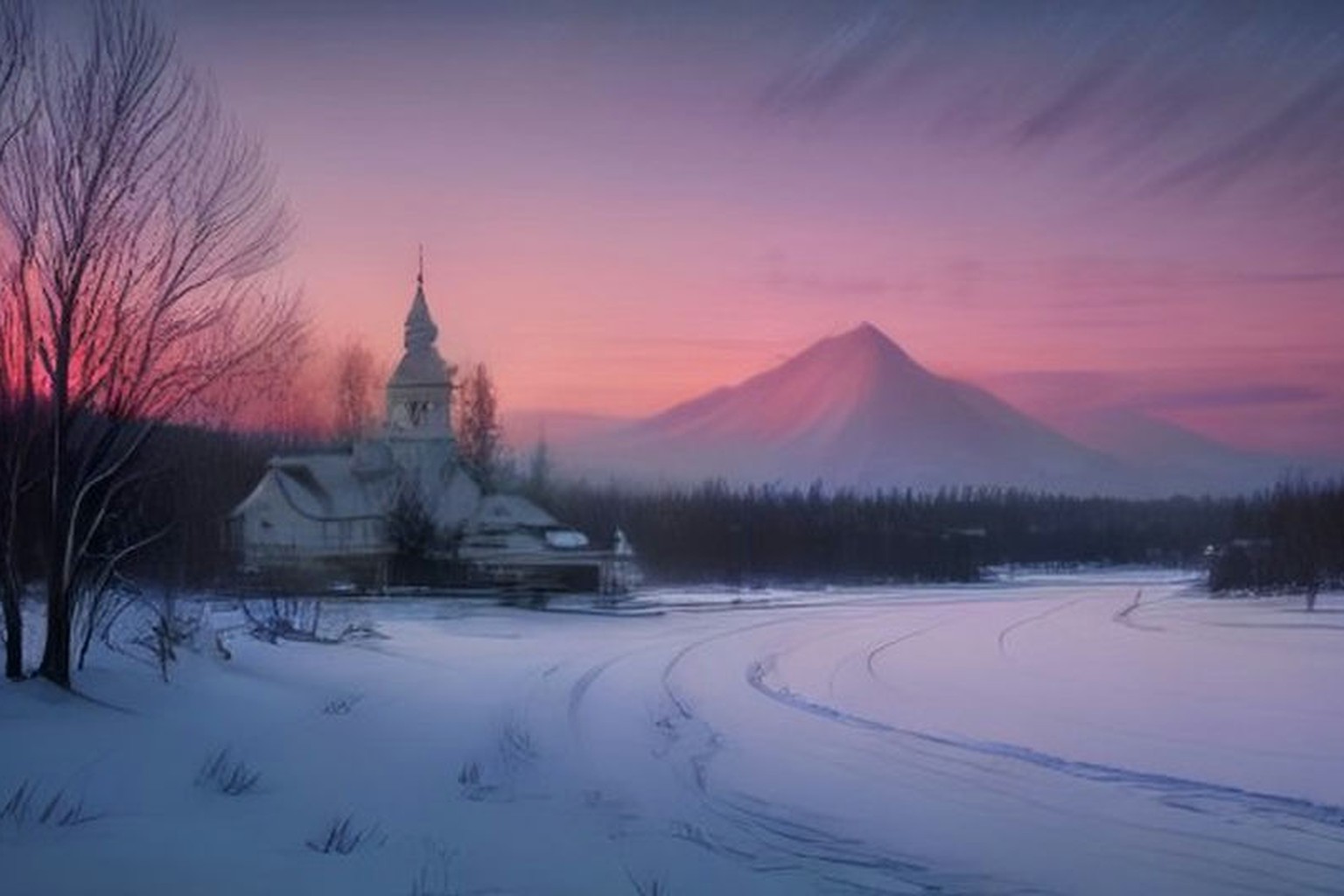
Russia is the largest country on Earth, stretching across eleven time zones from the Baltic Sea in eastern Europe to the Pacific Ocean in northeastern Asia. Its vast forests, great rivers, golden-domed cathedrals, and towering literary and musical traditions have shaped world culture for centuries. Often called the “land of birches and endless horizons,” Russia is a place where grand scale and deep tradition meet at every turn.
Geography and Climate
Russia covers about 17.1 million square kilometers, nearly twice the size of the next largest country. It shares land borders with fourteen countries, including Norway, Finland, Poland, Ukraine, Georgia, Kazakhstan, Mongolia, China, and North Korea. Moscow, the capital, is the largest city, followed by Saint Petersburg.
The Ural Mountains traditionally divide the continent’s European and Asian parts. West of them lie broad plains and the Volga, the longest river in Europe, while to the east spreads Siberia, a huge region of taiga forest, tundra, and mighty rivers such as the Ob, Yenisei, and Lena. The Caucasus Mountains in the south include Mount Elbrus, the highest peak in Europe at 5,642 meters.
Lake Baikal in southern Siberia is the deepest lake in the world and holds a remarkable share of the planet’s unfrozen fresh water. Much of the country experiences long, snowy winters and short, warm summers.
History and Independence
The roots of Russian statehood lie in Kievan Rus’, a medieval federation of East Slavic peoples that adopted Christianity in 988 under Prince Vladimir. After the Mongol invasions of the thirteenth century, the Principality of Moscow gradually gathered power and became the core of a new state. In 1547 Ivan IV was crowned the first tsar of all Russia.
The Romanov dynasty came to the throne in 1613 and ruled until 1917. Peter the Great modernized the country and founded Saint Petersburg in 1703, while Catherine the Great expanded its borders and patronized the arts. By the nineteenth century the Russian Empire reached from Poland to Alaska and the Pacific coast.
The revolutions of 1917 ended the monarchy, and in 1922 the Soviet Union was established. It became a major world power and played a decisive role in the Second World War. The Soviet Union dissolved in December 1991, and the Russian Federation emerged as an independent state with a new constitution adopted in 1993.
Economy and Natural Resources
Russia has one of the world’s largest economies, with great mineral wealth spread across its territory. It is among the leading producers of oil and natural gas, and it also has major reserves of coal, iron ore, nickel, gold, diamonds, and timber. Energy and raw materials have long been central to its exports.
Agriculture is another important sector, as the fertile black-earth regions of southern Russia grow wheat, barley, sunflowers, and sugar beet. The country is one of the world’s biggest wheat exporters. Heavy industry and aerospace add to a broad industrial base.
The national currency is the ruble. Russia has also built strengths in science, mathematics, and space exploration, having launched the first artificial satellite, Sputnik, in 1957 and sent Yuri Gagarin into orbit as the first human in space in 1961.
Culture and Language
Russian is the official language and is written in the Cyrillic alphabet. It is the most widely spoken Slavic language and is used as a common tongue among many of the country’s more than one hundred ethnic groups.
Russian literature is among the most celebrated in the world, with writers such as Alexander Pushkin, Leo Tolstoy, Fyodor Dostoevsky, Anton Chekhov, and Anna Akhmatova. Composers including Tchaikovsky, Rimsky-Korsakov, Rachmaninoff, and Stravinsky created music that fills concert halls everywhere. The Bolshoi and Mariinsky theaters keep Russian ballet and opera at the highest international level.
The Russian Orthodox Church is the largest religious community, though Islam, Buddhism, Judaism, and other faiths are also practiced. Painted nesting dolls called matryoshka and Maslenitsa, the pancake festival that bids farewell to winter, are cherished traditions.
Food and Cuisine
Russian cuisine is hearty and warming, shaped by cold winters and a long tradition of preserving food. Borscht, a ruby-red beet soup served with sour cream, is perhaps the best-known dish, along with shchi, a cabbage soup, and ukha, a clear fish soup. Pelmeni, small dumplings filled with meat, are a favorite across Siberia and the Urals.
Blini, thin pancakes served with butter, jam, sour cream, or caviar, are a symbol of Russian hospitality. Pirozhki, savory stuffed pastries, and kasha, a comforting porridge of buckwheat or other grains, are everyday staples. Tea poured from a samovar and the tangy fermented drink kvass accompany many meals.
Tourism and Attractions
Moscow draws visitors with Red Square, the Kremlin, and Saint Basil’s Cathedral, whose colorful swirling domes are among the most recognizable sights in the world. The city also offers the Tretyakov Gallery and grand metro stations decorated like palaces.
Saint Petersburg, often called the cultural capital, enchants travelers with canals, elegant bridges, and the vast Hermitage Museum housed in the Winter Palace. Its summer White Nights, when the sky stays bright near midnight, are a famous seasonal highlight. Peterhof’s fountain gardens and the city’s historic center are both UNESCO World Heritage Sites.
Adventurous travelers can ride the Trans-Siberian Railway, which crosses the country for thousands of kilometers, and explore Lake Baikal, Kazan, and the volcanoes of Kamchatka. Russia’s scale means every region has something different to offer.
Challenges and Opportunities
Russia faces challenges including a shrinking and aging population, heavy dependence on energy exports, and the difficulty of maintaining infrastructure across enormous distances. In the far north, melting permafrost threatens roads, buildings, and pipelines. Economic conditions and international relations can also strongly affect everyday life.
At the same time, the country has great potential in its educated workforce, scientific tradition, and vast natural wealth. Developing technology, modern transport, and sustainable tourism could help diversify the economy and open new regions to visitors. Protecting wild places such as Baikal and the Arctic will remain an important task.
A Land of Birches and Boundless Horizons
Russia is a country of striking contrasts, where ancient monasteries stand near modern skyscrapers and snowy forests give way to sunlit southern coasts. Its writers, composers, and scientists have left a lasting mark on humanity, and its landscapes inspire awe in all who see them. Vast, proud, and endlessly fascinating, Russia truly is a land of boundless horizons.