
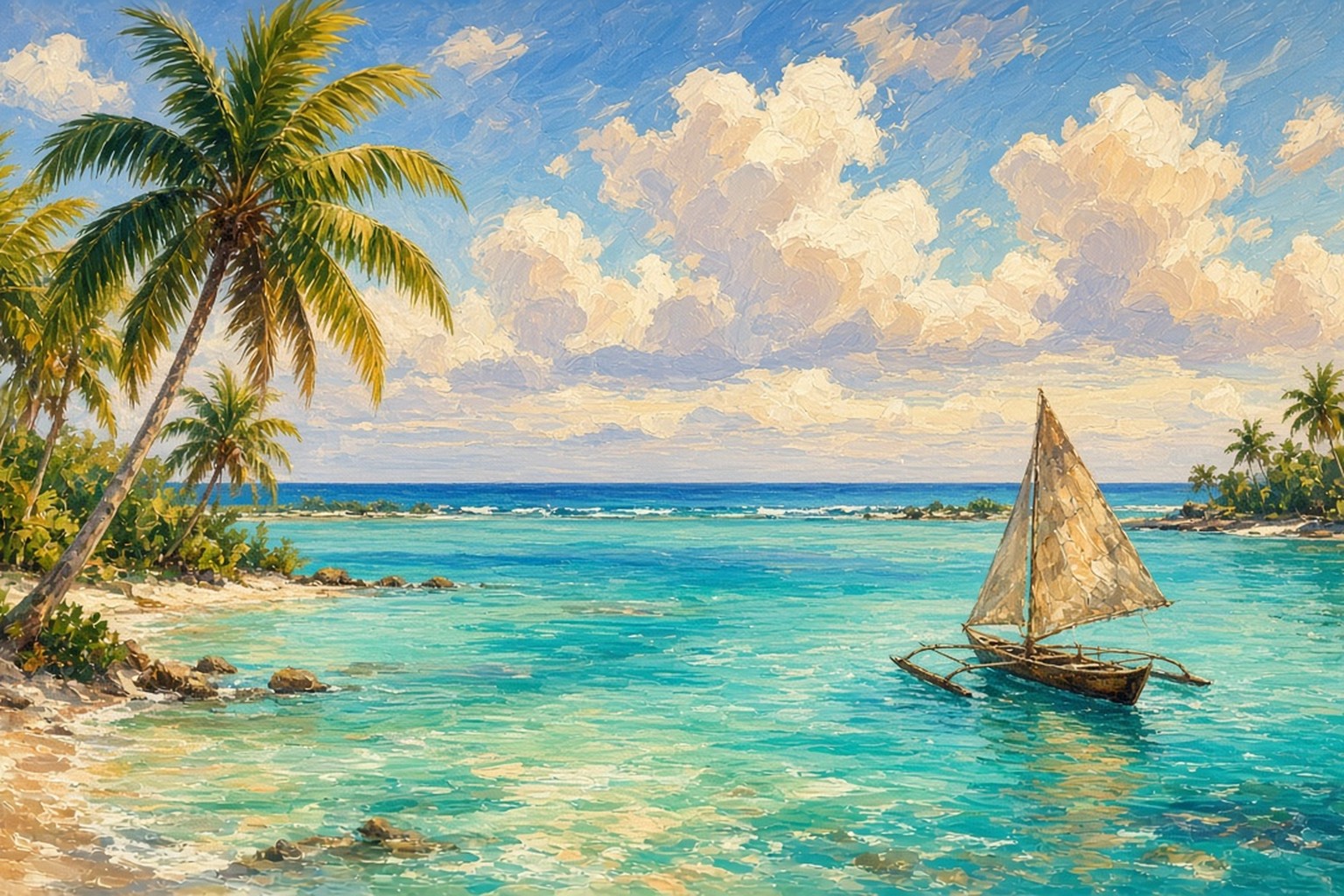
The Marshall Islands is a nation of coral atolls scattered across the central Pacific Ocean, roughly halfway between Hawaii and Australia. Its people have lived in harmony with the sea for thousands of years, becoming some of the most skilled navigators in history. With turquoise lagoons, palm-fringed islets, and a resilient culture, the Marshall Islands is a remarkable ocean nation.
Geography and Climate
The Marshall Islands consists of 29 coral atolls and five single islands, arranged in two roughly parallel chains known as Ratak, meaning “sunrise,” and Ralik, meaning “sunset.” Although its total land area is only about 180 square kilometers, the country’s islands are spread across nearly two million square kilometers of ocean.
Each atoll is a ring of low coral islets surrounding a central lagoon, and Kwajalein Atoll has one of the largest lagoons in the world. The islands are very flat, with most land only a few meters above sea level. The capital, Majuro, is located on the atoll of the same name.
The climate is tropical, hot, and humid throughout the year, with a wetter season from about May to November. The northern atolls are drier, while the southern atolls receive more rainfall. Trade winds bring cooling breezes, and the islands can occasionally be affected by typhoons and drought.
History and Independence
Micronesian voyagers settled the islands around two thousand years ago, navigating vast distances using knowledge of waves, stars, and winds. They created stick charts, made from palm ribs and shells, to represent ocean swells and the positions of islands.
European explorers passed through the region from the sixteenth century, and the islands were later named after British captain John Marshall, who sailed there in 1788. Germany established control in the late nineteenth century, and after World War I, Japan governed the islands. In 1944, American forces captured the atolls during major battles of World War II.
After the war, the islands became part of the United Nations Trust Territory of the Pacific Islands administered by the United States. Between 1946 and 1958, the United States conducted 67 nuclear tests at Bikini and Enewetak atolls, leaving lasting effects on the people and environment. The Marshall Islands adopted its constitution in 1979, entered a Compact of Free Association with the United States in 1986, and joined the United Nations in 1991.
Economy and Natural Resources
The economy of the Marshall Islands is small and relies heavily on financial assistance from the United States under the Compact of Free Association. The United States dollar is the official currency.
The surrounding ocean is the nation’s greatest resource, and fees from foreign fishing fleets, especially for tuna, provide important revenue. Copra, the dried meat of coconuts, has long been a traditional export from the outer islands.
The Marshall Islands also operates one of the largest ship registries in the world. A United States military installation on Kwajalein Atoll provides employment, while small-scale tourism, handicrafts, and fisheries support local livelihoods.
Culture and Language
Marshallese and English are the official languages, and Marshallese is spoken in nearly every home. Christianity, introduced by missionaries in the nineteenth century, is practiced by most of the population, and churches are at the heart of community life.
Marshallese society is traditionally matrilineal, meaning that land rights and clan membership are passed down through the mother’s line. Land is deeply valued and connects families to their ancestors and history. Traditional chiefs, known as iroij, continue to hold respected roles.
The islands are famous for their fine handicrafts, especially woven mats, baskets, and fans made from pandanus and coconut leaves. Outrigger canoe building and sailing remain treasured skills, and canoe races are a highlight of local celebrations.
Food and Cuisine
Traditional Marshallese food relies on what the islands and sea provide. Breadfruit, pandanus, coconut, taro, and fish are staples, often prepared in an earth oven or over an open fire.
Fresh fish, crabs, clams, and other seafood are eaten in many forms, from grilled to raw with coconut milk. Breadfruit is cooked, preserved, or made into a fermented paste, and coconut provides both food and refreshing drinks.
Imported foods such as rice, flour, and canned goods have become common, especially in urban areas. Feasts with large amounts of food are an important part of celebrations, including a child’s first birthday, which is traditionally marked with a big party.
Tourism and Attractions
The Marshall Islands offers some of the most pristine diving in the Pacific, with clear waters, coral reefs, and abundant marine life. Bikini Atoll, a UNESCO World Heritage Site, is known for the shipwrecks sunk during the nuclear tests, including an aircraft carrier and other warships.
Majuro has a peaceful lagoon, local markets, and the Alele Museum, which displays traditional crafts and stick charts. Nearby atolls such as Arno offer quiet beaches, fishing, and a glimpse of traditional island life, while World War II relics remain on several atolls.
Sportfishing for marlin, tuna, and wahoo draws anglers from around the world, and lagoon kayaking and snorkeling reveal colorful reef fish just offshore. Visitors who travel to the outer islands often find warm hospitality and a slower, traditional pace of life.
Challenges and Opportunities
The Marshall Islands faces serious challenges from rising sea levels, which threaten homes, fresh water supplies, and farmland on its low-lying atolls. The lasting legacy of nuclear testing, limited economic opportunities, and dependence on imports are also concerns.
At the same time, its vast ocean territory, rich fisheries, and strong community bonds provide important strengths. Investments in renewable energy, coastal protection, and education are helping communities adapt. The Marshall Islands has become a leading voice in international climate negotiations, working to protect its future and inspire global action.
A Nation of Ocean and Courage
The Marshall Islands is a nation where turquoise lagoons, swaying palms, and ancient navigation traditions define daily life. From the bustling streets of Majuro to the historic waters of Bikini Atoll, it tells a powerful story of resilience and connection to the sea. Small in land yet vast in spirit, the Marshall Islands is a true treasure of the Pacific.