
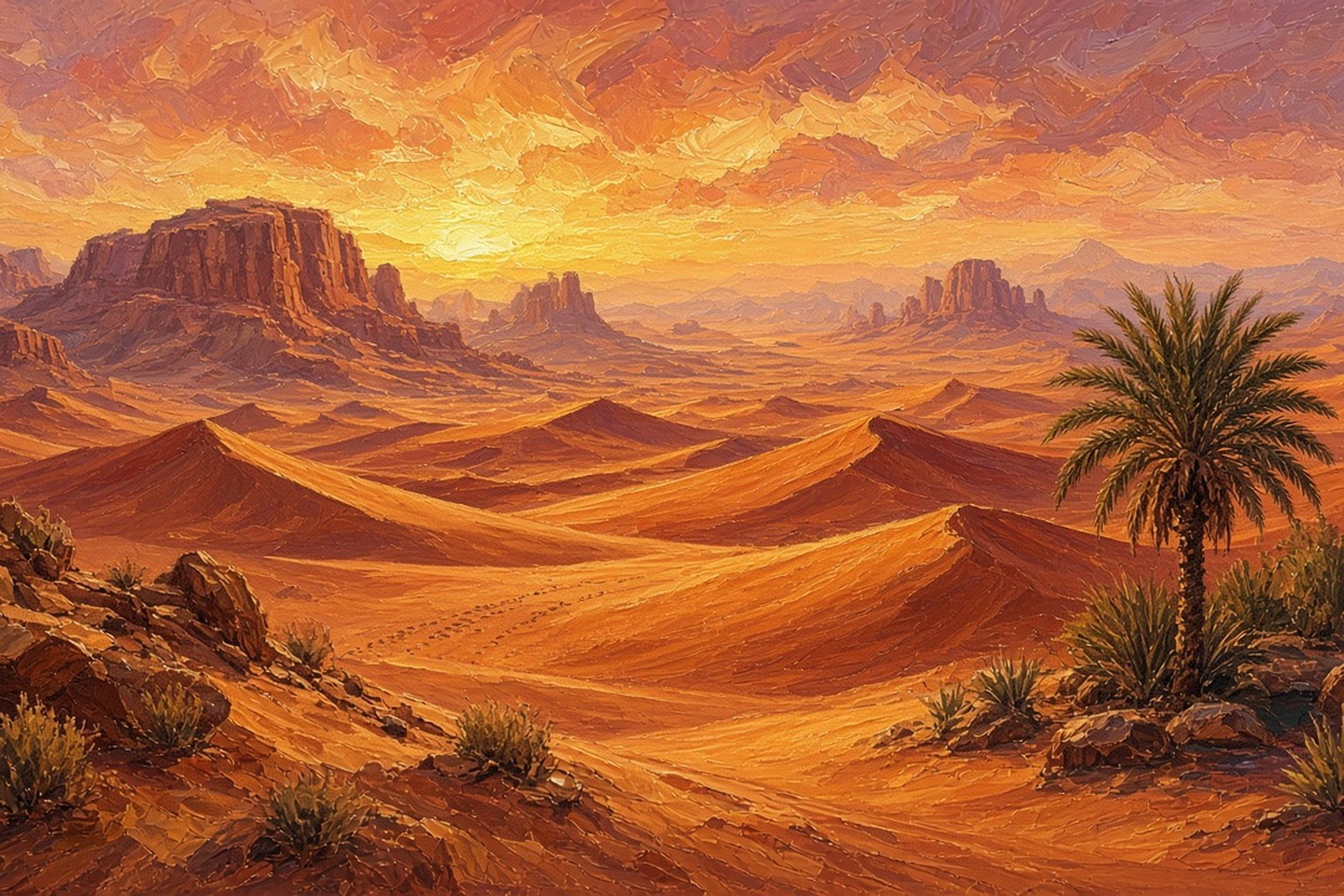
Saudi Arabia is a vast kingdom that covers most of the Arabian Peninsula, bordered by the Red Sea to the west and the Persian Gulf to the east. It is known as the “Land of the Two Holy Mosques,” because Mecca and Medina, the two holiest cities of Islam, lie within its borders. Today it is a country of ancient desert traditions and fast-growing modern cities.
Geography and Climate
Saudi Arabia covers about 2.15 million square kilometers, making it the largest country in the Middle East. It shares borders with Jordan, Iraq, Kuwait, Qatar, the United Arab Emirates, Oman, and Yemen, and a causeway links it to Bahrain. The capital and largest city is Riyadh, which sits on a high plateau in the center of the country.
Much of the land is desert, including the Rub’ al Khali, or Empty Quarter, which is one of the largest sand deserts on Earth. The Nafud desert lies in the north, and the Hejaz and Asir mountains rise along the western side, with peaks above 3,000 meters. The Red Sea coast has coral reefs and sandy beaches, while the eastern plains are home to major oil fields.
The climate is hot and dry for most of the year, and summer temperatures in the interior often climb above 40 degrees Celsius. Rain is scarce and there are no permanent rivers, so people have long relied on wells, oases, and groundwater.
History and Independence
The Arabian Peninsula has been home to trading peoples for thousands of years, and caravan routes carrying incense and spices once crossed the desert. Islam began in the early seventh century in Mecca and Medina, and the region became the spiritual center of the Muslim world. Every year millions of pilgrims travel there for the Hajj and the Umrah.
The first Saudi state was founded in 1744, when Muhammad bin Saud of Diriyah joined forces with the religious reformer Muhammad ibn Abd al-Wahhab. In the early twentieth century, Abdulaziz ibn Saud recaptured Riyadh in 1902 and gradually united the regions of Najd, Hejaz, and others under his rule. The Kingdom of Saudi Arabia was officially proclaimed on 23 September 1932, a date now celebrated as National Day.
Oil was discovered in commercial quantities near Dammam in 1938, which transformed the country’s fortunes in the decades that followed. Saudi Arabia is an absolute monarchy governed by the House of Saud, with a king who also holds the title Custodian of the Two Holy Mosques.
Economy and Natural Resources
Saudi Arabia holds some of the largest proven petroleum reserves in the world and is one of the biggest oil exporters. The state oil company, Saudi Aramco, is among the most valuable companies on Earth. Petroleum and natural gas account for a large share of government revenue and exports.
The national currency is the Saudi riyal, and the economy is the largest in the Middle East. Under a reform plan called Vision 2030, the country is investing in tourism, entertainment, mining, renewable energy, and technology. Large projects such as NEOM and the Red Sea tourism developments aim to reduce dependence on oil.
Other natural resources include natural gas, phosphates, gold, and other minerals, while farming relies on irrigation and modern technology. Dates are the best-known crop, and the kingdom is one of the world’s top producers. Because fresh water is so scarce, Saudi Arabia operates some of the largest desalination plants in the world.
Culture and Language
Arabic is the official language, and the Arabic of the Hejaz and Najd regions each has its own distinct accent. Islam is the state religion, and daily life follows the rhythm of the five daily prayers. Traditional dress includes the white thobe and head cloth for men and the black abaya for women, although styles vary by region.
Hospitality is one of the strongest values in Saudi culture, and guests are traditionally welcomed with Arabic coffee and fresh dates. The Ardah is a traditional sword dance performed by men to the beat of drums, and it is recognized by UNESCO as part of the world’s intangible heritage.
The Janadriyah Festival near Riyadh celebrates national heritage with crafts, music, and folk performances. Each region has its own architecture, from the mud-brick towers of Najd to the coral-stone houses of old Jeddah with their carved wooden balconies.
Food and Cuisine
Kabsa is considered the national dish, made with spiced rice and chicken, lamb, or camel meat, and it is often served from a large shared platter. Other favorites include jareesh, a porridge of crushed wheat, and mutabbaq, a stuffed pastry sold in street stalls.
Gahwa, the lightly spiced Arabic coffee flavored with cardamom, is served in small cups and is a sign of welcome. Dates are eaten all year and are especially important during Ramadan, when they are traditionally used to break the fast.
Tourism and Attractions
Hegra, also known as Mada’in Salih, became the country’s first UNESCO World Heritage Site in 2008. This ancient Nabataean city has more than a hundred rock-cut tombs carved into sandstone cliffs, and it lies near the oasis valley of AlUla. Diriyah, the birthplace of the first Saudi state, and the old coral-stone district of Al-Balad in Jeddah are also recognized by UNESCO.
Other highlights include the Edge of the World, a dramatic cliff overlooking a vast plain not far from Riyadh, and the coral reefs of the Red Sea. Many people visit for the Hajj and the Umrah, and the country has recently made it easier for other travelers to come.
Challenges and Opportunities
Saudi Arabia must manage its scarce water supplies and make its economy less dependent on oil. Extreme summer heat and a growing population add pressure on energy and resources. Creating enough jobs for a young and well-educated population is also a priority.
The country is investing heavily in solar and wind power, new cities, and global events and tourism. Expanding private business, culture, and sport could open new opportunities for people across the kingdom. If these plans succeed, Saudi Arabia may become a very different place within a generation.
A Kingdom Between Two Seas
Saudi Arabia is a land of sweeping dunes, sacred cities, and bold ambition, where ancient heritage meets rapid change. Its generous hospitality and remarkable landscapes continue to draw travelers from around the world.