
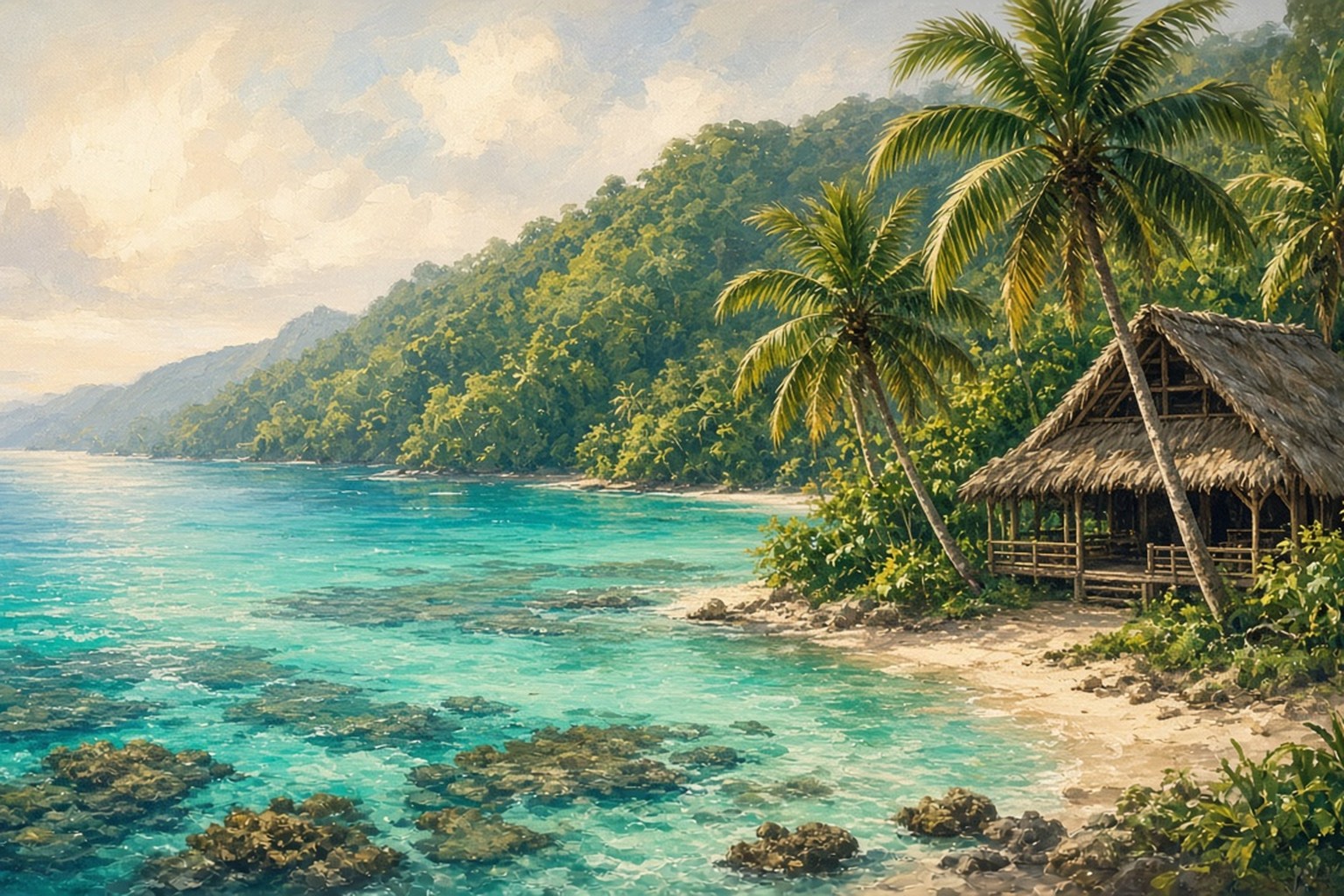
Samoa is a Polynesian island nation in the South Pacific, lying about halfway between Hawaii and New Zealand. Lush volcanic islands, sparkling lagoons, thundering waterfalls, and a deeply rooted way of life make it one of the most welcoming places in Oceania. Samoans call their traditions fa’a Samoa, or “the Samoan way,” and these customs remain at the heart of daily life.
Geography and Climate
Samoa covers about 2,800 square kilometers and consists of two large islands, Savai’i and Upolu, along with several smaller islands. Savai’i is the larger of the two, while Upolu is home to the capital, Apia, and most of the population. The islands lie in the western part of the Samoan archipelago, and the neighboring islands to the east form the territory of American Samoa.
Both main islands are volcanic and mountainous, with Mount Silisili on Savai’i, at about 1,858 meters, the highest point. Rainforest covers much of the interior, while lava fields, coconut groves, and coral-fringed beaches line the coast. Waterfalls and freshwater pools are found on both islands.
The climate is tropical, with warm temperatures all year. The wet season runs roughly from November to April, when heavy rain and cyclones can occur, and the drier season from May to October is the most popular time to visit.
History and Independence
Polynesian navigators settled the islands about three thousand years ago, and Samoa is often described as a cradle of Polynesian culture. European contact began in the eighteenth century, and missionaries arrived in the 1830s, after which Christianity spread widely. Rivalry among Germany, Britain, and the United States over the islands led to a division in 1899.
Germany took control of the western islands in 1900, and New Zealand occupied them at the start of the First World War in 1914. New Zealand later administered the islands under a League of Nations mandate and then a United Nations trusteeship. A peaceful independence movement called the Mau grew strong in the 1920s and 1930s, and its struggle is remembered with great respect.
Samoa became independent on 1 January 1962, the first Pacific island nation to do so in modern times. It was known as Western Samoa until 1997, when it officially took the name Samoa. The country is a parliamentary democracy led by a prime minister and the Fono, or legislative assembly.
Economy and Natural Resources
Agriculture and fishing support many households, with taro, coconuts, bananas, and cocoa among the main crops. Coconut products and fish are important exports, and traditional foods are grown for family use. Many families also depend on money sent home by relatives working in New Zealand, Australia, and the United States.
Tourism has become a major part of the economy, with small beach fales and resorts spread along the coasts. Visitors come for the scenery, the culture, and the friendly hospitality. The national currency is the tala, which is divided into 100 sene.
The country’s main natural resources are its fertile volcanic soil, its forests, and its surrounding waters. Samoa has also been developing solar, hydroelectric, and biomass power to rely less on imported fuel.
Culture and Language
Samoan and English are the official languages, and Samoan is spoken in nearly every home. Traditional society is organized around extended families and matai, or chiefs, who represent their families in village councils. Villages remain strongly connected to their customs, and Sunday is devoted to church and family.
Samoan arts include siva, a graceful dance, and the fire knife dance, which began in Samoa and is known as siva afi. Traditional tattooing, called tatau, is a respected art, with the pe’a for men and the malu for women. Fine mats called ’ie toga are woven from pandanus leaves and exchanged at weddings, funerals, and other important ceremonies.
The ’ava ceremony, in which a drink made from the root of the kava plant is shared according to rank, is a central ritual of welcome and respect. Rugby is the most popular sport, and the national team, Manu Samoa, has a strong reputation. Cricket and kilikiti, a local version played with a three-sided bat, are also enjoyed.
Food and Cuisine
Many traditional meals are cooked in an umu, an earth oven heated with hot stones. Taro, breadfruit, and green bananas are baked alongside fish, pork, or chicken. Palusami, which is made of coconut cream wrapped in taro leaves, is one of the best-loved dishes.
Oka is a fresh salad of raw fish marinated in lime juice and coconut cream, and it is common at family feasts. Fresh tropical fruits such as papaya, pineapple, and mangoes are widely available. Koko Samoa, a hot drink made from locally grown cocoa, and sweet coconut buns known as panipopo are popular treats.
Tourism and Attractions
The To Sua Ocean Trench on Upolu is a huge natural swimming hole, reached by a ladder down into clear turquoise water. Lalomanu Beach, on the southeastern coast, is known for its soft white sand and calm lagoon. Papase’ea Sliding Rock and the Fuipisia and Sopo’aga waterfalls are favorite stops.
In Apia, visitors can see the Robert Louis Stevenson Museum at Vailima, the home of the Scottish author, who spent his last years on Upolu and is buried on Mount Vaea. Savai’i offers lava fields, blowholes, and the Falealupo rainforest with its canopy walkway. In 2011, Samoa moved across the International Date Line, skipping a day to be closer to its main trading partners.
Challenges and Opportunities
Samoa faces risks from cyclones, tsunamis, and rising seas. A powerful tsunami struck the southern coast of Upolu in September 2009, and Cyclone Evan caused major damage in 2012. Communities have worked to rebuild and improve preparedness.
The country is working to make its economy more varied and to create jobs for young people at home. Climate-resilient farming, sustainable tourism, and renewable energy offer promising paths. Strong family and village networks remain a major source of support.
Where Fa’a Samoa Endures
Samoa blends a deep respect for tradition with an easy, friendly spirit that visitors notice right away. Its rainforests, lagoons, and ancient customs are tied together by strong families and a sense of shared identity. It is a small nation with a proud and enduring place in the Pacific.