
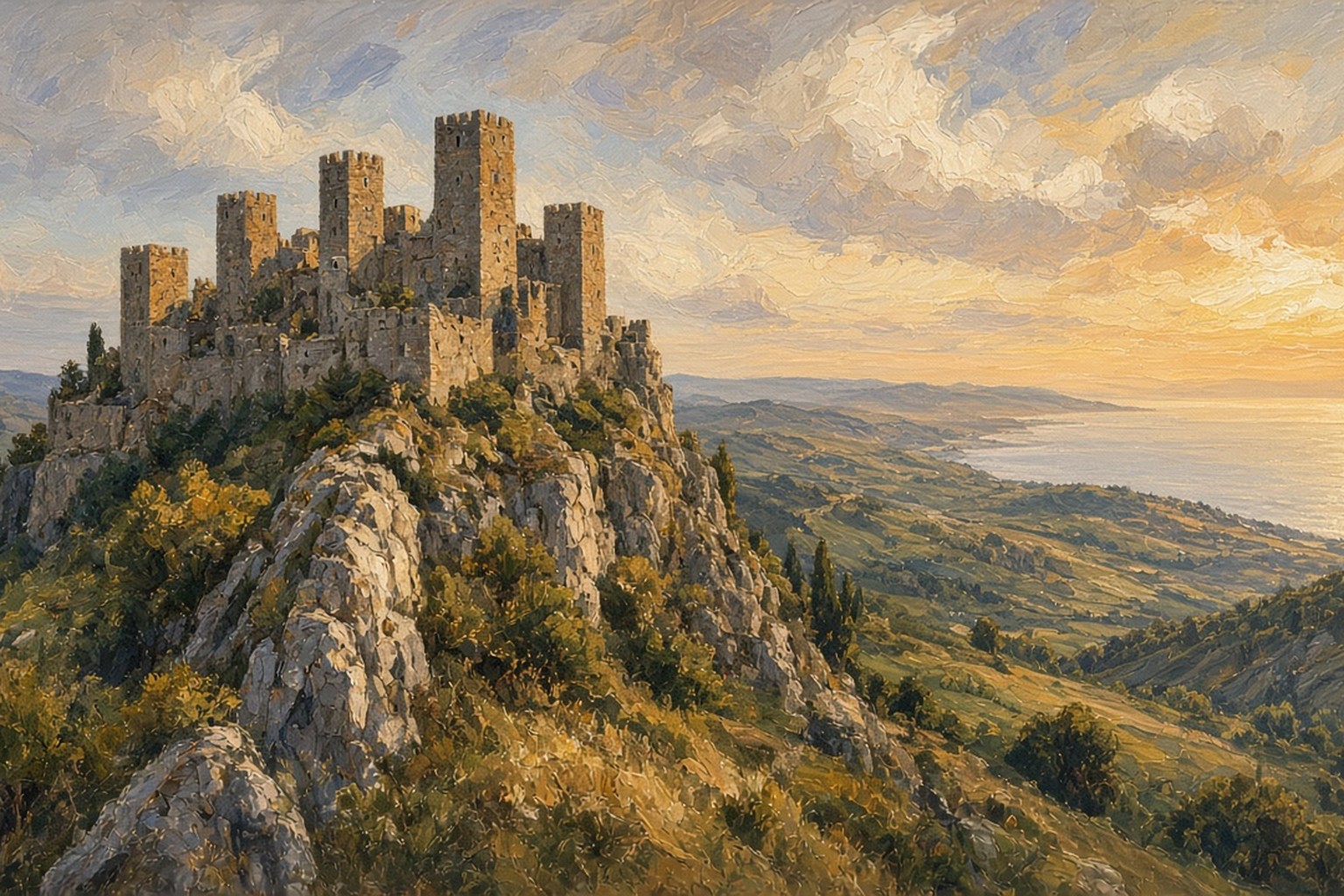
San Marino is a tiny mountain republic surrounded entirely by Italy, set between the regions of Emilia-Romagna and Marche. Perched on the slopes of Monte Titano, it is often called the “Most Serene Republic,” a title that reflects its long tradition of peaceful independence. Despite its size, it claims to be the oldest surviving sovereign state and constitutional republic in the world.
Geography and Climate
San Marino covers only about 61 square kilometers, which makes it one of the smallest countries on Earth. It is landlocked and completely enclaved by Italy, and the Adriatic coast at Rimini lies just a short drive to the northeast. The capital, the City of San Marino, sits near the summit of Monte Titano, while the largest town by population is Dogana, in the municipality of Serravalle.
The landscape is made of rolling hills, steep limestone ridges, and small valleys dotted with vineyards and olive groves. Monte Titano rises to about 749 meters and dominates the skyline, with its three famous towers visible from far across the surrounding Italian countryside.
The climate is mild and Mediterranean in character, with warm summers and cool winters. Snow falls occasionally on the high ground, and rain is most common in spring and autumn.
History and Independence
According to tradition, San Marino was founded in the year 301 by Saint Marinus, a stonemason from the island of Rab in present-day Croatia. He is said to have fled religious persecution and settled on Monte Titano, where he built a small chapel and gathered a community of followers. The date of 3 September is still celebrated each year as the founding day of the republic.
Over the centuries, the little state developed its own laws and institutions, and its written statutes date from 1600. When Napoleon arrived in 1797, he chose to respect its independence, and in 1849 the republic offered refuge to Giuseppe Garibaldi and his followers during the unification of Italy.
Today San Marino is a parliamentary republic led by two Captains Regent, who are chosen by the sixty-member Great and General Council and serve for six months at a time. They take office on 1 April and 1 October each year. The country joined the United Nations in 1992 and is also a member of the Council of Europe.
Economy and Natural Resources
San Marino has one of the highest standards of living in Europe, with an economy built on services, finance, light industry, and tourism. Visitors come in large numbers throughout the year, and shops selling ceramics, wine, and souvenirs line the streets of the old town. The country is well known to collectors for its postage stamps and commemorative coins, which are sold around the world.
Manufacturing includes ceramics, textiles, electronics, and food products, and many companies benefit from close economic ties with northern Italy. San Marino is not a member of the European Union, but it uses the euro under a special agreement. The banking sector has been reformed in recent years to meet international standards of transparency.
The country has few natural resources beyond its stone, fertile hillsides, and scenic beauty. The landscape itself is the nation’s most valuable asset, because it draws so many visitors.
Culture and Language
Italian is the official language, and the local dialect, known as Sammarinese, belongs to the Romagnol family of languages spoken in neighboring Romagna. Most residents are Roman Catholic, and religious festivals and processions remain an important part of community life. Culture and daily habits are closely linked to those of nearby Italian towns.
Medieval traditions are kept alive in colorful pageants, especially the Medieval Days festival held each July in the historic center. Crossbowmen in period costume compete in tournaments that go back centuries, and the sport is a source of great local pride.
Sammarinese society places great value on civic participation and on the memory of its long independence. The city’s main square, Piazza della Libertà, features a statue of liberty beside the Palazzo Pubblico, the seat of government.
Food and Cuisine
The food of San Marino is closely related to that of Emilia-Romagna, with hearty pasta dishes and simple, flavorful ingredients. Cappelletti in broth, tagliatelle with meat sauce, and nidi di rondine, a baked pasta dish layered with ham, cheese, and tomato, are all popular. Piadina, a thin flatbread filled with cured meats and cheeses, is a favorite everyday snack.
The best-known dessert is Torta Tre Monti, a delicate cake of wafer layers filled with chocolate and hazelnut cream and named after the three towers. Local wines include Sangiovese and the white Biancale, and Sammarinese honey and olive oil are also prized.
Tourism and Attractions
The Historic Centre of San Marino and Mount Titano was named a UNESCO World Heritage Site in 2008. The three towers, called Guaita, Cesta, and Montale, stand along the ridge, and visitors can walk between them on a scenic path. The Basilica of San Marino, the Palazzo Pubblico with its changing of the guard, and the narrow cobbled lanes of the old town are further highlights.
A cable car links the town of Borgo Maggiore with the old city, offering sweeping views over the hills below. Many travelers combine a day in San Marino with a stay on the nearby Adriatic coast.
Challenges and Opportunities
San Marino’s small size means that its economy depends on neighbors, especially Italy, and that it must adapt carefully to changes in European finance and trade. The population is small and aging, and the number of young workers is limited. Heavy day-visitor traffic can also put pressure on the narrow streets of the historic center.
The republic is working to widen its economy by supporting technology, innovation, and sustainable tourism. Closer cooperation with the European Union and a growing interest in cultural and outdoor travel offer new possibilities. Its long record of peaceful self-government is an asset that few places can match.
A Stone Fortress of Liberty
San Marino shows that a very small country can hold onto its identity for more than seventeen centuries. Its towers, traditions, and tranquil hills make it a memorable stop for anyone exploring the heart of Italy.