
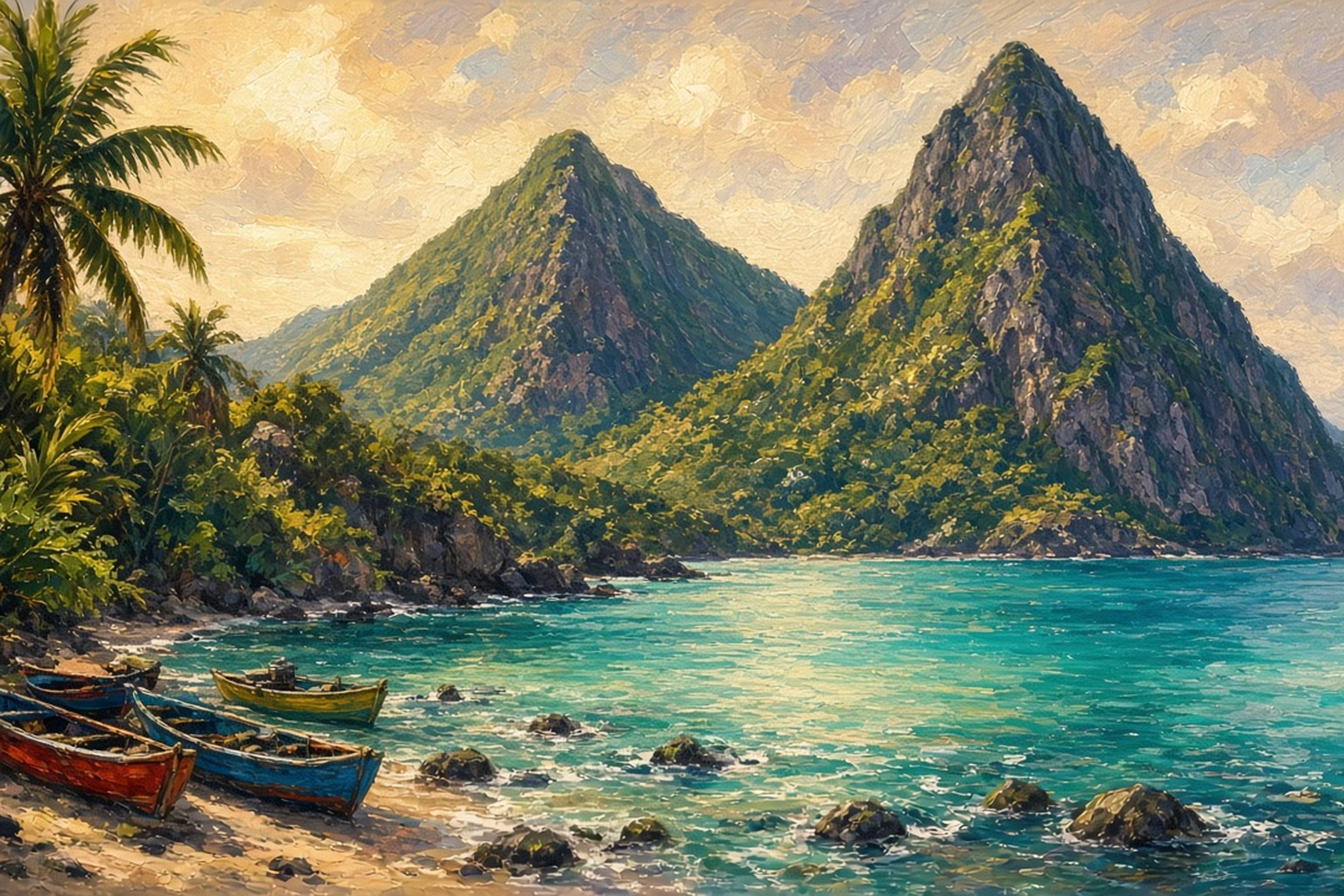
Saint Lucia is a volcanic island nation in the Windward Islands of the eastern Caribbean, set between the Caribbean Sea and the Atlantic Ocean. Rainforest-covered mountains, two dramatic twin peaks, sulphur springs, and sheltered bays make it one of the most scenic islands in the region. It is often called the “Helen of the West Indies,” a nickname that recalls how fiercely Britain and France once fought over it.
Geography and Climate
Saint Lucia covers about 617 square kilometers, which makes it a little larger than most of its neighbors in the Windward Islands. It lies north of Saint Vincent and south of Martinique, and its capital and main port is Castries on the northwest coast.
Volcanic activity formed a rugged interior of steep ridges and deep valleys, with Mount Gimie, at about 950 meters, as the highest point. Rivers run down through banana plantations and tropical forest to the coast, where beaches range from golden sand to dark volcanic grains. In the south, the Pitons rise straight out of the sea as two pointed cones.
The climate is tropical and warm throughout the year, moderated by the northeast trade winds. The drier season runs from about January to April, while the rainier months from June to November overlap with the Atlantic hurricane season.
History and Independence
The island was first settled by Arawak peoples, who were later followed by the Kalinago, who called it Hewanorra. European sailors began visiting in the sixteenth century, and the name Saint Lucia is usually linked to Saint Lucy of Syracuse. Early attempts at settlement by the English and the Dutch were driven back by the Kalinago.
The French established the first lasting settlement in the middle of the seventeenth century, and sugar plantations worked by enslaved Africans soon followed. Control passed back and forth between Britain and France many times during the wars of the eighteenth and early nineteenth centuries. Britain gained lasting control in 1814, and slavery was abolished in the British Empire in the 1830s.
Saint Lucia became a self-governing associated state in 1967 and won full independence from the United Kingdom on 22 February 1979. It is a parliamentary democracy and a constitutional monarchy, and it belongs to the Commonwealth.
Economy and Natural Resources
For much of the twentieth century, bananas were the backbone of the economy, and many families depended on small farms. Over time, the island has shifted toward tourism, which now provides the largest share of jobs and income. Hotels, resorts, yacht charters, and cruise visits are concentrated around Rodney Bay, Castries, and Soufrière.
Agriculture remains important, with bananas, coconuts, cocoa, mangoes, and other tropical crops grown in the valleys. Fishing supplies local markets and restaurants, and small manufacturers produce goods such as beverages and cardboard. The currency is the Eastern Caribbean dollar, which Saint Lucia shares with several nearby islands.
Natural resources include fertile volcanic soil, abundant sunshine, and beautiful coastal scenery, all of which support the visitor economy. The island is also exploring geothermal energy, because of its volcanic origins, as one way to reduce its dependence on imported fuel.
Culture and Language
English is the official language, and most people also speak Saint Lucian Creole, known locally as Kwéyòl, which is based on French. The population is largely of African descent, and the island’s traditions blend African, French, and British influences. Catholicism is the most widely practiced religion, and village feast days remain important community events.
Music and festivals bring the island to life through the year. The Saint Lucia Jazz and Arts Festival draws performers and fans from around the world, while Carnival fills the streets with costumes and soca rhythms in July. Jounen Kwéyòl, or Creole Day, celebrates the language with traditional dress, music, and food.
Saint Lucia is also known for its remarkable literary and academic record. Sir Arthur Lewis won the Nobel Memorial Prize in Economic Sciences in 1979, and the poet and playwright Derek Walcott received the Nobel Prize in Literature in 1992. Both were born on the island, which is a source of great national pride.
Food and Cuisine
The national dish is green fig and saltfish, made with boiled green bananas, which are called figs locally, served with salted cod and sautéed onions and peppers. Seafood is plentiful, and grilled fish, lobster, and conch appear on many menus. Coconut, plantain, breadfruit, and fresh tropical fruit also feature in everyday cooking.
On Friday nights, the fishing village of Gros Islet holds a lively street party known as the Friday Night Jump-Up. Visitors can sample grilled meats, fresh fish, and local snacks while listening to music.
Tourism and Attractions
The Pitons, Gros Piton and Petit Piton, are the island’s best-known landmark and a UNESCO World Heritage Site since 2004. Nearby, the Sulphur Springs near Soufrière are often described as a drive-in volcano, with bubbling pools and mineral-rich mud. Marigot Bay, with its sheltered harbor and palm-fringed shore, is a favorite for sailors.
Pigeon Island National Landmark, joined to the mainland by a causeway, preserves old military ruins and offers wide views over the sea. Waterfalls such as Toraille and Diamond Falls and the rainforest trails of the Edmund Forest Reserve invite hikers into the green interior. The Saint Lucia parrot, the national bird, lives in these forests and is protected.
Challenges and Opportunities
Like other small island states, Saint Lucia is vulnerable to hurricanes, heavy rain, and landslides, and climate change adds to those risks. Heavy reliance on tourism also leaves the economy exposed to global travel slowdowns.
The island is investing in resilient infrastructure, renewable energy, and a more varied economy that includes agriculture, education, and creative industries. Efforts to protect reefs, forests, and the Pitons area aim to keep the natural beauty that draws visitors. Strong community traditions and a highly educated population are important assets for the years ahead.
Where the Pitons Meet the Sea
Saint Lucia combines mountains, rainforest, and warm Caribbean water with a culture shaped by African, French, and British heritage. Its music, its Creole language, and its remarkable list of achievers give the island a character far larger than its size suggests. For travelers and curious readers alike, it remains a welcoming and unforgettable corner of the Caribbean.