
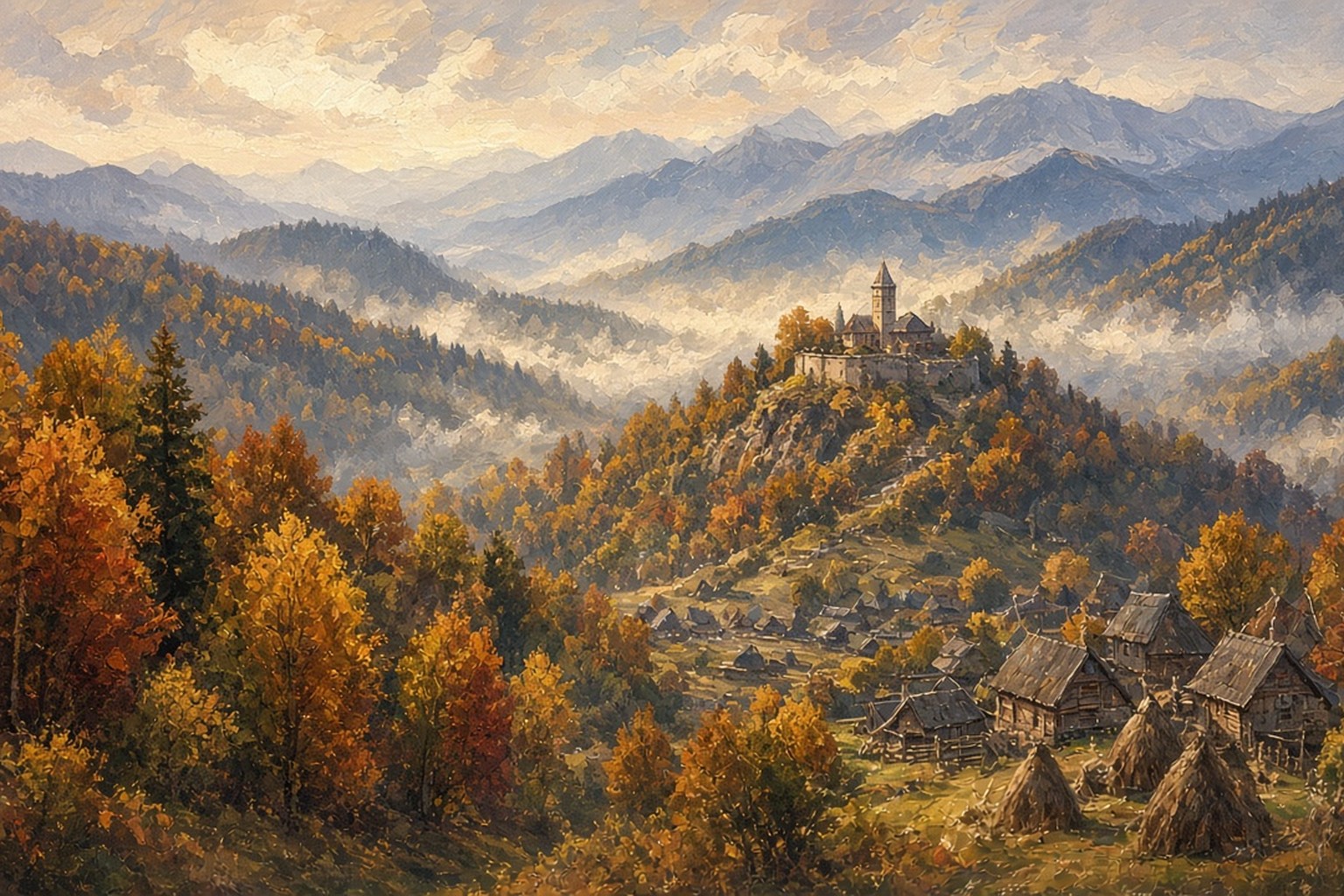
Romania is a country in southeastern Europe where the arc of the Carpathian Mountains meets the Danube River and the shores of the Black Sea. Its story blends Roman roots, medieval principalities, and vibrant folk traditions that still shape village life today. With painted monasteries, fortified churches, and wild forests, Romania is often celebrated as one of Europe’s most enchanting and “undiscovered” destinations.
Geography and Climate
Romania covers about 238,000 square kilometers, making it one of the larger countries in the European Union. It borders Ukraine, Moldova, Bulgaria, Serbia, and Hungary, and has a coastline along the Black Sea. Bucharest is the capital and largest city, while Cluj-Napoca, Timișoara, Iași, Constanța, and Brașov are important regional centers.
The Carpathian Mountains curve through the heart of the country, enclosing the Transylvanian plateau and rising to Moldoveanu Peak, the highest point. Beyond the mountains lie fertile plains, rolling hills, and the Danube, which forms much of the southern border before spreading into the Danube Delta, one of Europe’s largest wetlands.
Romania has a temperate continental climate with four distinct seasons, featuring warm summers, cold snowy winters, and colorful springs and autumns. The Carpathian forests shelter brown bears, wolves, and lynx in some of the largest populations in Europe, while the delta is a paradise for pelicans and countless other birds.
History and Independence
In ancient times the region was home to the Dacians, who were conquered by the Roman Emperor Trajan in the early second century. Roman settlement left a lasting legacy, most clearly in the Romanian language, which descends from Latin and gives the country its name.
During the Middle Ages the principalities of Wallachia, Moldavia, and Transylvania developed separately, often resisting powerful neighbors such as the Ottoman Empire. Rulers like Stephen the Great of Moldavia and Vlad III of Wallachia became legendary figures in this long struggle for survival and autonomy.
Wallachia and Moldavia united in 1859, independence was recognized in 1878, and Transylvania joined the country in 1918, creating Greater Romania. After the Second World War a communist regime took power, ending with the revolution of December 1989, and Romania later joined NATO in 2004 and the European Union in 2007.
Economy and Natural Resources
Romania has an upper-middle-income economy that has grown strongly since joining the European Union. Major sectors include automotive manufacturing, with plants producing Dacia and Ford vehicles, along with machinery, information technology, agriculture, and energy.
The country has notable natural resources, including oil and natural gas, fertile farmland, timber, and rivers used for hydropower. Romania is a major grower of wheat, maize, and sunflowers, and its wine regions have produced quality wines for centuries.
The national currency is the Romanian leu. Cities such as Bucharest and Cluj-Napoca have become thriving technology hubs, known for skilled software developers and a fast-growing startup scene that attracts international investment.
Culture and Language
Romanian is the official language and is the most widely spoken Romance language in eastern Europe, closely related to Italian, French, Spanish, and Portuguese. Most Romanians belong to the Eastern Orthodox Church, and religious holidays such as Easter and Christmas are celebrated with special foods, songs, and gatherings.
Folk traditions remain strong, especially in regions like Maramureș and Bucovina, where embroidered blouses, carved wooden gates, and painted eggs reflect centuries of craftsmanship. Each spring Romanians exchange the mărțișor, a small red and white token celebrating the arrival of warmer days.
Romania has given the world notable figures such as the sculptor Constantin Brâncuși, the composer George Enescu, and the national poet Mihai Eminescu. Music, theater, and film continue to flourish, and the gymnast Nadia Comăneci became famous for scoring the first perfect ten at the Olympic Games.
Food and Cuisine
Romanian cuisine is hearty and comforting, combining local farm produce with influences from neighboring Balkan, Hungarian, and Turkish traditions. Sarmale, cabbage or vine leaves stuffed with minced meat and rice, are considered the national dish and are served at holidays and family celebrations.
Mămăligă, a golden polenta made from maize, often accompanies meals with sour cream and cheese, while ciorbă, a tangy sour soup, appears on tables across the country. Grilled mici sausages are a summer favorite, and desserts such as papanași, fried dumplings topped with jam and cream, complete a memorable meal.
Tourism and Attractions
Transylvania draws visitors with medieval towns such as Sighișoara, whose historic center is a UNESCO World Heritage Site, along with Brașov and Sibiu. Bran Castle, often linked with the Dracula legend, and the grand Peleș Castle near Sinaia are among the most popular landmarks.
The painted monasteries of Bucovina, decorated with vivid exterior frescoes, and the wooden churches of Maramureș are also UNESCO-listed treasures. Nature lovers can hike the Carpathians, drive the dramatic Transfăgărășan road, or explore the Danube Delta by boat, while the Black Sea coast offers summer beaches.
Bucharest itself rewards visitors with the vast Palace of the Parliament, elegant boulevards, and the lively cafés and restaurants of its Old Town. Cluj-Napoca and Timișoara add music festivals, historic squares, and a youthful energy that makes city breaks across Romania equally rewarding.
Challenges and Opportunities
Romania faces challenges such as emigration of young workers, an aging population, regional inequality between cities and rural areas, and the need to modernize roads and public services. Protecting old-growth forests and wildlife from illegal logging and development is another important concern.
At the same time, the country has great potential thanks to its skilled workforce, natural resources, European Union funding, and growing technology sector. Sustainable tourism built on its castles, villages, and wild landscapes can bring new opportunities while preserving Romania’s rich heritage for future generations.
A Land Beyond the Forest
Romania is a country where ancient forests, mountain villages, and medieval citadels tell stories that have endured for centuries. From the frescoed monasteries of Bucovina to the wild waters of the Danube Delta and the lively streets of Bucharest, it offers a rare blend of tradition and renewal. Warm, proud, and full of surprises, Romania truly is a land beyond the forest.