
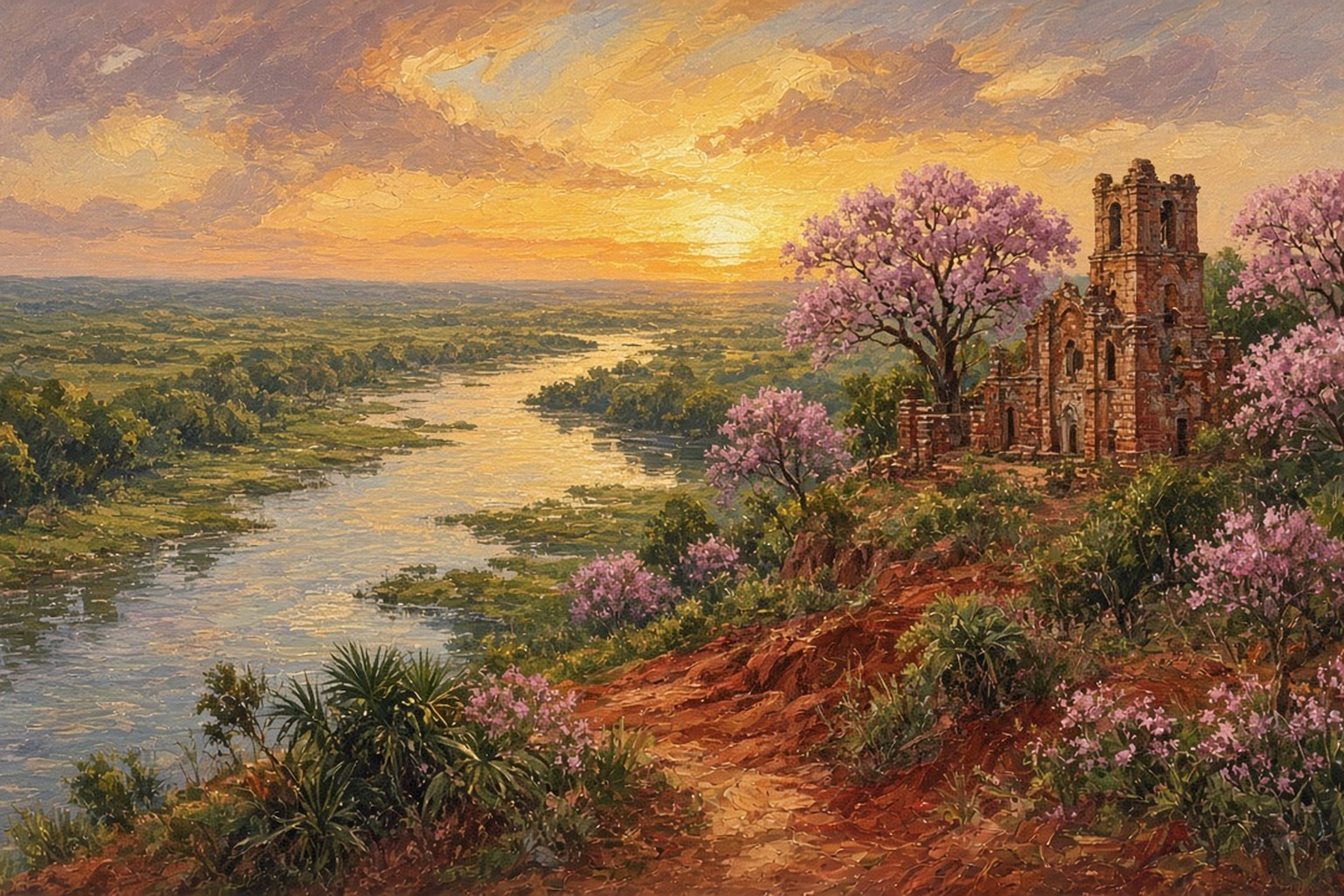
Paraguay is a landlocked country in the center of South America, bordered by Argentina, Brazil, and Bolivia. Often called the “Heart of South America,” it is known for its great rivers, warm hospitality, and a living Indigenous heritage reflected in the Guaraní language spoken by most of its people. With its Jesuit ruins, vast wilderness, and relaxed way of life, Paraguay is one of the continent’s most authentic and least-discovered destinations.
Geography and Climate
Paraguay covers about 407,000 square kilometers and is divided by the Paraguay River into two very different regions. East of the river lies the Región Oriental, a land of rolling hills, fertile farmland, forests, and most of the population, including the capital, Asunción.
West of the river stretches the Gran Chaco, a vast, sparsely populated plain of dry forests, scrubland, and seasonal wetlands. The Paraná River forms much of the southern and eastern border, and the country’s northern edge touches the wetlands of the Pantanal.
The climate ranges from subtropical in the east to hot and semi-arid in the Chaco, with long, hot summers and mild winters. Paraguay’s landscapes shelter jaguars, giant anteaters, capybaras, armadillos, and hundreds of bird species, and the flowering lapacho trees paint cities pink and yellow in late winter.
History and Independence
Before Europeans arrived, the region was home to Guaraní and other Indigenous peoples who farmed, fished, and traded along the rivers. Spanish explorers founded Asunción in 1537, and it became one of the oldest cities in South America and an important early base for Spanish colonization.
From the early seventeenth century, Jesuit missionaries established settlements known as reductions, where Guaraní communities lived, farmed, and created remarkable music and art. Paraguay declared independence from Spain on 14 and 15 May 1811, events still celebrated as national holidays.
The country suffered terribly during the War of the Triple Alliance from 1864 to 1870 against Brazil, Argentina, and Uruguay, losing much of its population and territory. Paraguay later fought the Chaco War with Bolivia from 1932 to 1935, and after a long dictatorship under Alfredo Stroessner ended in 1989, it returned to democratic government.
Economy and Natural Resources
Agriculture is the backbone of Paraguay’s economy, and the country is one of the world’s leading exporters of soybeans. Beef, maize, wheat, rice, and sugarcane are also important, and large cattle ranches spread across both the eastern region and the Chaco.
Paraguay is a world leader in renewable energy thanks to its mighty rivers. The Itaipú Dam, shared with Brazil, is one of the largest hydroelectric plants on Earth, and the Yacyretá Dam is shared with Argentina, providing nearly all of Paraguay’s electricity and a surplus for export.
River transport along the Paraguay and Paraná rivers connects the country to the Atlantic, and Paraguay has one of the largest river barge fleets in the world. The national currency is the guaraní, named after the country’s Indigenous people and language.
Culture and Language
Paraguay is one of the few countries in the Americas where an Indigenous language is spoken by most of the population. Spanish and Guaraní are both official languages, and many Paraguayans mix the two in daily conversation in a blend called Jopara.
Music plays a central role in national life, especially the Paraguayan harp, which is played in traditional folk songs and dances such as the polka paraguaya and the guarania. The bottle dance, in which dancers balance stacked bottles on their heads, is a much-loved tradition at festivals.
Artisans are famous for ñandutí, a delicate lace whose name means spiderweb in Guaraní, made especially in the town of Itauguá. Catholic faith and community festivals shape the calendar, and sharing tereré, a cold infusion of yerba mate, is a beloved social ritual recognized by UNESCO.
Food and Cuisine
Paraguayan cuisine is built on corn, cassava, beef, and cheese, reflecting both Guaraní and Spanish traditions. Sopa paraguaya is a famous national dish that, despite its name, is not a soup at all but a rich, savory cornbread made with cheese, onions, and milk.
Chipa, a ring-shaped bread made with cassava starch and cheese, is sold everywhere from street stalls to bus stations. Other favorites include mbejú, a cassava and cheese pancake, and asado, grilled beef shared with family and friends, often served with cassava on the side.
Tourism and Attractions
The Jesuit Missions of La Santísima Trinidad de Paraná and Jesús de Tavarangue, a UNESCO World Heritage Site, are the country’s most impressive historic landmarks. Their red sandstone churches and carved stonework reveal the skill of the Guaraní craftsmen who built them.
Asunción offers colonial buildings, riverside promenades, and lively markets, while nearby Lake Ypacaraí and the town of San Bernardino are popular summer escapes. Encarnación, on the banks of the Paraná, is known for its sandy river beaches and colorful carnival, and the Saltos del Monday waterfalls thunder through a forested gorge near Ciudad del Este.
In the Chaco, travelers can explore remote national parks, spot wildlife, and visit Mennonite communities around Filadelfia. The Itaipú Dam also welcomes visitors who come to see its enormous spillways and learn how it powers much of the region.
Challenges and Opportunities
Paraguay faces challenges such as inequality, deforestation in the Chaco and eastern forests, and the need to diversify an economy heavily dependent on agriculture and the weather. Strengthening public institutions and improving access to education and health care remain priorities.
At the same time, abundant clean energy, fertile land, and a young population offer great opportunities. Investment in industry, sustainable farming, and tourism could help Paraguay grow while protecting its forests and rich cultural traditions.
A Quiet Heart of South America
Paraguay is a land of wide rivers, pink lapacho blossoms, and a proud Indigenous heritage that lives on in everyday speech. From the Jesuit ruins of the south to the wild expanses of the Chaco and the melodies of the Paraguayan harp, it rewards travelers who take the time to discover it. Warm, genuine, and full of quiet charm, Paraguay truly beats at the heart of the continent.