
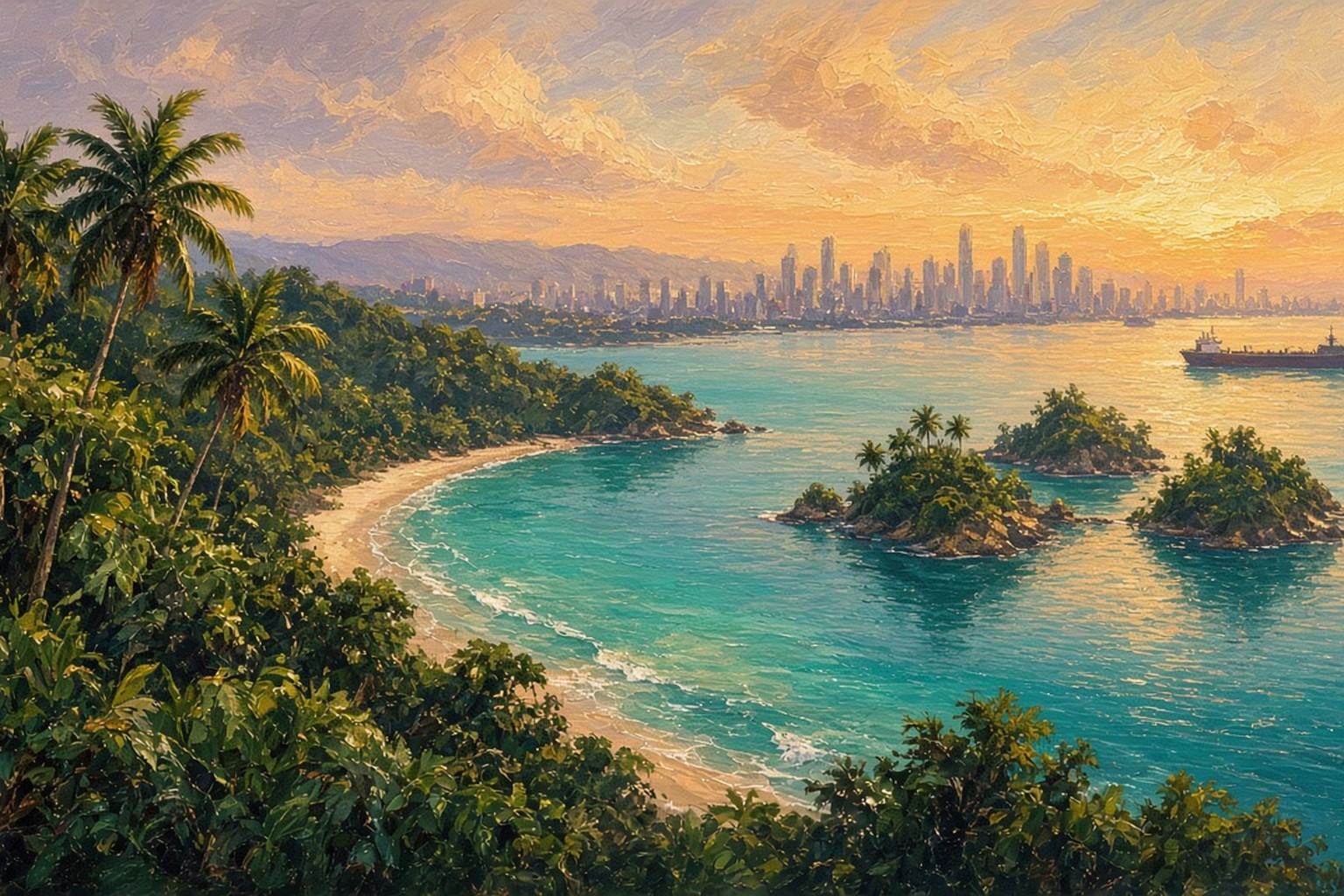
Panama is a slender country in Central America that links North and South America and separates the Caribbean Sea from the Pacific Ocean. Famous around the world for the Panama Canal, it is often called the “Crossroads of the Americas” and the “bridge of the world.” With its rainforests, island chains, colonial old towns, and modern skyline, Panama offers a remarkable blend of nature, history, and city life.
Geography and Climate
Panama covers about 75,000 square kilometers and forms an S-shaped isthmus between Costa Rica to the west and Colombia to the east. It has long coastlines on both the Caribbean Sea and the Pacific Ocean, and more than a thousand islands lie offshore, including the San Blas Islands, the Pearl Islands, and the Bocas del Toro archipelago.
A mountainous spine runs through much of the country, reaching its highest point at Volcán Barú, an inactive volcano in the western province of Chiriquí that rises to about 3,474 meters. To the east, the Darién region is covered by dense rainforest and remains one of the wildest areas in the Americas.
The climate is tropical, warm, and humid at low elevations, with a rainy season from roughly May to December and a drier season in the early months of the year. The highlands around Boquete are noticeably cooler, and the country’s forests are home to jaguars, sloths, toucans, and the harpy eagle, Panama’s national bird.
History and Independence
Indigenous peoples lived on the isthmus for thousands of years before Spanish explorers arrived in the early sixteenth century. In 1513, Vasco Núñez de Balboa crossed the isthmus and became the first European to see the Pacific from the Americas, and Panama City was founded in 1519.
Under Spanish rule, Panama became a vital route for carrying silver and gold from South America to the Caribbean and on to Spain, and fortresses were built at Portobelo and San Lorenzo to defend it. Panama declared independence from Spain on 28 November 1821 and joined the newly formed republic of Gran Colombia.
On 3 November 1903, Panama separated from Colombia with support from the United States, which soon began building the Panama Canal. The canal opened in 1914 and was administered by the United States until it was fully handed over to Panama on 31 December 1999.
Economy and Natural Resources
The Panama Canal is the heart of the national economy, allowing ships to pass between the Atlantic and Pacific without sailing around South America. An expansion with a new set of larger locks opened in 2016, allowing much bigger vessels to use the route.
Banking, shipping, logistics, and trade are also major industries, and the Colón Free Trade Zone is one of the largest duty-free zones in the Americas. Panama uses its own currency, the balboa, alongside the United States dollar, which circulates as everyday money.
Agriculture produces bananas, pineapples, sugarcane, rice, and coffee, and the highlands of Chiriquí are known for prized Geisha coffee. Tourism is growing steadily, while forests, fisheries, and minerals such as copper add to the country’s natural wealth.
Culture and Traditions
Spanish is the official language, and many Panamanians also speak English, especially along the Caribbean coast where communities of Afro-Caribbean descent have deep roots. Several Indigenous peoples, including the Guna, Ngäbe, and Emberá, keep their own languages and traditions alive.
The pollera, an elaborate embroidered dress worn with gold jewelry and beaded hair ornaments, is the national costume and a symbol of pride. Folk music such as the tamborito, played with drums and accompanied by clapping and singing, is performed at festivals and celebrations.
Carnival is the most famous festival, with parades, music, and water spraying in the days before Lent, and the town of Las Tablas is known for its lively celebrations. Guna women are celebrated for their molas, colorful hand-stitched textile panels made with layered fabric.
Food and Cuisine
Panamanian cuisine combines Indigenous, Spanish, African, and Caribbean influences. The national dish is sancocho, a comforting chicken soup cooked with yam, corn, and the fragrant herb culantro, often served with white rice.
Other favorites include arroz con pollo, tamales wrapped in banana leaves, crispy fried plantains called patacones, and fresh ceviche made from local seafood. On the Caribbean coast, dishes are often cooked with coconut milk, and tropical fruits like mango, papaya, and pineapple are enjoyed every day.
Tourism and Attractions
Visitors can watch huge ships rise and fall through the locks at the Miraflores visitor center or travel along the canal by boat. In Panama City, the cobbled streets of Casco Viejo and the ruins of Panamá Viejo together form a UNESCO World Heritage Site.
The islands of Guna Yala offer palm-fringed beaches and turquoise water, while Bocas del Toro is popular for snorkeling, surfing, and relaxed island life. The mountain town of Boquete attracts hikers, birdwatchers, and coffee lovers, and Coiba National Park protects rich marine life off the Pacific coast.
History lovers can explore the Spanish fortifications of Portobelo and San Lorenzo on the Caribbean coast, another UNESCO World Heritage Site. Nature enthusiasts can walk the rainforest trails of Soberanía National Park, just outside the capital, or visit Emberá villages along forested rivers to learn about traditional crafts, music, and daily life.
Challenges and Opportunities
Panama faces challenges such as income inequality, pressure on forests, and the need to secure enough fresh water for both its people and the canal, which depends on rain-fed lakes. Debates over mining and development have also sparked strong public discussion in recent years.
At the same time, its strategic location, stable trade links, and remarkable biodiversity offer great opportunities. Investment in education, sustainable tourism, and conservation could help Panama share its prosperity more widely while protecting its natural treasures.
A Bridge Between Two Oceans
Panama is a land of rainforests, islands, and a canal that changed the world. From the colorful molas of Guna Yala to the misty coffee farms of Boquete and the historic streets of Casco Viejo, it connects cultures as surely as it connects oceans. Vibrant, welcoming, and full of surprises, Panama is a true crossroads of the Americas.