
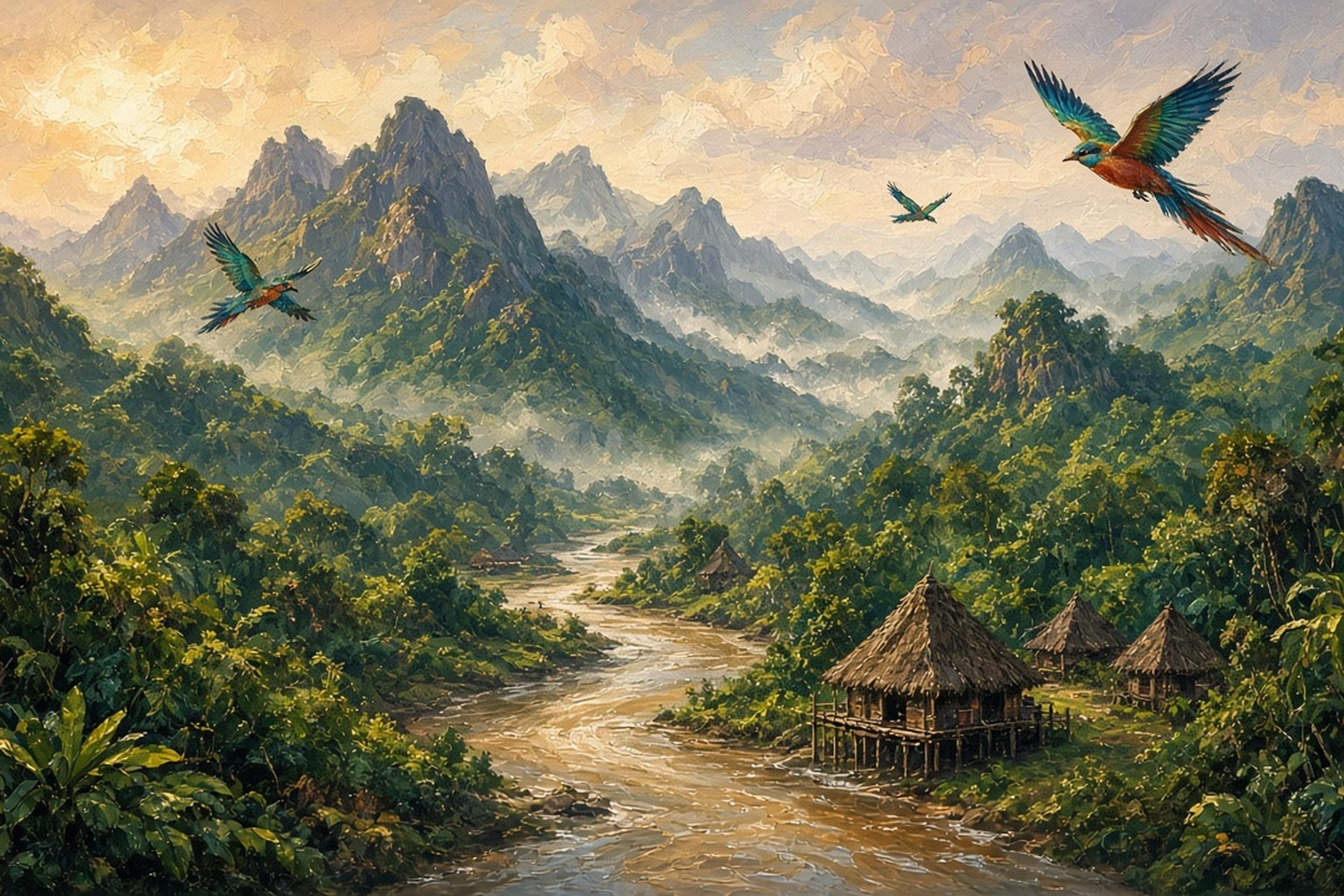
Papua New Guinea is a rugged and remarkably diverse nation in the southwestern Pacific Ocean, occupying the eastern half of the island of New Guinea and hundreds of surrounding islands. Often described as “the land of the unexpected,” it is home to towering mountains, vast rainforests, coral reefs, and more languages than any other country on Earth. With its vibrant cultures and extraordinary wildlife, Papua New Guinea is one of the world’s last great frontiers.
Geography and Climate
Papua New Guinea covers about 463,000 square kilometers, making it the largest Pacific island nation. It shares the island of New Guinea with Indonesia to the west and includes many islands, among them New Britain, New Ireland, Manus, and Bougainville.
A great central range of mountains runs across the mainland, and Mount Wilhelm, at about 4,509 meters, is the country’s highest peak. Mighty rivers such as the Sepik and the Fly wind through lowland swamps and forests, while active volcanoes rise on several islands, including Tavurvur near the town of Rabaul.
The climate is tropical, with high temperatures and heavy rainfall in the lowlands and cooler conditions in the highlands. Its rainforests and reefs are among the most biodiverse on the planet, sheltering birds of paradise, tree kangaroos, cassowaries, and countless species of orchids and butterflies.
History and Independence
People first reached New Guinea at least 40,000 years ago, making it one of the oldest inhabited regions outside Africa. In the highlands, communities developed farming thousands of years ago, and the Kuk Early Agricultural Site is recognized by UNESCO as evidence of one of the world’s earliest centers of agriculture.
European explorers visited from the sixteenth century, and in 1884 the northern part of the eastern island became German New Guinea while the southern part became the British protectorate of Papua. Australia took over Papua in 1906 and occupied German New Guinea during the First World War, later governing both territories together.
During the Second World War, the country saw fierce fighting, including the famous Kokoda Track campaign of 1942. Papua New Guinea gained independence from Australia on 16 September 1975 and became a parliamentary democracy within the Commonwealth.
Economy and Natural Resources
Papua New Guinea is rich in natural resources, including gold, copper, nickel, oil, and natural gas. Mining and energy provide most of the country’s export earnings, and a large liquefied natural gas project began exports in 2014.
Most people, however, live in rural areas and rely on farming, fishing, and small-scale trade. Coffee, cocoa, copra, and palm oil are important export crops, and highland coffee in particular has earned a strong international reputation.
Vast forests and rich fisheries add to the nation’s wealth, and tuna caught in its waters supplies markets across the region. The national currency is the kina, named after a traditional shell once used as valuable money.
Culture and Language
With more than 800 living languages, Papua New Guinea is the most linguistically diverse country in the world. English, Tok Pisin, and Hiri Motu are widely used for communication between communities, and Tok Pisin is the most common shared language.
Each region has its own customs, art, and ceremonies, and colorful gatherings known as sing-sings bring communities together with dancing, drumming, and elaborate body decoration. The Goroka Show and the Mount Hagen Show are famous festivals where groups from across the highlands perform in feathered headdresses and painted faces.
Traditional arts include carved spirit masks and figures from the Sepik region, woven bilum bags, and decorated canoes. Most people are Christians, and traditional beliefs, clan ties, and the practice of exchanging gifts remain important in daily life.
Food and Cuisine
Papua New Guinean cuisine is based on root crops, fruit, and fresh local produce. Sweet potato, known as kaukau, is a staple in the highlands, while sago, taro, yam, bananas, and coconut are common in lowland and coastal areas.
A mumu is a traditional feast in which pork, chicken, vegetables, and greens are wrapped in banana leaves and slow-cooked with hot stones in an earth oven. Coastal communities enjoy fresh fish, crab, and shellfish cooked in coconut milk, often shared at village celebrations.
Fresh produce markets in towns and villages overflow with pineapples, papayas, peanuts, and leafy greens. Betel nut, chewed with mustard stick and lime, is a widespread social custom, and locally grown coffee is a source of national pride.
Tourism and Attractions
Adventurous travelers come to hike the Kokoda Track, a demanding trail through jungle-covered mountains that honors wartime history. Others journey along the Sepik River to visit villages with impressive spirit houses and skilled wood carvers.
The waters around Kimbe Bay, Milne Bay, and Tufi offer world-class diving among healthy coral reefs and Second World War wrecks. In the highlands, visitors can enjoy cultural festivals, mountain scenery, and the chance to see birds of paradise in the wild.
The capital, Port Moresby, offers the National Museum and Art Gallery, the striking Parliament House built in the style of a traditional spirit house, and nearby Varirata National Park. On New Britain, the volcanic landscapes and sheltered harbor of Rabaul reveal both natural power and wartime history.
Challenges and Opportunities
Papua New Guinea faces challenges such as rugged terrain that makes transport difficult, limited infrastructure, and the need to improve health care and education. Balancing resource development with protection of forests and community land is an ongoing concern.
At the same time, its natural wealth, young population, and cultural richness offer real opportunities. Investment in roads, sustainable agriculture, and eco-tourism could help bring prosperity to more remote communities while preserving the country’s unique heritage, its languages, and its extraordinary natural environment for future generations.
A Land of Countless Voices and Wild Peaks
Papua New Guinea is a land of soaring mountains, winding rivers, and an astonishing variety of peoples and traditions. From the feathered dancers of the highlands to the carved spirit houses of the Sepik and the coral reefs of its islands, every journey reveals something new. Wild, colorful, and deeply rooted in tradition, Papua New Guinea is truly the land of the unexpected.